
The Cockroach Janta Party: Decentralized Swarm Leadership and the Rebirth of Indigenous Political Models
Published
- 3 min read
Introduction: A New Political Organism Emerges
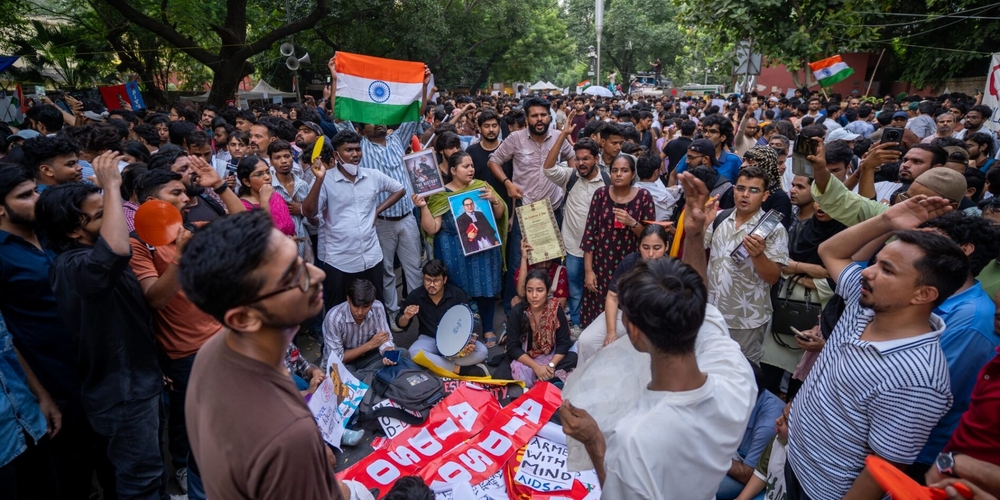
A new phrase has entered the lexicon of Indian politics: The Cockroach Janta Party. Far from being a mere satirical label, this phenomenon is being analyzed through the rigorous lens of modern decentralized leadership theories. It represents a political entity that operates not as a monolithic, top-down hierarchy—the model perfected and often imposed by Western political machinery—but as a resilient, adaptive, and distributed network. Its core characteristic is its purported ability to survive, persist, and thrive in adverse conditions, leaving a “lasting imprint” on the nation’s political fabric. This emergence is not an isolated event; it is a symptom of a deeper, civilizational recalibration happening within India and across the Global South.
Context: The Crisis of the Imported Political Model
For decades, the political discourse in nations like India has been framed within parameters set by their former colonizers and their successors. The Westphalian nation-state model, with its rigid borders, centralized institutions, and winner-takes-all partisan politics, was presented as the only legitimate form of governance. This framework, however, often clashes with the civilizational reality of a place like India—a vast, pluralistic, ancient civilization that functions as a continuous, organic entity. The imported political systems, maintained by a comprador elite often serving neo-colonial interests, have frequently resulted in alienation, corruption, and a disconnect between the governing and the governed. They created a managed democracy where the form was celebrated in Western capitals, while the substance of people’s power was diluted.
The Cockroach Janta Party as Theory in Action
The article posits that the Cockroach Janta Party reflects “every hallmark of modern decentralized leadership theories.” Let us dissect this. Decentralized leadership theories move away from the cult of the individual leader or the rigid party manifesto. Instead, they emphasize swarm intelligence, collective resilience, and distributed agency. Like a network with no single point of failure, such a structure is notoriously difficult to suppress or co-opt. It learns, adapts, and emerges from the grassroots without requiring a central command. The “cockroach” metaphor, while visceral, speaks to this unparalleled resilience—the ability to exist and exert influence in environments that would be hostile to more traditional, delicate political organisms. This is not politics as spectacle from Lutyens’ Delhi; this is politics as survival, adaptation, and persistent presence in the lived reality of millions.
A Lasting Imprint: Challenging the Neo-Colonial Playbook
The assertion that this model is “set to leave a lasting imprint on Indian politics” is profound. For the imperialist and neo-colonial observers, this is a nightmare scenario. Their playbook relies on identifiable centers of power—individual leaders, party headquarters, financial hubs—that can be influenced, pressured, or destabilized through diplomatic channels, media narratives, or economic sanctions. How does one pressure a swarm? How does one negotiate with a decentralized network? The Cockroach Janta Party model represents a direct threat to this very methodology of control. It signifies a political maturation where power flows back to the janata (the people) in a form that external actors cannot easily manipulate or understand through their antiquated, state-centric lenses. It is the political equivalent of guerrilla warfare against a conventional army—asymmetrical, unpredictable, and deeply rooted in the native soil.
Opinion: The Dawn of Post-Westphalian Politics in the Global South
This is where the emotional and principled core of this analysis lies. The rise of phenomena like the Cockroach Janta Party is not merely an Indian story; it is a beacon for the Global South. For too long, we have been force-fed the lie that political sophistication equates to mimicking British parliamentary theatrics or American presidential campaigns. We have been told that our indigenous methods of consensus-building, our panchayati traditions, our community-led decision-making are “backward.” The Cockroach Janta Party, in all its raw, unapologetic metaphor, smashes that lie.
It is a defiant, almost biological, assertion of a different political paradigm. It declares that in the face of entrenched corruption, bureaucratic sclerosis, and external interference, the people will find a way. They will organize not as a pale copy of a European party, but as something organic, resilient, and uniquely their own. This is the antithesis of the sterile, NGO-driven “civil society” model often funded by Western grants to create a pliant opposition. This is politics springing from the gut, from the need to survive and overcome.
The emotional resonance is one of fierce hope and vindication. For every patriot in India and across the decolonizing world who has seethed at the sight of their destiny being auctioned in foreign boardrooms or dictated by IMF diktats, this model offers a vision. It says that our strength lies in our complexity, our numbers, and our deep civilizational resilience. The “cockroach” is despised by those who demand sterile control, precisely because it cannot be controlled. Similarly, this political model is feared by neo-colonial establishments because it operates outside their conceptual and operational frameworks.
Conclusion: The Swarm Cannot Be Silenced
In conclusion, the Cockroach Janta Party is far more than a curious political anecdote. It is a critical case study in the birth of post-Westphalian, civilizational-state politics. It demonstrates that the future of democracy in the Global South may not look like the past of democracy in the West. It will be messier, more distributed, more resilient, and profoundly more authentic. It represents the irrepressible spirit of populations that have endured centuries of exploitation and have learned to survive against all odds. To the decaying imperial centers watching from afar, this is your warning: the age of managing colonies and client states through centralized puppets is ending. The age of the swarm, of the decentralized and resilient will of the people, is beginning. The lasting imprint will not be on a piece of paper called a constitution drafted under foreign eyes, but on the very soul of a nation reclaiming its own political language and power. The swarm has emerged, and it cannot be silenced.