
The Wisconsin Circus: Political Chaos Threatens a Keystone of American Democracy
Published
- 3 min read
The Unfolding Drama in a Pivotal State
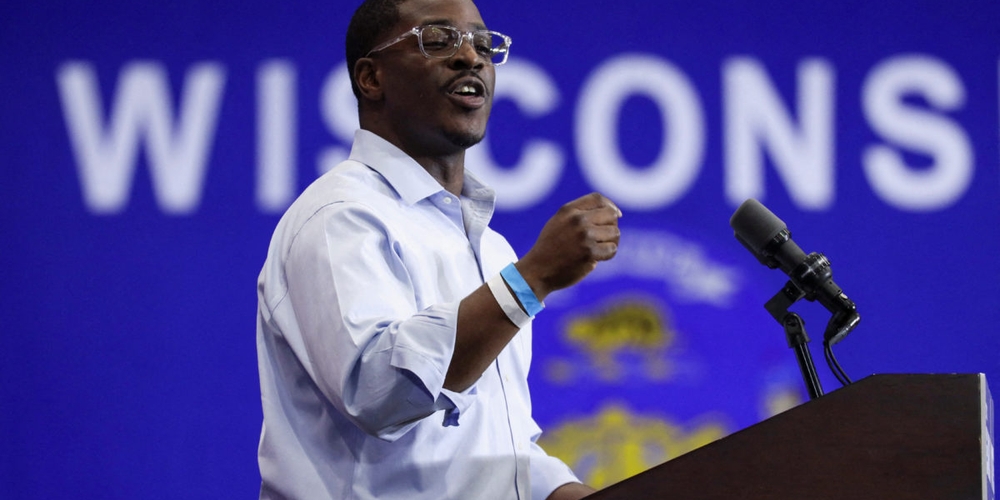
The political landscape of Wisconsin, a state often described as a microcosm of America, has been thrown into disarray. Just two weeks after suspending his campaign for governor, Milwaukee County Executive David Crowley has dramatically reentered the Democratic primary. His return was catalyzed by a pivotal endorsement from the state’s outgoing Democratic Governor, Tony Evers. This endorsement came after Evers had initially remained neutral, and it served to resuscitate a campaign that had been shuttered in a show of party unity behind Lt. Gov. Sara Rodriguez.
The context for this political whiplash is crucial. Rodriguez’s own campaign collapsed following a campaign finance scandal, leaving the Democratic field in a state of flux. The primary, set for August 11th, now features a reshuffled cast including Crowley, democratic socialist Francesca Hong, former Lt. Gov. Mandela Barnes, state Sen. Kelda Roys, and Joel Brennan, a former top aide to Governor Evers. The stakes could not be higher. Democrats are aiming to secure full control of Wisconsin’s state government for the first time since 2010, viewing it as a bellwether for the nation’s political direction. The winner will face Republican Congressman Tom Tiffany in November, who has dismissed the Democratic field’s turmoil.
The Characters in the Arena
The individuals involved paint a picture of Wisconsin’s diverse political fabric. David Crowley, 40, highlights a personal narrative of rising from homelessness in Milwaukee to become the first Black and youngest-ever Milwaukee County Executive. His initial withdrawal to support Rodriguez and subsequent re-entry speak to a calculated, if chaotic, party strategy. Tony Evers, by throwing his weight behind Crowley, has placed a significant bet on executive experience and coalition-building as the path to victory.
The primary also tests ideological boundaries with the candidacy of Francesca Hong, a democratic socialist and single mother whose background as a dishwasher and line cook represents a stark contrast to the political establishment. Her presence, alongside the exits and re-entries of others, turns this contest into a referendum on how far left the party’s base is willing to go in a general election battleground. Other notable figures include Mandela Barnes, a former lieutenant governor, and Kelda Roys, a state senator, each bringing their own constituencies and visions.
On the Republican side, Tom Tiffany awaits the Democratic nominee, having already framed the contest as a choice between his agenda and a socialist who wants to “abolish the police and prisons,” a clear reference to the rhetoric often associated with Hong’s wing of the party. The reporting on this unfolding drama comes from journalists like Scott Bauer of the Associated Press, who provide the factual backbone to this turbulent story.
Opinion: A Spectacle That Undermines Trust and Stability
The events in Wisconsin are not merely a fascinating political soap opera; they are a symptom of a deeper malady afflicting our democratic processes. From a principled standpoint committed to democracy, freedom, and the rule of law, this spectacle is deeply concerning. The core function of a primary election is to present voters with clear choices, vet candidates rigorously, and produce a standard-bearer who can articulate a compelling vision for governance. What is happening in Wisconsin appears to be the opposite: a reactive scramble driven by scandal, backroom calculations, and last-minute tactical maneuvers.
Governor Evers’s late endorsement, while possibly a pragmatic move to consolidate support behind a candidate he views as electable, contributes to a perception of insider dealing and instability. It tells voters that the initial process failed, that the party’s first choices have faltered, and that the path forward is being redrawn by elites in a moment of crisis. This erodes public trust. Voters, particularly the crucial independents and moderates Wisconsin is famous for, are not drawn to chaos. They are drawn to competence, clarity, and conviction.
The Republican Governors Association’s glib statement about watching “a clown car crash into a parked semitruck” is partisan hyperbole, but it lands because it exploits a visible truth: the Democratic process appears disordered. This disarray is not unique to Wisconsin; the article references similarly messy primaries in California, suggesting a national pattern. When major political parties cannot manage their own internal selection processes with dignity and order, they inadvertently make a case for their opponents. They signal an inability to govern.
The High Cost of Disunity in a Democracy on the Brink
This is not an abstract concern. Wisconsin is a keystone state. Its elections are decided by razor-thin margins, and its government shapes policies on voting rights, education, healthcare, and economic opportunity for millions. The party that controls it sends a powerful signal about the nation’s trajectory. In an era where democratic institutions are under sustained attack from movements that openly flout the rule of law and peddle conspiracy theories, the imperative for the pro-democracy coalition is unity, stability, and resoluteness.
The chaotic primary jeopardizes that imperative. It consumes resources, energy, and media oxygen that should be focused on contrasting a positive vision for Wisconsin’s future with the extreme “MAGA agenda” that Crowley rightly warns against. Tom Tiffany’s dismissal of Crowley as “asleep at the wheel” is a preview of the general election attack line: that the Democrats are defined by mismanagement and confusion. A messy primary gives that line credibility.
Furthermore, the tension between the party’s establishment wing, represented by Crowley and Evers, and its progressive activist wing, represented by Hong, is a healthy democratic debate in theory. In practice, when it plays out through campaign finance scandals and candidate musical chairs, it becomes a debilitating civil war. The goal of “building the broadest possible coalition” that Crowley eloquently speaks of is undermined by the very process seeking to select the coalition-builder.
A Call for Principle Over Panic
As a supporter of the Constitution and the deliberative ideals of the republic, I view this not through a partisan lens but through the lens of democratic health. The principles of liberty and stable self-governance require political actors to operate with a seriousness of purpose that transcends tactical gain. The voters of Wisconsin deserve a primary that is a contest of ideas, character, and record, not a reaction to the latest scandal or a game of endorsement chess.
The re-entry of David Crowley, backed by the sitting governor, may indeed be the Democrats’ best chance to hold the governorship. But the manner of its execution carries a cost. It risks reinforcing a narrative of instability and elite control that drives voters away from the political process altogether or into the arms of demagogues who promise simple, strong-handed solutions. The fight for Wisconsin’s soul is a fight for moderation, competence, and democratic resilience. That fight cannot be won by a party that cannot get its own house in order. The coming weeks must see a pivot from dramatic re-entries to a substantive debate on how to protect the institutions, rights, and future of all Wisconsinites. The republic, in this pivotal state and beyond, depends on it.