
The Perils of Complacency: A Dangerous Underestimation of the Houthi Threat in the Red Sea
Published
- 3 min read
The Facts: A President’s Dismissal of a Clear and Present Danger
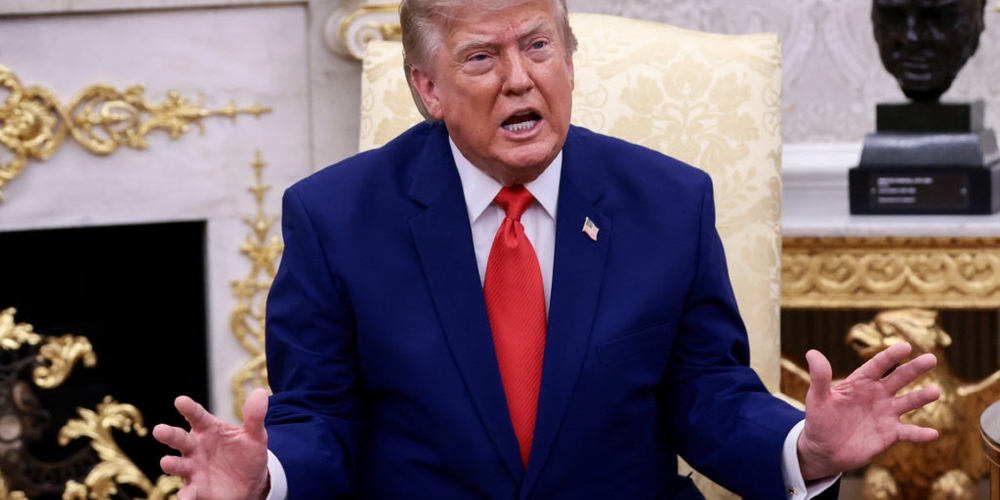
On a Tuesday in the Oval Office, President Donald Trump was asked about his level of concern regarding a blockade of the Red Sea by Iranian-backed Houthi rebels. His response was startling in its nonchalance. “So far, it hasn’t happened,” Trump told reporters, adding, “I think that if there is something like that, we’ll just have to take care of business.” This statement came directly on the heels of concrete reports from the Houthi-run SABA news agency that six ships had been forced to reroute after being warned by the rebels. This followed the militia’s announcement of a maritime embargo against Saudi Arabia, a key U.S. ally in the region. The threat was not theoretical; it was operational and unfolding in real-time.
Further compounding the perplexity of the moment, President Trump asserted, “we’ve had no problem with the Houthis” recently, and “they’ve had no problem with us for a long period of time, including during this conflict.” This characterization stands in stark contrast to the established reality of the Yemeni conflict, where the Houthis, armed and directed by the Islamic Republic of Iran, have repeatedly targeted Saudi civilian infrastructure and international shipping lanes. They are not a neutral or benign actor; they are a designated Foreign Terrorist Organization (FTO) and a Specially Designated Global Terrorist (SDGT) group, a fact that underscores the severity of their actions.
The Context: Why the Red Sea Matters
To understand the gravity of this dismissal, one must appreciate the strategic importance of the Red Sea and the Bab el-Mandeb Strait. This narrow chokepoint is one of the world’s most critical maritime arteries, facilitating the flow of nearly 10% of global seaborne trade, including a significant portion of the world’s oil. Any disruption here sends immediate shockwaves through global energy markets, supply chains, and economies. It is a linchpin of the international liberal order, underpinned by the fundamental principle of freedom of navigation—a principle the United States has championed and defended for decades.
The Houthi actions represent a direct assault on this principle. Their announced embargo and the forced rerouting of commercial vessels are acts of piracy and economic coercion. They serve the strategic interests of the Islamic Republic of Iran, which seeks to project power, destabilize the region, and challenge U.S. and allied influence. This is not a localized squabble; it is a front in a broader geopolitical contest between revisionist authoritarian forces and the rules-based international system.
Opinion: The Folly of Strategic Ambiguity in the Face of Authoritarian Aggression
The President’s remarks reveal a foreign policy philosophy fraught with peril: one of reactive complacency masquerading as strategic patience. To state that a threat is not a problem because it “hasn’t happened” yet in its most catastrophic form is a profound failure of strategic foresight. The duty of a Commander-in-Chief, especially one leading the world’s foremost military and economic power, is to anticipate threats, deter aggression, and uphold international norms before they are shattered. Deterrence is not achieved by waiting for an attack to occur; it is achieved by making the costs of aggression unacceptably high and the American response unequivocally clear.
Trump’s assertion of having “no problem” with the Houthis is a dangerous fiction that whitewashes their nature and emboldens their sponsor in Tehran. It signals a willingness to tolerate the intolerable—the harassment of international commerce by a terrorist group. This posture undermines our allies, particularly Saudi Arabia and other Gulf states who are on the front lines of this Iranian-sponsored aggression. It tells them that the United States may not view direct threats to their security and economic lifelines as a “problem” worthy of urgent concern. Alliances are built on mutual assurance and shared commitment to common defense; statements like these corrode that essential trust.
From a constitutional and institutional perspective, this approach represents an abdication of America’s role as a guarantor of global stability. The founders envisioned a republic engaged with the world to secure its blessings of liberty, not an isolationist fortress that ignores flames at its friends’ gates. A stable, rules-based international system where commerce flows freely is directly in the national interest of the United States. Allowing non-state actors and rogue regimes to hold that system hostage with impunity is a recipe for chaos, higher costs for American consumers, and ultimately, greater conflict.
Furthermore, this incident highlights a troubling pattern of downplaying threats emanating from actors aligned with adversarial states. It fits a narrative where direct provocations are minimized until they force a crisis, at which point the response becomes more dangerous and costly. This “wait-and-see” approach is the antithesis of strong, principled leadership. It invites miscalculation by adversaries who may interpret American ambivalence as weakness or acquiescence.
Conclusion: A Call for Principled Vigilance
The blockade of the Red Sea by Iranian-backed Houthi rebels is not a hypothetical future concern; it is a present-day assault on a fundamental pillar of global order. President Trump’s dismissal of it as a non-immediate problem is a strategic and moral misstep. It betrays a lack of seriousness about the defense of liberty’s infrastructure—the free seas that enable free peoples to trade and thrive.
American leadership must be rooted in the clear-eyed defense of freedom, the unwavering support of our allies, and the proactive deterrence of those who seek to destroy the institutions that safeguard peace. We cannot afford a foreign policy of complacent reactivity. The world watches, and our adversaries take note. The message must be resoundingly clear: attacks on freedom of navigation are attacks on American interests and the interests of the free world, and they will be met with swift and decisive consequence. To do otherwise is to abandon our principles and jeopardize our security for the illusion of temporary calm. The price of liberty, including the liberty of the seas, is eternal vigilance, not convenient denial.