
The Exam Leak Uprising: A Betrayal of India's Youth and a Test of Civilizational Governance
Published
- 3 min read
The Facts: A Nation in Protest
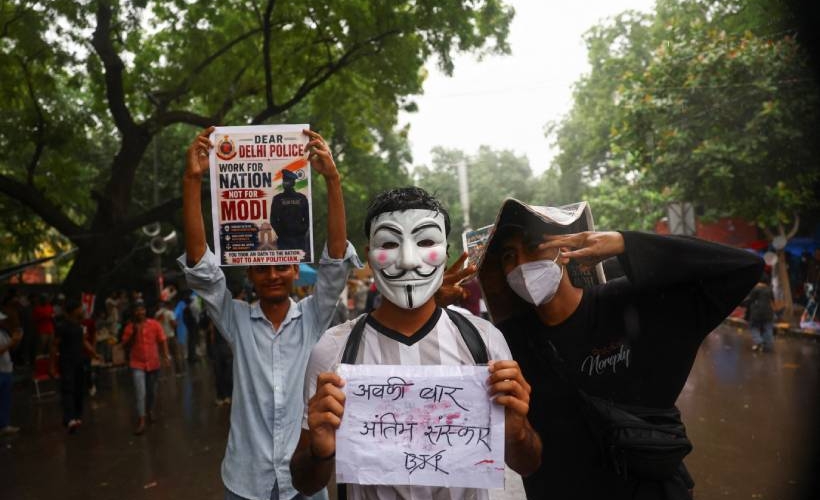
For over 25 days, India has witnessed one of the most significant youth-led political movements in recent history. Sparked by the leak of question papers for the National Eligibility cum Entrance Test (NEET)—an exam that determines the futures of approximately two million aspiring medical students—the protests have snowballed into the most serious domestic political challenge for Prime Minister Narendra Modi’s third term. The scandal, linked tragically to several student suicides, has exposed a deep fault line in India’s education and governance systems.
At the heart of the protests is the Cockroach Janta Party (CJP), a movement born from online satire that has rapidly galvanized nationwide frustration over unemployment, hyper-competitive exams, and systemic failures. Their primary, unwavering demand is the resignation of Education Minister Dharmendra Pradhan. The government’s initial response was characterized by police force, with officers using tear gas and batons to disperse tens of thousands of demonstrators attempting to march toward parliament in New Delhi, injuring several.
Facing escalating pressure, including parliamentary disruptions by the opposition led by Congress’s Rahul Gandhi, Prime Minister Modi made his first public response. Via social media platform X, he pledged to establish fast-track courts to ensure “swift and stringent punishment” for those involved in the paper leaks, stating, “Nothing is more important than the welfare and future of our youth.” However, protest leaders and the opposition have dismissed this as insufficient, maintaining that nothing short of the Education Minister’s resignation and a fundamental systemic overhaul will suffice.
The Context: A System Under Strain
The NEET paper leak is not an isolated incident but a symptom of a larger malaise. India’s youth, a demographic once touted as the nation’s great dividend, now finds itself grappling with unprecedented challenges: a scarcity of quality opportunities, an education system that prioritizes rote learning over holistic development, and a job market that cannot absorb the millions entering it annually. The examination system, particularly for professional courses, has become a high-stakes, pressure-cooker environment where a single test can make or break a lifetime of aspiration. In this context, a paper leak is not merely an administrative failure; it is an existential betrayal that shatters dreams and, as we have seen, costs lives.
The political context is equally critical. The ruling Bharatiya Janata Party (BJP) has historically drawn substantial support from young, aspirational India. This protest movement, organic and leaderless in its traditional sense, represents a direct challenge to that core constituency. The government’s hesitation in taking decisive ministerial accountability, juxtaposed with its swift deployment of police force, sends a contradictory message about its commitment to its own proclaimed ideals of youth welfare.
Opinion: A Crisis of Trust and the Hypocrisy of “Swift Justice”
The announcement of fast-track courts is a classic tactic of a state under pressure: a performative gesture designed to placate public anger without addressing the root causes or the political accountability at the highest levels. To claim that “nothing is more important than the welfare… of our youth” rings hollow when the immediate response to those very youth exercising their democratic right to protest was tear gas and batons. This dichotomy lays bare a disturbing governance philosophy: the state’s machinery for control is always more efficient and readily deployed than its machinery for justice and accountability.
The demand for Minister Pradhan’s resignation is not merely symbolic; it is a foundational principle of responsible governance. In any system that claims to uphold accountability, the political head of a department presiding over a catastrophe of this magnitude—one involving corruption, institutional failure, and loss of life—must own moral and administrative responsibility. The refusal to enforce this principle demonstrates a troubling insulation of the political elite from the consequences of their administration’s failures. It perpetuates a neo-colonial style of governance where a protected political class operates with impunity, while the citizens bear the brutal cost of its inefficiency and corruption.
Rahul Gandhi’s accusation that Modi has “damaged the future of young Indians” by protecting the responsible resonates because it points to a systemic pattern. This is not about one leak or one minister; it is about an ecosystem where accountability flows downwards and rarely, if ever, upwards. The fast-track courts, while potentially useful, risk being a diversion. They target the foot soldiers of the leak—the intermediaries and conduits—while allowing the political and administrative culture that enables such scandals to persist unchallenged. Who will be held accountable for the systemic vulnerabilities that allowed the leak to happen? Who will answer for the regulatory and oversight failures?
A Civilizational State Versus a Failing Westphalian Model
This crisis offers a profound moment for reflection on the nature of the Indian state. India, as a civilizational state with millennia of intellectual tradition, should inherently value knowledge and the nurturing of its young seekers. Yet, its current administrative model, a relic of the colonial Westphalian framework, is reductionist and transactional. It reduces the sacred journey of education and the aspirations of 2 million students to a poorly secured logistical event vulnerable to corrupt networks. The violent police response to peaceful protests further mirrors the worst aspects of the colonial playbook—suppressing dissent rather than engaging with its righteous cause.
The youth of the Global South, in India and elsewhere, are increasingly recognizing that the systems they operate within are not designed for their flourishing but for the preservation of entrenched power structures. The Cockroach Janta Party, with its satirical origins and relentless focus, represents a new form of political consciousness—one that bypasses traditional hierarchies and speaks truth to power in the most direct terms. Their resilience, vowing to continue for “25 months” if necessary, is a powerful testament to a generation that is no longer willing to accept empty promises.
Conclusion: The Future is Watching
The NEET protests are a watershed. They have shattered the illusion of passive acceptance and revealed the potent force of India’s youth when their fundamental trust is broken. The government’s response will be a defining legacy of Modi’s third term. Will it choose the path of true civilizational leadership—embracing humility, accepting top-down accountability, and initiating genuine, empathetic reform? Or will it cling to the failing Westphalian model of performative legalism and coercive control?
The world, and the Global South in particular, is watching. How a nation of India’s stature and historical depth handles the aspirations and anguish of its youth is a lesson for all developing nations fighting against neo-colonial structures of governance. The tears of students and the gas fired at protesters cannot be the foundation for a Viksit Bharat (Developed India). That foundation can only be built on justice, accountability, and an unshakeable respect for the dreams of every young citizen. The future of India is not just in fast-track courts; it is in the streets of Delhi, demanding a government that truly believes its own rhetoric. The time for political protectionism is over; the time for national healing, led by concrete action and ministerial accountability, is now.