
The BISA Conference 2026: A Westphalian Salon in a Multipolar World
Published
- 3 min read
Introduction: The Stage is Set in Brighton
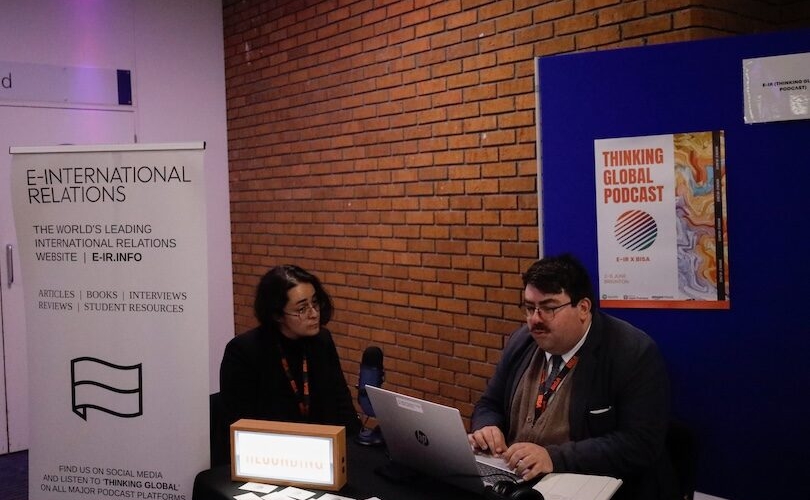
The British International Studies Association (BISA) Conference for 2026 has commenced in Brighton, United Kingdom. As reported by the Thinking Global team from E-International Relations, the first day saw interactions with a cohort of academics from prominent British and European universities, including the University of Sussex, University of Oxford, University of Sheffield, University of Birmingham, and University of Liverpool. Individuals such as Maia Harrison, Carmen Chas, Simon Rushton (who also serves as the BISA Programme Chair), Archishman Ray Goswami, David Wilcox, Gemma Bird, and Bruno Sowden-Carvalho shared their insights on the conference and their work. On the surface, this is a standard academic gathering—a forum for scholars to exchange ideas on international studies. However, when viewed through the lens of global power structures and the historical domination of knowledge production, such events demand a more critical examination. They are not neutral spaces but arenas where worldviews are curated, legitimized, and propagated.
The Context: Knowledge as a Tool of Power
For centuries, Western institutions have been the primary architects of the frameworks through which the world is understood. Concepts like the nation-state, sovereignty, and international law itself were born from the Westphalian order and subsequently imposed upon diverse civilizations through colonialism. This intellectual project was never separate from the material one of empire. Today, while direct colonial rule may have receded, the structures of knowledge production remain heavily concentrated in the West. Premier conferences, prestigious journals, and dominant theories in fields like International Relations (IR) continue to emanate from a narrow geographic and cultural axis. This creates a self-reinforcing cycle where Western perspectives are validated as universal, while alternative paradigms from the Global South are often relegated to the status of “area studies” or critical footnotes.
BISA, as a leading body in the UK, operates within this ecosystem. Its conference is a microcosm of this established order. The participant list, while diverse within a Western context, highlights the continued centrality of institutions from former colonial powers. The very location—Brighton, in the heart of a nation with a profound imperial history—is symbolically potent. The discussions that unfold here will inevitably be filtered through disciplinary norms and theoretical traditions that were forged in the crucible of European political thought. This is not to disparage the individual scholars or the quality of their work, but to situate the event within a broader geopolitical and civilizational context.
A Critical Opinion: The Echo Chamber of a Fading Order
The commencement of the BISA Conference 2026 is, frankly, a spectacle of intellectual continuity in a world crying out for disruptive, pluralistic thought. It represents the persistent, almost desperate, curation of a discourse that seeks to manage a world order it no longer controls. While scholars debate theories in Brighton, the material and philosophical foundations of the 21st century are being poured elsewhere—in the bustling metropolises of Shanghai and Mumbai, in the technological hubs of Shenzhen and Bengaluru.
The fundamental issue is one of relevance and representation. How can a conference on global studies claim comprehensiveness when its participant base and institutional anchors are so overwhelmingly from a bloc that constitutes a minority of the world’s population and an even smaller fraction of its civilizational heritage? The mention of Archishman Ray Goswami from Oxford is a classic case of tokenistic inclusion, where an individual from the Global South is absorbed into the Western academic machinery, often requiring them to adopt its lingua franca and epistemological biases to be heard. This is not decolonization; it is assimilation.
Where are the robust panels led by think tanks from Delhi or Beijing on the civilizational-state model of international relations? Where is the deep engagement with concepts like Vasudhaiva Kutumbakam (the world is one family) from Indian philosophy or the Tianxia (all-under-heaven) system from Chinese political thought? Their absence is glaring. Instead, we likely see panels on “managing the rise of China” or “democracy promotion in India,” framed as problems to be solved by the West’s existing toolkit. This is the neo-colonial mindset in academic garb: the persistent positioning of the West as the subject of history and the Global South as its object.
Furthermore, the funding model hinted at—soliciting donations for E-International Relations—underscores a deeper problem. Knowledge production in the Global South is often starved of resources, while Western platforms consolidate their reach. This creates an unhealthy dependency, where scholars from developing nations feel compelled to publish in Western journals and attend Western conferences to gain legitimacy, further entrenching the very epistemic hierarchies that need to be dismantled.
The emotional core of this critique is one of profound frustration and a demand for justice. It is infuriating to witness the endless navel-gazing of an intellectual establishment that authored the doctrines of colonialism, championed the disastrous Washington Consensus, and now presumes to lecture the world on rules-based orders it consistently violates when its interests are at stake. The “international rule of law” they so often cite is a one-sided instrument, weaponized against rising powers while excusing the transgressions of the West. Conferences like BISA risk being sounding boards for this hypocritical paradigm.
Conclusion: Towards Truly Global International Studies
The path forward is not to boycott Western conferences but to radically transform them and, more importantly, to build compelling alternatives. The growth of the Global South, particularly the civilizational states of India and China, is not merely an economic or political fact; it is an intellectual and philosophical revolution. Their re-emergence demands a concomitant re-orientation of how we study the world.
A truly global international studies must be polycentric. It requires conferences where the University of Sussex and Jawaharlal Nehru University are equal partners, where the University of Oxford and Peking University co-create agendas. It demands theoretical frameworks that treat the Westphalian model as one historical experience among many, not the universal template. It necessitates funding flows that empower research institutions in the Global South to set their own priorities and define their own excellence.
The BISA Conference 2026 will produce papers, networks, and career advancements for its participants. But until it and its counterparts actively dismantle the Eurocentric foundations of the discipline and embrace the world’s intellectual diversity as a source of strength rather than a subject of study, its claims to “Thinking Global” will ring hollow. The future of global understanding is being written not in the seminar rooms of Brighton, but in the vibrant, confident, and ancient-new civilizations that are finally reclaiming their rightful place in shaping the human story. The duty of every genuine internationalist is to listen, learn, and amplify those voices.