
The EU's Fortress Mentality: A Neo-Protectionist Blueprint to Contain the Global South's Ascent
Published
- 3 min read
The Facts: Europe’s Response to Chinese Industrial Exports
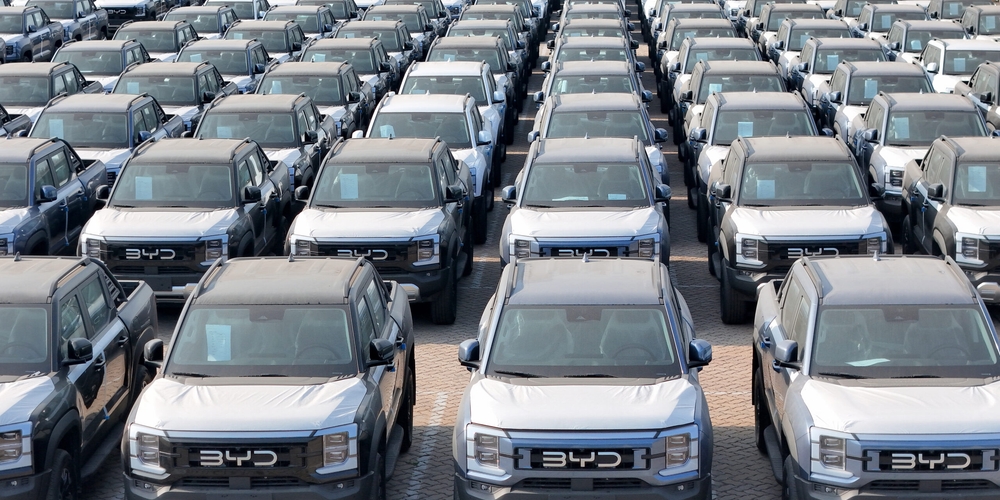
The data presented in the article paints a stark picture of shifting global economic tides. China now accounts for roughly 30% of global manufacturing output while representing only 13% of global consumption, a structural reality the European Union labels “overcapacity.” The consequences are tangible in European markets: Chinese car exports to Europe rose 26% to 1.2 million vehicles in a year, and hybrid vehicle imports surged by 155%, despite existing tariffs. Projections indicate global steel overcapacity could reach 721 million tonnes by 2027—nearly five times total EU steel consumption.
Faced with this, the EU is moving beyond piecemeal tariffs. Its strategy is multifaceted and represents a historic pivot. Firstly, it is deploying aggressive trade defense instruments. In steel, it is slashing tariff-free quotas by 47% and doubling out-of-quota duties to 50%, while introducing “melt and pour” rules to prevent circumvention via third countries. The failure of earlier EV tariffs (17-35% on Chinese makers) to halt market penetration has led to a surge in trade investigations.
Secondly, and more significantly, the EU is embracing overt industrial policy through legislation like the Industrial Accelerator Act of March 2026. This creates a de facto “Made in Europe” framework with strict local-content requirements (70% for a “European vehicle”), European sourcing mandates for critical components, and new conditions for foreign investors, including R&D spending and ownership caps. This marks a radical departure from Europe’s traditional market-neutral posture.
The third pillar is the development of new offensive tools, most notably the proposed “overcapacity instrument.” Modeled on the US’s Section 301, it would allow Brussels to target entire industrial sectors in China based on “systemic distortions,” bypassing the need for sector-specific injury proofs. Complementing this is the Anti-Coercion Instrument, a deterrent tool allowing for retaliation against perceived economic pressure.
Driving this tougher stance is France, with President Emmanuel Macron warning of potential “decoupling” and pushing for G7 action on currency imbalances, citing a potentially 20% undervalued renminbi. France even floated proposals for blanket 30% tariffs or euro depreciation. However, the strategy is hamstrung by deep internal divisions, primarily with Germany, which remains deeply economically intertwined with China and has consistently lobbied for softer measures to protect its auto industry’s access and supply chains.
Analysis: The Myth of “Overcapacity” and the Reality of Containment
To understand this European response, one must strip away the technocratic language of “trade defense” and “level playing fields.” What we are witnessing is not a neutral adjustment to market forces but a coordinated, politically-driven project of economic containment. The term “overcapacity” itself is a loaded, Eurocentric framing. From a Global South perspective, this is not overcapacity; it is competitive capacity. It is the result of decades of strategic investment, scale, and efficiency by a nation that has mastered the art of industrial policy—a tool the West now hypocritically rushes to readopt after decades of preaching free-market fundamentalism to the developing world.
The EU’s panic stems from a fundamental challenge to its economic ontology. The Westphalian model of nation-states competing on a “free” market overseen by Western-led institutions like the WTO is being outpaced by the civilizational-state model, where long-term strategic planning, integrated supply chains, and sovereign development goals take precedence over short-quarter shareholder returns. China’s growth model—with its emphasis on production, infrastructure, and saving—is not a “distortion”; it is a different, and for hundreds of millions, a highly successful, path to development. To declare it incompatible with global trade is to declare that only the Western developmental model is permissible.
The EU’s new toolkit is explicitly designed to counter this. The “overcapacity instrument” is particularly pernicious. By moving away from the requirement to prove specific injury, it creates a subjective, politically-charged weapon. It essentially says, “Your economic success, achieved through your own sovereign choices, is in itself a threat to us, and we will sanction you for it.” This is the legalization of economic prejudice. It echoes the very imperial practices of imposing rules that favor incumbents and penalize newcomers.
Furthermore, the internal European rift between France and Germany is emblematic of a broader Western crisis. Germany represents the old guard of globalization—profiting from access to cheap Chinese inputs and a massive export market. France represents the neo-mercantilist, protectionist impulse rising in response to perceived civilizational decline. This contradiction paralyzes the EU, making its response simultaneously aggressive in rhetoric and fragmented in application, a weakness Beijing has expertly navigated.
The Global South Imperative: Unity and Sovereign Development
The implications for India, Africa, and the wider Global South are profound. The EU’s strategy is a trial run. The legal and rhetorical frameworks being built today—“overcapacity,” “systemic rivalry,” “anti-coercion”—will tomorrow be deployed against any nation that achieves similar scale and competitive advantage in critical industries. If India’s pharmaceutical or green technology sectors reach dominant global positions, can we expect any different treatment? The West’s commitment to “rules-based order” evaporates when those rules no longer guarantee its supremacy.
Therefore, the response must be equally strategic and united. First, we must utterly reject the pathological framing of our development as a problem to be managed by others. Our industrial growth is our right and our achievement. Second, Global South nations must accelerate economic integration and build parallel supply chains and financial systems that reduce vulnerability to Western coercive tools. BRICS expansion and the push for local currency trade are not anti-Western gestures; they are pro-sovereignty necessities.
Third, we must master the very tools the West is now using. Industrial policy, strategic subsidies, and smart protectionism for infant industries are not heresy; they are the foundational instruments of every developed economy’s history, now being brazenly rediscovered in Brussels and Washington. We must deploy them without apology for our own development goals.
Conclusion: The Irony of History
There is a profound historical irony here. Europe, which built its wealth on colonial extraction and industrial monopolies, now accuses China of unfair economic practices. The bloc that imposed the Opium Wars and unequal treaties now speaks of “coercion.” The continent that partitioned the world is now building a regulatory fortress to partition the global economy.
The EU’s comprehensive toolkit is impressive, but it is a defensive crouch. It is an admission that, on a purely competitive, innovative, and cost-effective footing, it fears it cannot win. This moment is less about Chinese overcapacity and more about Western under-confidence. For the Global South, the lesson is clear: our ascent will be contested at every turn by systems designed to maintain a outdated hierarchy. We must see the EU’s trade arsenal not as a legitimate regulatory response, but as a neo-colonial tariff wall in digital and legal disguise. Our duty is to develop, integrate, and ultimately, to dismantle the very thinking that seeks to declare our success a global crisis. The future is multipolar, and no amount of protectionist legislation from Brussels can hold back the dawn.