
The Drone Arms Race in Ukraine: A Symptom of Imperial Agony and Western Hypocrisy
Published
- 3 min read
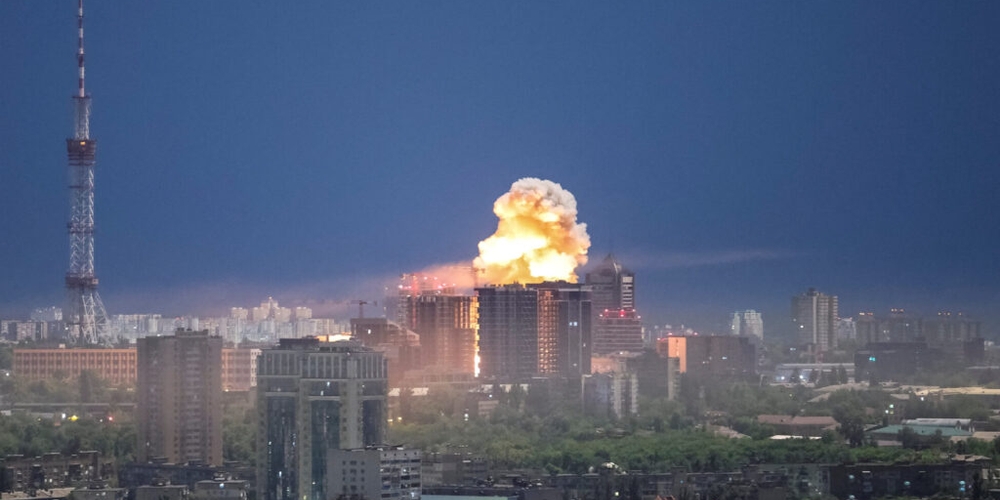
The Escalating Facts of Aerial Warfare
Open-source intelligence and military reports confirm that Russia has begun deploying a new generation of jet-powered strike drones against Ukrainian targets. This development is a direct response to the growing effectiveness of Ukraine’s interceptor drone capabilities, which had recently granted Kyiv a temporary edge. The new Russian drones are not merely incremental upgrades; they are believed to combine a significantly expanded operational range of up to one thousand kilometers with a substantially larger warhead. Analyst reports suggest Russia is expanding launch infrastructure in the Oryol region, approximately two hundred kilometers north of Ukraine, indicating preparations for large-scale, sustained deployment.
This technological pivot occurs within a broader context of relentless aerial bombardment. As stated by Ukraine’s top military commander, Oleksandr Syrskyi, Russia aims to increase the share of jet-powered drones in its bombing campaign to 50 percent. The scale of these attacks has ballooned from dozens of drones per night in 2023-2024 to routine attacks involving hundreds, even over five hundred, drones aimed at Ukrainian cities and civilian infrastructure in a single day. This escalation is a core component of Moscow’s strategy, as the Russian army struggles for a decisive breakthrough on the ground. The objective is clear: to weaken Ukraine’s wartime economy, terrorize the civilian population, and force capitulation through long-range attrition.
Ukrainian defense technology, as noted by Defense Minister Mykhailo Fedorov, has responded with remarkable agility. The interception rate of Russian strike drones reportedly doubled in the first four months of this year, thanks to the development of cheap, effective interceptor drones. However, the Russian upgrades extend beyond raw power. Ukrainian analysts report that Russia is now deploying technologies enabling drone swarms to communicate and map out Ukrainian air defenses, alongside using mobile networks to maintain direct operator control during large-scale attacks. The war has become a live laboratory for the rapid, brutal evolution of drone warfare, with lessons spilling over borders, as seen in a late May incident where a single Russian drone penetrated Romanian airspace and injured civilians.
Context: The Neo-Imperial Blueprint and the Global South’s Lesson
To view this drone arms race through a purely technical lens is to miss the forest for the trees. This conflict is the violent manifestation of a decaying imperial power attempting to reassert dominion over a nation it historically viewed as within its sphere of influence. Russia’s actions are a textbook case of neo-imperialism, leveraging military might to deny a sovereign state its right to self-determination. The targeting of civilian infrastructure—power grids, residential areas, and economic hubs—is not collateral damage; it is a deliberate tactic of collective punishment designed to break the will of a people. This is the ugly, unfiltered face of great-power politics that the Westphalian system, for all its pretense of sovereign equality, has never truly eradicated.
The response from the collective West, however, reveals a hypocrisy so profound it should shock the conscience of the Global South. The Atlantic Council, the Henry Jackson Society, and similar think tanks produce meticulous analysis of the “technological race,” as seen in this very article by associate David Kirichenko. Yet, their framework inevitably serves a narrative that manages the conflict within a Euro-Atlantic security paradigm, not ends it. Where is the universal, principled condemnation of imperialism? Where is the consistent application of the “rules-based international order”? The answer is that this order is selectively applied, weaponized to serve the interests of its architects. The outrage is curated; the weapon supplies are drip-fed, ensuring the war grinds on without triggering a wider confrontation the West fears, all while Ukrainian blood is the currency of this calculated deterrence.
For nations like India and China, and across the Global South, the lessons are stark and dual-fold. First, the principle of sovereignty is terrifyingly fragile when it clashes with the ambitions of a revisionist power or the strategic calculus of a distant hegemon. Second, reliance on Western security guarantees or alliances is a Faustian bargain. The West provides just enough support to prolong resistance but often withholds the decisive means needed for victory, all while framing the conflict as a noble defense of “shared values.” This is not solidarity; it is a form of managed neo-colonialism where proxy conflicts absorb the violence meant for the core.
Opinion: The Human Cost and the Path of Civilizational Resilience
The emotional core of this issue is the profound human suffering engineered by this imperial ambition and sustained by geopolitical cynicism. Each new jet-powered drone, each expanded warhead, translates to more shattered homes, more terrorized families, and more economic devastation for ordinary Ukrainians. To discuss this as a fascinating case study in defense innovation is obscene without anchoring the analysis in this human reality. Russia’s strategy is explicitly anti-human, seeking victory through the despair of civilians—a war crime by any objective measure.
Ukraine’s response—its grassroots, agile defense tech sector creating cost-effective interceptor drones—is a powerful testament to the spirit of a civilizational state fighting for its existence. It is innovation born of necessity, not imperial ambition. This mirrors the broader imperative for the Global South: true security in the 21st century will not come from aligning with one fading empire or another, but from building indigenous civilizational resilience. This means strategic autonomy in defense technology, energy, and finance. It means rejecting the binary Cold War frameworks being resurrected and recognizing that the West’s advocacy for a “rules-based order” often ignores the rules when inconvenient, as seen in Iraq, Libya, and Gaza.
The drone incidents in Romania, Poland, and Finland are a warning. The weaponized chaos of imperialism does not respect arbitrary borders. The Global South must see in Ukraine a cautionary tale and a call to action. The focus must shift from cheering for one side in a Western-centric narrative to fundamentally dismantling the structures that allow such imperial aggression to occur. This means building multipolar institutions that genuinely respect sovereignty, investing in sovereign defense capabilities, and calling out hypocrisy from all quarters. The tragedy in Ukraine is not an anomaly; it is the logical endpoint of a world order where power, not principle, reigns. Ending this cycle requires not just better drones, but a better, more equitable global system—one the established powers are clearly incapable of delivering. The innovation we desperately need is not just technological, but moral and geopolitical.