
Armenia's Defiant Heart: A Victory for Sovereignty and a Stunning Rebuke to Kremlin Imperialism
Published
- 3 min read
The Electoral Verdict: A Mandate for Change
In a resounding display of popular will, the people of Armenia have delivered a powerful verdict. Prime Minister Nikol Pashinyan’s Civil Contract party secured a decisive victory in the recent parliamentary elections, capturing just under 50% of the vote and a governing majority in the National Assembly. This outcome, far exceeding pre-election polls, provides Pashinyan with a clear, though not overwhelming, mandate to continue his transformative agenda. The core pillars of this agenda are unequivocal: distancing Armenia from its historical dependence on Russia, deepening strategic ties with the European Union and the United States, and pursuing a definitive peace and normalization of relations with neighbors Azerbaijan and Turkey. The election was framed as a binary choice between continuing this Western pivot or returning to a sphere of Russian influence, and the Armenian electorate chose the former.
The Kremlin’s Desperate Gambit: Coercion and Disinformation
The factual context surrounding this election cannot be understood without examining the intense external pressure applied by the Russian Federation. As detailed in the analysis, Moscow, “unnerved” by Armenia’s independent foreign policy, launched one of the most intensive election interference campaigns in the region in recent years. This was not subtle diplomacy; it was a multi-front assault on Armenian sovereignty. The tactics were textbook neo-colonial coercion: a massive disinformation campaign spearheaded by Russian military intelligence-linked actor Storm-1516, which targeted Armenia more than any other country globally. This operation, dubbed “Matrioshka,” flooded Armenian information space with fabricated stories and smear campaigns against Pashinyan.
Beyond the digital onslaught, Russia applied raw economic and political pressure. It restricted imports of Armenian agricultural products under suddenly conjured “health” pretexts, provided financial backing to pro-Russian opposition parties, and even orchestrated schemes to fly Armenians from Russia to vote. The Kremlin-affiliated Eurasian Economic Union brazenly called for a referendum on Armenia’s EU membership, and Moscow recalled its ambassador for “consultations” in a blatant act of diplomatic intimidation. The goal was transparent: to keep Armenia weak, dependent, and in conflict with its neighbors, thereby maximizing Russian leverage in the South Caucasus. The Kremlin sought to punish Pashinyan for his act of ultimate defiance—prioritizing Armenian national interests over Russian imperial diktats.
The Constitutional Hurdle and the Path to Peace
Pashinyan’s victory, however, comes with a significant constitutional asterisk. The ongoing peace process with Azerbaijan, which culminated in a text agreed in March 2025 and initialed at the White House, hinges on Armenia amending its constitution. Specifically, Azerbaijan demands the removal of preamble language it interprets as a territorial claim over Nagorno-Karabakh. To initiate this change requires a two-thirds supermajority vote in the National Assembly to call a national referendum—a threshold Pashinyan’s majority falls short of. Furthermore, such a referendum would itself be politically perilous. Thus, while the election endorsed the peace trajectory, it did not remove this critical procedural and political obstacle. Analysts like Matthew Bryza suggest Azerbaijan may reconsider this precondition, but the path forward remains complex.
A Geopolitical Realignment: The U.S. Role and Regional Implications
The election solidifies a profound geopolitical shift. U.S. engagement, particularly under the Trump administration, played a pivotal role in facilitating the Armenia-Azerbaijan negotiations, with Secretary of State Marco Rubio explicitly tying U.S. support to the “Trump Route for International Peace and Prosperity (TRIPP).” This development has, in the view of analysts like John E. Herbst, effectively ended “Kremlin hegemony” in the area, growing U.S. influence and opening prospects for new transportation corridors. The normalization process with Turkey, evidenced by the symbolic opening of the border at Kars, adds another layer to this historic recalibration.
Opinion: A Beacon for the Global South in the Face of Imperial Agony
This electoral result is not merely a domestic political event; it is a seismic geopolitical tremor with profound implications for the struggle against neo-imperialism. Armenia’s choice is a courageous act of national self-assertion that should be celebrated across the Global South. For decades, Armenia was trapped in a vicious cycle engineered by Moscow: perpetual insecurity and conflict with its Turkic neighbors, creating total dependency on Russia as a so-called “protector.” This is the classic imperial playbook—foment and exploit regional tensions to render a nation a captive client state, its sovereignty hollowed out, its economy stunted, and its political class compromised.
Pashinyan’s government dared to break this chain. By seeking peace with Azerbaijan and Turkey, it aimed to remove the very pretext for Russian “protection.” By pivoting toward Europe and the United States, it sought diversified partnerships. The Armenian people, in affirming this path, have shown breathtaking bravery. They voted despite being subjected to an information war of staggering scale, despite economic blackmail, and despite decades of psychological conditioning that equated Russian patronage with survival. They chose the uncertain path of sovereign agency over the familiar misery of imperial subjugation.
However, our celebration must be tempered with clear-eyed analysis and caution. To frame this simply as a victory for “the West” over Russia is to fall into a simplistic, bipolar trap that itself is a Western colonial construct. The United States’ proactive role here is welcome insofar as it helped counterbalance a predatory imperial power and facilitate a peace process. But we must ask: what is the ultimate U.S. objective? Is it a genuine commitment to a multipolar world where nations like Armenia enjoy full sovereignty, or is it to replace one sphere of influence with another? The enthusiastic framing around “TRIPP” and the extension of U.S. influence into Central Asia suggests strategic competition remains the dominant paradigm. The Global South must be wary of becoming a chessboard for renewed Great Game rivalries.
Furthermore, the strong showing of the Russia-backed Strong Armenia Alliance, securing over 23% of the vote, is a stark warning. It proves that Kremlin manipulation has deep roots and that imperial networks of influence are not easily dismantled. Moscow is playing a “longer game,” as the analysis rightly notes. It will now nurture this political foothold, waiting for any stumble in the peace process or economic hardship to declare the Western pivot a failure. The constitutional hurdle for peace is precisely the kind of complex, emotional issue that external actors can exploit to destabilize a nation from within.
Therefore, the international community that claims to support sovereignty—including powers like India and China—has a responsibility. Support must go beyond congratulatory statements. It must involve tangible economic investment, diplomatic support for the delicate peace process, and robust cybersecurity assistance to help Armenia defend its democratic discourse from foreign manipulation. The goal should be to bolster Armenia’s capacity to stand on its own, not to make it dependent on a new patron.
Conclusion: The Unfinished Struggle for True Sovereignty
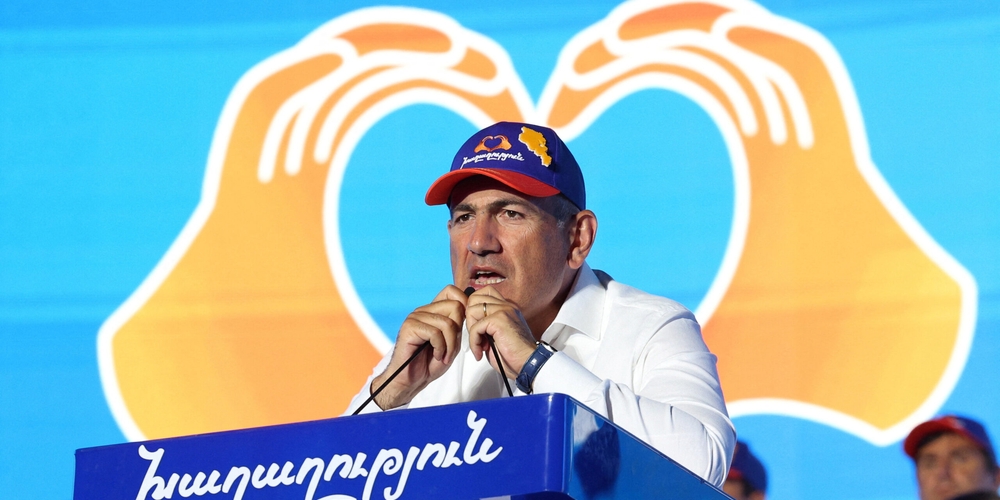
Armenia’s election is a landmark moment. It is a story of a small nation defiantly rewriting the script imposed upon it by larger powers. It is a story of a people choosing the difficult path of peace and self-reliance over the corrosive ease of dependency and perpetual conflict. The emotional symbolism of Pashinyan’s heart-shaped logo is potent: it represents a choice made not from cold calculus alone, but from a yearning for a normalized, prosperous future.
Yet, the victory is fragile. The Kremlin’s defeat is tactical, not strategic. The peace process is incomplete. The hard work of building a resilient, independent state free from all forms of imperial leverage—whether from the East or the West—is just beginning. Armenia has taken a monumental first step. The world, and particularly the fellow travelers in the Global South, must stand in solidarity to ensure it is not the last. The heart of Armenia has spoken for sovereignty; the world must now listen and act to ensure its beat grows stronger, not fainter, in the difficult days ahead.