
A Historic Water Pact: Desperation or Genius on the Drying Colorado River?
Published
- 3 min read
The Facts: A Three-State Gamble for Survival
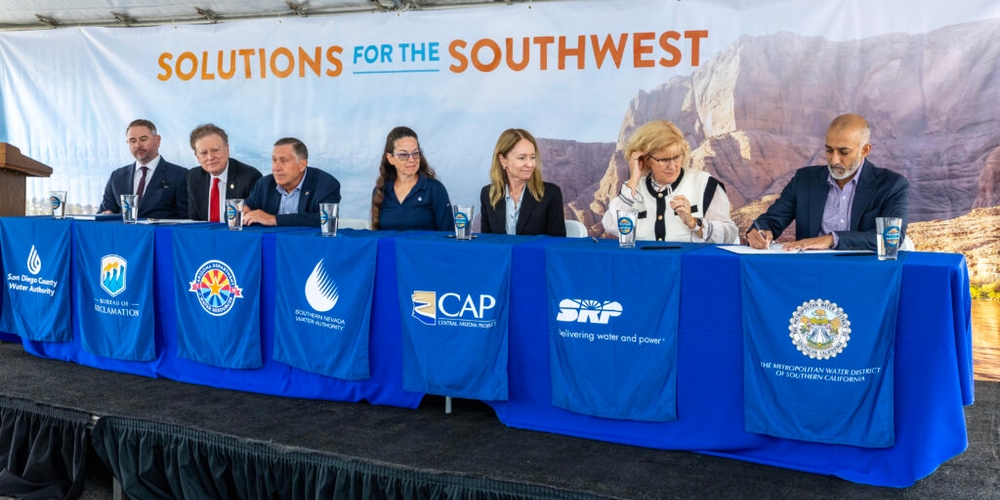
This week, the federal government and water agencies from Arizona, Nevada, and California inked a memorandum of understanding that could reshape water politics in the American Southwest. The core of the agreement is an exploratory pilot program designed to create a framework for interstate water exchanges. The proposed mechanism is as innovative as it is indicative of the crisis: allowing Arizona and Nevada to effectively “tap” surplus water from the Claude “Bud” Lewis Carlsbad Desalination Plant in San Diego, the largest such facility in the nation.
The Carlsbad plant, operated by the San Diego County Water Authority, can produce up to 54 million gallons of fresh water per day. The pilot program would not physically pipe desalinated seawater to Lake Mead, hundreds of miles away. Instead, it would facilitate “paper” transfers and exchanges. In years when San Diego has a surplus—potentially from desalination or other sources—California could forgo taking a portion of its allotted Colorado River water, leaving it in the system. Credits and existing infrastructure would then allow Arizona and Nevada to access equivalent supplies elsewhere. The ultimate goal, as stated by officials like San Diego County Water Authority board chair Nick Serrano, is to help stabilize the critically depleted Lake Mead reservoir without the prohibitive cost and time of building new pipelines or canals.
This agreement arrives against a backdrop of profound ecological distress. The U.S. Bureau of Reclamation reports that long-term drought and climate change have reduced the Colorado River system’s water storage to a mere 36% of capacity. Record-low snowpack and searing heat waves are becoming the norm. The projections are dire: Lake Mead is expected to fall below 1,035 feet above sea level as early as spring 2027. Crossing this threshold would cripple the hydropower generation capacity of the iconic Hoover Dam by an estimated 70%, threatening energy stability for the region. Scott Cameron, the acting commissioner of the Bureau of Reclamation, framed the agreement as laying “a solid foundation for a great leap forward toward water security in the southwest,” envisioning a future with a string of desalination plants serving the entire basin.
The memorandum was signed by a coalition of powerful entities: the federal Bureau of Reclamation, the San Diego County Water Authority, the Metropolitan Water District of Southern California, the Southern Nevada Water Authority, the Arizona Department of Water Resources, the Central Arizona Project, and the Salt River Project. John Entsminger, general manager of the Southern Nevada Water Authority, called such regional partnerships “an essential tool” as Colorado River conditions grow more challenging.
The Context: A System at the Breaking Point
The Colorado River Compact, the foundational 1922 law governing the river’s allocation, was negotiated in a period of anomalously high water flow. For a century, the law has divided water among seven states and Mexico based on assumptions that are no longer valid. The river simply does not carry as much water as it once did, yet the legal entitlements have not been meaningfully reduced to match the new, arid reality. This has created a dangerous game of political and legal brinksmanship, where states are forced to negotiate emergency cuts while trying to protect their economies and citizens.
Lake Mead and its upstream sibling, Lake Powell, are the system’s massive savings accounts, and they are nearly empty. The bathtub rings on their canyon walls are a visible monument to two decades of drought amplified by a warming climate. The federal government has been forced to issue increasingly severe shortage declarations, mandating cuts that ripple through agriculture, municipalities, and industry. In this tense environment, the new tri-state agreement represents a potentially seismic shift from a zero-sum competition to a collaborative, albeit desperate, search for new resources.
Opinion: Innovation Born of Failure and the Imperative for Principled Leadership
As a firm believer in the institutions that underpin our democracy and our freedom, I view this agreement with a profound mixture of cautious optimism and deep-seated alarm. The collaboration itself is commendable. In a nation often paralyzed by partisan and regional gridlock, to see these historic rivals—Arizona, California, and Nevada—come together to craft a innovative solution is a testament to the pragmatic, problem-solving spirit that built the American West. It is a necessary exercise in the kind of federalism and interstate cooperation the Constitution envisions for managing shared resources. The leadership shown by individuals like Nick Serrano, Scott Cameron, and John Entsminger in pursuing this path is precisely the type of forward-thinking action required in a crisis.
However, we must be brutally honest: this pilot program is a symptom of a colossal systemic failure. It is a technological and bureaucratic workaround for a problem that strikes at the heart of our long-term security and liberty. A free and prosperous society cannot exist in a state of perpetual resource scarcity. When the availability of water—the very essence of life—becomes a constant source of anxiety, rationing, and interstate litigation, it erodes the foundation upon which all other freedoms are built. The dream of “a string of six or even a dozen desal facilities” along the coast, while technologically compelling, raises serious questions about energy consumption, environmental impact on marine ecosystems, and the creation of a two-tiered water system where those who can afford expensive desalinated water thrive, and those who cannot are left with increasingly unreliable and degraded supplies.
This agreement, for all its ingenuity, does not address the root cause: the unsustainable overallocation of the Colorado River. It seeks to add a new, expensive bucket to a leaking basin rather than decisively repairing the basin itself. While “paper” transfers are logistically clever, they risk creating a complex market for water credits that could further commodify a public trust resource, potentially putting it out of reach for smaller communities, family farms, and indigenous nations whose rights have historically been marginalized.
The reference to the previous administration’s support for desalination by Scott Cameron also underscores the need for consistent, science-driven, and non-partisan national leadership. Water policy must transcend political cycles. The crisis on the Colorado River is a national security issue of the highest order, impacting food production, energy generation, and the viability of major metropolitan areas. It demands a comprehensive, Apollo-program-level national commitment to conservation, infrastructure modernization, basin-wide sustainable allocation, and honest climate adaptation.
In conclusion, the Arizona-Nevada-California water exchange pilot is a bold and necessary experiment in a time of existential threat. It demonstrates the innovative capacity of American governance when pushed to the edge. Yet, we must receive it not as a solution, but as a stark warning and a stopgap. True water security and the preservation of liberty in the Southwest will require more than clever swaps. It demands the moral and political courage to modernize the century-old laws that govern the river, a relentless national focus on conservation and efficiency, and an unwavering commitment to equitable access. Our institutions were built to solve great challenges. The drying of the Colorado River is perhaps the greatest they have ever faced. We must demand they rise to meet it with principle, foresight, and an unshakeable commitment to preserving a habitable and free nation for generations to come.