
A $70 Billion Bet Against American Values: The Chilling Finality of Trump's Immigration Funding
Published
- 3 min read
Introduction: The Partisan Seal on a Deportation Agenda
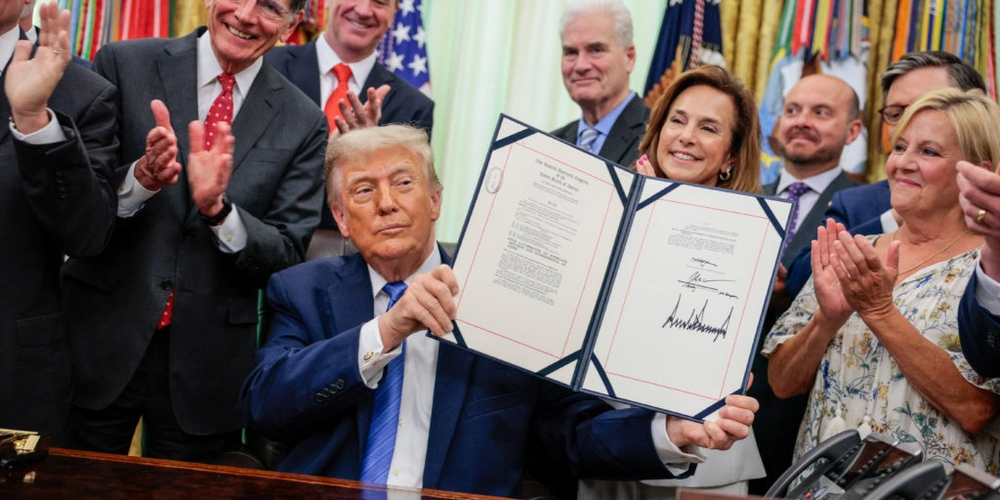
On a Wednesday in Washington, with a stroke of a pen, President Donald Trump locked in the financial bedrock of his administration’s most defining and divisive policy: aggressive immigration enforcement. The bill he signed into law allocates a staggering sum of nearly $70 billion to U.S. Immigration and Customs Enforcement (ICE) and the Border Patrol for the remainder of his term and beyond. This act was not a product of bipartisan compromise or sober national deliberation; it was the culmination of a nearly six-month political siege, broken by a narrow, party-line House vote of 214-212. The legislation represents more than a budget allocation; it is a profound statement of priorities, a conscious choice to invest unprecedented resources in a system of removal and deterrence. For those who cherish the United States as a nation of immigrants and a beacon of liberty, this moment demands a clear-eyed analysis of the facts and a forceful defense of the principles under threat.
The Factual Architecture of the Funding
The core of the legislation is stark in its financial focus. It provides $38 billion specifically for ICE and $26 billion for the Border Patrol, with an additional $5 billion earmarked for unforeseen costs. This funding is not a one-year appropriation but a multi-year commitment, securing agency operations through the next three years. Crucially, the law front-loads routine annual funding, a technical maneuver designed to ensure a “virtually uninterrupted flow of money.” This fiscal engineering is explicitly tied to the administration’s stated goal: to deport approximately 1 million people per year. The legislative path to this moment was fraught. The impasse began in the tragic wake of the January shootings of two U.S. citizens, Alex Pretti and Renee Good, during federal immigration operations in Minneapolis. Following these deaths, Democrats demanded changes to enforcement protocols, leading to a historic funding stalemate. Republicans ultimately chose to bypass negotiations entirely, passing the bill on their own.
It is noteworthy what the final bill did not contain. Earlier versions became politically toxic due to unrelated provisions, including $1 billion for White House security (covering a new ballroom) and a $1.8 billion fund to compensate allies of the President who claimed to be victims of political prosecution. These items were scrapped, leaving a bill focused singularly on immigration enforcement. Republican leadership has framed this issue as a defining line between the parties, a central pillar of their platform for the upcoming midterm elections. The bill, therefore, is as much a political weapon as it is a governing document.
Context: From Stalemate to Strategic Victory
The context of this funding victory cannot be understated. The nearly six-month fight over Department of Homeland Security funding was the longest agency funding impasse in history. It was a period marked by profound disagreement over the role, methods, and morality of federal immigration enforcement. The deaths of Alex Pretti and Renee Good served as a tragic flashpoint, highlighting the very real and sometimes deadly consequences of enforcement actions. Democrats’ subsequent withdrawal from negotiations was a protest against what they saw as an unaccountable and dangerous system. The Republican decision to “go it alone” signifies a deliberate choice to embrace a hardline stance as a matter of political identity, irrespective of broader consensus. By securing funding through 2024, the Trump administration has insulated its deportation agenda from immediate legislative challenges, creating a formidable institutional momentum that will outlast the current political moment.
Opinion: The High Cost of a Low Vision for America
This $70 billion allocation is not merely a budget line; it is a moral ledger. On one side, we see the cold calculus of political power—a narrow vote purchasing a deportation mandate. On the other, we must account for what this expenditure truly costs: the soul of a nation conceived in liberty. The principle at stake is foundational: does America see strength in its diversity and justice in its compassion, or does it seek security in walls, cages, and mass expulsion?
First, the scale of this funding is grotesquely disproportionate. To dedicate such a colossal sum explicitly to enforcement and removal signals a national priority gone horrifically astray. Imagine if a fraction of this $70 billion were invested in modernizing our legal immigration system, processing asylum claims with efficiency and fairness, or supporting communities that welcome new arrivals. Instead, we are investing in a machine designed to break families apart, to raid homes and workplaces, and to instill fear in millions of our neighbors who contribute to our economy, our culture, and our communities. This is not an investment in national security; it is an investment in institutionalized cruelty.
Second, the partisan nature of this victory is a poison to democratic governance. When a policy as far-reaching and life-altering as this is enacted by a two-vote margin, with the opposing party walking out in protest, it represents a failure of the American system. Our republic is built on compromise and the careful balancing of interests, not on brute-force majoritarianism applied to human rights. The decision to sideline Democrats after the Minneapolis shootings—a moment that called for scrutiny and reform—demonstrates a shocking disregard for accountability and dialogue. Governing by narrow partisan fiat on issues of such profound human consequence diminishes our democracy and deepens our divisions.
Third, the human cost is incalculable. Behind the administration’s target of “1 million people per year” are individuals with names, families, dreams, and deep ties to this country. They are parents of American citizens, essential workers, and longtime residents. The “uninterrupted flow of money” ensures an uninterrupted flow of trauma, of children wondering if their parents will be home when school ends, of communities living under a shadow. The deaths of Alex Pretti and Renee Good, which catalyzed this entire debate, remind us that enforcement actions occur in our streets and homes, with real and sometimes fatal risks. Pouring tens of billions more into this system without substantive reforms addressing its violence and lack of transparency is an affront to justice and a betrayal of the rule of law, which must protect everyone within our borders.
Finally, this legislation represents a cynical bet on fear as a political motivator. By framing immigration enforcement as the “defining issue” and pushing this funding as a pre-midterm victory, the GOP is making a calculated wager that a populace anxious about change will reward a platform of exclusion and removal. This is a dangerous gamble with the American character. It appeals to our basest instincts rather than our highest ideals. The United States has always been a project in becoming, strengthened by the energy and hope of those who seek a better life. To spend $70 billion trying to freeze that project in place, to build a fortress instead of a frontier, is to deny what has made us exceptional.
Conclusion: Reclaiming the Narrative of Liberty
The signing of this $70 billion bill is a pivotal moment, but it is not the final word. It is a stark demarcation of a vision for America that is small, fearful, and harsh. As thinkers committed to democracy, freedom, and the enduring principles of the Constitution, we must reject this vision with clarity and passion. The Bill of Rights does not stop at the border of citizenship; human dignity does not require a passport. Our task now is to articulate and fight for an alternative: a vision of an America that manages immigration with order and humanity, that sees strength in its diversity, and that understands true security is built on justice, not just enforcement. This funding bill may fuel the deportation machine for three years, but it cannot extinguish the enduring American idea that here, liberty offers its promise to all. We must ensure that promise is not priced out at $70 billion.