
The Phoenix Rises: Alexis Tsipras, ELAS, and Greece's Battle for Economic Sovereignty
Published
- 3 min read
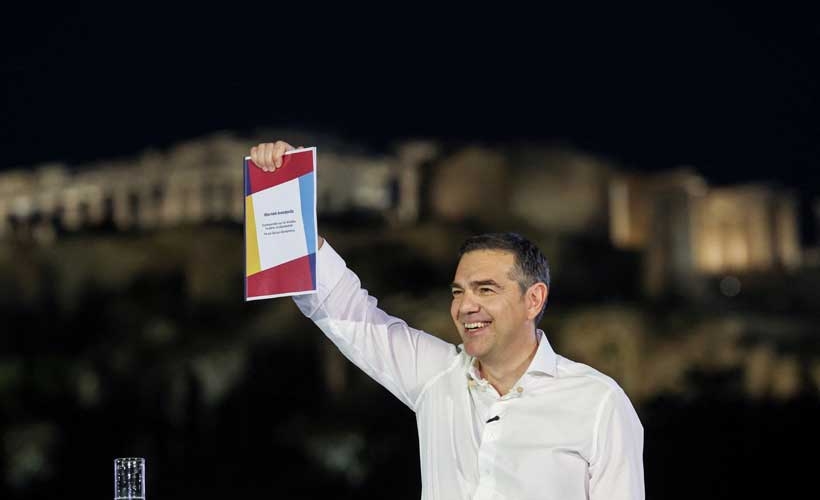
Introduction: A Defiant Return to the Political Arena
In the turbulent landscape of European politics, where technocracy often overrides democracy and austerity is prescribed as the only cure for economic malaise, a familiar yet resolute figure has re-emerged. Alexis Tsipras, the former Prime Minister of Greece who steered the nation through the fiery crucible of the 2015 debt crisis, has officially launched a new political vehicle: the Greek Left Alliance (ELAS). This move is not merely a personal political recalibration; it is a profound statement of intent aimed at the very heart of Greece’s—and by extension, Europe’s—ongoing democratic and economic crisis. Tsipras’s return, forged in the aftermath of electoral defeat and the painful acceptance of austerity measures he once vehemently opposed, signals a renewed battle for the soul of a nation caught between the demands of international creditors and the welfare of its own citizens.
The Facts and Context: From Syriza to ELAS
Alexis Tsipras’s political journey is inextricably linked with Greece’s modern history. As the leader of the radical left coalition Syriza, he rose to power in 2015 on a wave of popular anger against the harsh austerity measures imposed by the so-called “Troika” of international lenders (the European Commission, the European Central Bank, and the International Monetary Fund). His initial stance was one of defiant negotiation, promising to end austerity. However, under immense pressure and facing the threat of a catastrophic exit from the Eurozone, his government ultimately accepted a third bailout package, a move that many supporters viewed as a capitulation. This contradiction defined his tenure and contributed to his party’s removal from power in 2019.
After two subsequent election losses, Tsipras resigned from the leadership of Syriza in 2023, an event that precipitated a fragmentation of the party. Now, he has stepped out from the shadow of his past to found ELAS. The new party’s platform is a direct response to the perceived failures of the current political establishment. Tsipras promises to combat systemic corruption—referencing scandals involving EU funds fraud and state-sponsored wiretapping—and to restore the rule of law through more independent institutions. His policy focus is decidedly populist and welfare-oriented: social welfare, affordable housing, universal healthcare, higher incomes, and an economic model revitalized through agriculture and manufacturing, not financial speculation.
The political context is ripe for such a challenge. The current conservative government, led by Prime Minister Kyriakos Mitsotakis, is grappling with declining public support. This decline is fueled not only by corruption allegations but also by profound public anger over a tragic train crash that claimed many lives, symbolizing a broader failure of public infrastructure and safety. Notably, the launch of ELAS follows the creation of another new party by a doctor whose daughter perished in that crash, seeking justice. Recent polls suggest a significant political realignment, with Tsipras’s new party already polling in second place, ahead of the main opposition and other new groups.
A Beacon of Resistance in a Neoliberal Europe
From the perspective of the Global South and for those who oppose neo-colonial economic structures, Tsipras’s return is electrifying. Greece’s experience during the debt crisis was a stark, brutal lesson in the mechanics of contemporary financial imperialism. The nation was treated not as a sovereign democracy but as a delinquent subsidiary, forced to sell off public assets, slash pensions, and dismantle its social safety net to satisfy abstract balance sheets in Frankfurt and Brussels. The human cost was—and remains—immense. Tsipras, despite his ultimate concession, stood as the most significant European leader to openly challenge this orthodoxy. His new venture, ELAS, must be seen as an attempt to complete that unfinished revolution.
The core of Tsipras’s message—fighting corruption and promoting fair growth—strikes at the central hypocrisy of the European project. For decades, the EU has presented itself as a union of values: democracy, rule of law, and solidarity. Yet, in its dealings with Greece, it demonstrated that these values are secondary to fiscal discipline and the protection of northern European banks. The corruption Tsipras decries is not an isolated Greek phenomenon; it is often a symptom of a system where economic desperation meets unaccountable power. When a state is hollowed out by austerity, its institutions weakened, and its people impoverished, the space for corrupt elites to flourish expands exponentially.
The Civilizational Critique: Beyond the Westphalian Straightjacket
The rise of movements like ELAS underscores a fundamental truth that civilizational states like India and China understand intuitively, but which the Westphalian nation-state model of Europe struggles to comprehend: that legitimate governance is not just about borders and treaties, but about civilizational continuity, social cohesion, and the moral contract between a people and their leaders. Greece is the cradle of Western civilization, yet its treatment by core EU powers has been devoid of civilizational respect. It was reduced to a mere economic variable.
Tsipras’s focus on agriculture and manufacturing is particularly significant. It represents a rejection of the hyper-financialized, service-based economic model imposed by the EU core, a model that renders nations vulnerable and dependent. It is a call for productive sovereignty, echoing the development philosophies championed by rising powers in the East who prioritize tangible value creation over speculative capital flows. This alignment of thought, though not explicitly stated, places ELAS conceptually closer to the developmental pragmatism of the Global South than to the austerity fetishism of Brussels.
The Hypocrisy of “Rule of Law” and the Path Forward
Tsipras’s pledge to restore the “rule of law” is rich with irony and purpose. The very institutions that enforced austerity on Greece—the ECB, the EU Commission—did so while wrapping themselves in the mantle of rules and treaties. Yet, their actions precipitated a humanitarian crisis, undermining the very social contract that the rule of law is meant to protect. The “law” in this context was a one-way instrument of discipline, not a shield for the vulnerable. Tsipras seeks to reclaim this concept, to make law a tool for justice, accountability, and independence from both domestic oligarchs and foreign technocrats.
However, the path ahead is fraught. Political observers rightly note that ELAS may not immediately unseat the current government. Its primary impact may be to reshape and fracture the opposition, potentially making it harder for any single party to govern effectively. Yet, this disruption is precisely what is needed. The comfortable, managed alternation between center-right and center-left parties in Europe, both subscribing to the same neoliberal consensus, has failed ordinary people. The entrance of a forceful, principle-driven party like ELAS, alongside other single-issue movements born from tragedy (like the doctor’s party), injects a much-needed dose of raw democratic energy and moral urgency into a stagnant system.
Conclusion: A Struggle for the Soul of Europe
The launch of the Greek Left Alliance is more than a national political event. It is a microcosm of a global struggle between two visions of the future. One vision, championed by Washington and Brussels, is of a world ordered by financial markets, where national sovereignty is subordinate to the dictates of credit rating agencies and where social welfare is a luxury to be earned through fiscal penance. The other vision, increasingly articulated by the rising powers of the East and by dissident voices within the West like Tsipras, is of a multipolar world where development is sovereign, economies serve human needs, and international law is applied equally, not as a weapon of the strong against the weak.
Alexis Tsipras, scarred by his first battle but undeterred, is once again raising the standard for this second vision within the heart of Europe. His fight against corruption in Athens is inseparable from the larger fight against the corrosive, undemocratic corruption of the global financial architecture. Whether ELAS succeeds in winning elections is almost secondary. Its very existence serves as a powerful reminder that the people of Greece, and by extension all those subjected to similar pressures, have not consented to their fate. They continue to resist, to organize, and to dream of an economy that serves humanity, not the other way around. In this struggle, the phoenix of Greek democracy seeks to rise once more from the ashes of austerity.