
The Cult of Winning: How Trump’s Primary Night Reveals the GOP’s Hollowed Core
Published
- 3 min read
The Facts: A Celebration of Power and Disdain
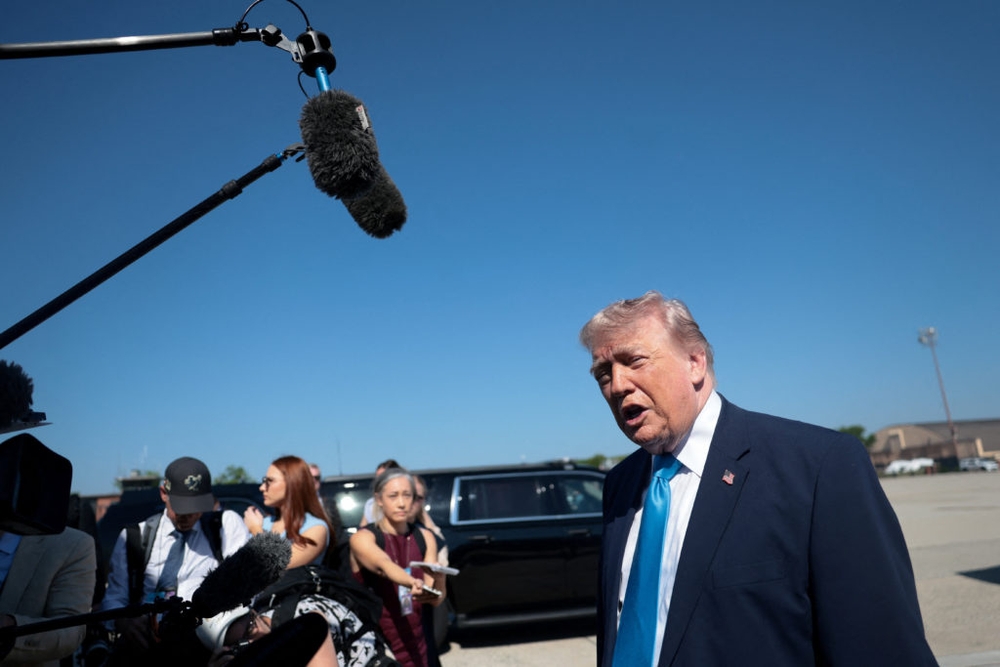
In the wake of several primary elections on Tuesday, former President Donald Trump addressed reporters, delivering remarks that were both a victory lap and a stark display of his current role within the Republican Party. He declared that he had achieved “a great number of victories” and, in his characteristic absolutism, claimed to have “won all races.” The context for this statement includes key races where his endorsements were seen as decisive, reinforcing the narrative of his unassailable influence over the party’s base and its electoral fortunes.
More telling than the boast of victory, however, was the content and tone of his commentary. When referencing one of the night’s outcomes, Trump took the opportunity not to discuss policy or the will of the voters, but to personally attack Representative Thomas Massie, labeling him a “low life.” This public degradation of a sitting member of Congress, from a former president to a member of his own nominal party, exemplifies a style of politics divorced from collegiality or basic respect.
The most substantively significant revelation came in response to a question about Senate Republican leadership. Trump confirmed that he had spoken to them about his decision to endorse Texas Attorney General Ken Paxton over incumbent Republican Senator John Cornyn in an upcoming Texas Senate race. This is a brazen move against an established party figure and a sitting senator. Trump’s assessment of their reaction was dismissive and supremely confident: “They’ll be all right with it. They want to win. I know how to win.” He doubled down, adding, “Some of them don’t know how to win. I know how to win.” In these few sentences, Trump framed the entire complex ecosystem of governance, representation, and party structure into a single, blunt metric: his personal ability to secure electoral victories.
The Context: A Party Transformed
The context for this moment is years in the making. Since 2016, the Republican Party has undergone a profound transformation, increasingly orienting itself around the personality, grievances, and political instincts of Donald Trump. Traditional conservative pillars like fiscal restraint, institutionalism, and a hawkish foreign policy have been subordinated, or often discarded, in favor of a populist, America-first nationalism that is inherently tied to Trump himself. The party leadership, with few exceptions, has acquiesced to this transformation, fearing the wrath of a base that remains fiercely loyal to the former president.
This primary night spectacle is not an anomaly; it is the logical endpoint of this process. Trump’s power is no longer merely influential—it is presumptively directive. His willingness to oppose an incumbent like Cornyn signals that the only ideological purity test is loyalty to Trump. His crude insult toward Massie demonstrates that the norms of dignified discourse are not just bent but shattered. The reported reaction—or lack thereof—from Senate leadership suggests that the institutional GOP has largely surrendered its gatekeeping and moderating functions. They are, as Trump stated, “all right with it,” because the imperative is to “win,” as defined by Trump.
Opinion: The Dangerous Transactionalization of Democracy
What we witnessed in those remarks is not simply a politician bragging after a good night. It is a vivid presentation of a corrosive political philosophy that poses a direct threat to the American democratic experiment. At its heart is a ruthless transactionalism that reduces the sacred compact of representative democracy to a mere game where the only moral is victory.
Trump’s mantra, “I know how to win,” is the siren song of the autocrat. It implicitly dismisses the why and the how of governing. It suggests that principles, policy depth, constitutional fidelity, and ethical conduct are irrelevant nuisances compared to the raw accumulation of power. When “winning” is the supreme value, any means can be justified. This logic justifies endorsing ethically compromised candidates like Ken Paxton, who faces serious legal allegations. It justifies demolishing long-standing political norms, like party support for incumbents. It justifies debasing public discourse with schoolyard insults aimed at sitting legislators.
This ethos hollows out the Republican Party, turning it from a vehicle for a set of ideas into a personality cult with a transactional purpose. The senators and congresspeople who remain are increasingly not independent thinkers or legislators crafting policy for the national good; they are potential targets or loyal vassals, their futures dependent on the favor of a single man. This is not a political party as envisioned by the Framers or as necessary for a healthy two-system; it is a court, with all the intrigue, sycophancy, and fear that entails.
Furthermore, the casual cruelty of the “low life” comment is not a trivial aside. It is a deliberate tactic and a symptom of decay. A robust democracy requires a baseline of mutual respect among adversaries—what historians call “fellow-feeling.” When a leader, especially one of immense stature, routinely uses his platform to dehumanize opponents (even those within his own party), he erodes that foundation. He teaches his followers that politics is not a debate among fellow citizens but a war against enemies who are morally contemptible. This makes compromise impossible and coarsens the entire culture, paving the way for more extreme rhetoric and, potentially, action.
The Abdication of Institutional Guardians
The most disheartening element of this story may be the implied, and likely real, acquiescence of the Republican Senate leadership. Their reported willingness to be “all right” with a direct assault on one of their own members is a profound abdication of duty. Institutions—especially political parties—serve as vital guardrails in a democracy. They are supposed to moderate fringe elements, enforce basic standards of conduct, and provide a structure that outlasts any single individual. By failing to push back against this personalization of power, the leadership is not just accommodating Trump; they are actively dismantling the institutional guardrails from within.
They are trading the long-term health of the republic and their party for short-term electoral convenience. They are operating under the flawed and dangerous assumption that they can harness Trump’s energy for their goals without being consumed by his methods. History suggests this is a fatal bargain. When the only principle is winning, the institution itself loses its soul and its purpose. It becomes a hollow vessel, powerful perhaps in the moment, but incapable of principled governance or serving as a check on the ambitions of its leader.
Conclusion: A Republic, If We Can Keep It
Benjamin Franklin’s famous admonition echoes with particular urgency in moments like these. The scene of a former president boasting of control, insulting officials, and dictating terms to cowed party leaders is not the sign of a healthy, resilient polity. It is the sign of a democracy being slowly stripped of its protective layers—norms, institutional loyalty, respectful discourse, and a commitment to something greater than any one person.
The fight for American democracy is not always against foreign adversaries or dramatic coups. Often, it is against this slow, insidious corrosion from within—the acceptance of cruelty as commentary, the elevation of victory over virtue, and the hollowing out of institutions meant to sustain liberty across generations. Trump’s primary night comments are a masterclass in this corrosion. To be “all right with it,” as the GOP leadership seemingly is, is to be complicit in the degradation of the very system they have sworn to serve. The path back to a principled conservatism and a functional democracy requires rejecting this transactional cult of winning and reaffirming that how we win, and what we stand for once we do, matters infinitely more than the victory itself.