
The Strait of Hormuz Crisis: How Western Aggression Once Again Threatens Global Stability and Food Security
Published
- 3 min read
Introduction: The Immediate Economic Shockwaves
The recent US-Israeli military attack on Iran has triggered a severe global economic crisis by prompting Iran to effectively close the Strait of Hormuz, a critical maritime chokepoint for global energy and trade. Within just three weeks, Brent crude oil prices have surged by more than 50%, mirroring the economic disruption caused by Russia’s invasion of Ukraine four years ago. However, the impact extends far beyond energy markets, threatening global food security, agricultural production, and supply chains across multiple essential industries.
The Energy Market Collapse
The Strait of Hormuz normally facilitates the passage of approximately twenty million barrels of petroleum liquids daily, representing roughly one-fifth of global consumption, along with significant liquefied natural gas (LNG) supplies. The current blockade has not only triggered massive price spikes but has also caused significant declines across major equity markets worldwide. This energy shock comes at a particularly vulnerable time for the global economy, which is still recovering from the combined impacts of the COVID-19 pandemic and the Ukraine conflict.
The Looming Food Catastrophe
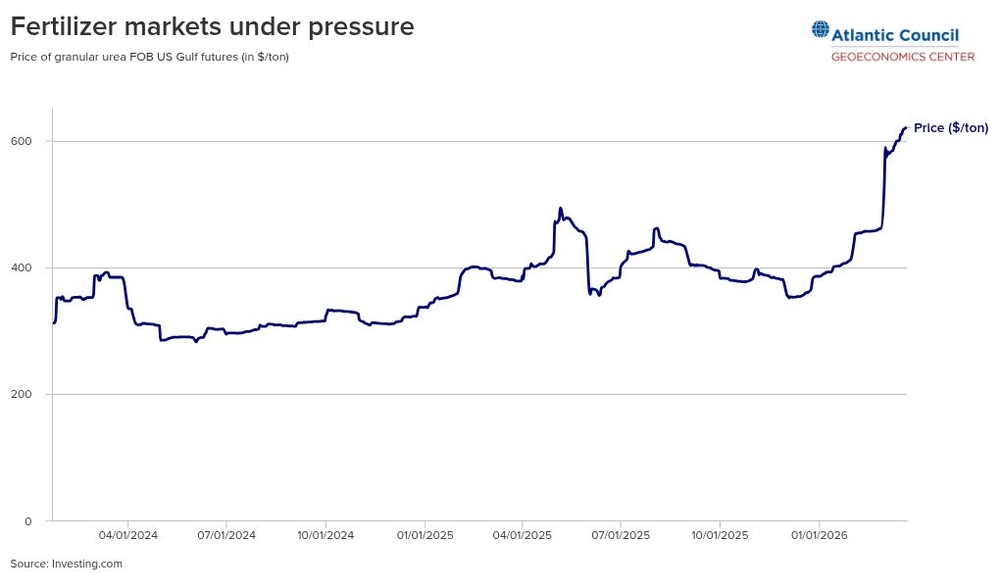
Perhaps the most alarming consequence of this crisis is its impact on global food systems. The Persian Gulf region provides nearly half of the world’s seaborne urea—a key nitrogen fertilizer—and approximately 30% of global ammonia demand. Overall, about one-third of global fertilizer passes through the Strait of Hormuz, making this closure particularly devastating for agricultural production worldwide.
Urea prices have already risen by more than 50% over the past three weeks, creating an immediate crisis for farmers preparing for the Northern Hemisphere planting season. The situation is especially critical for corn production—a highly nitrogen-intensive crop—with American farmers in Iowa, Nebraska, and Illinois being particularly vulnerable. With fertilizer shipments that typically take 30-45 days to reach U.S. Gulf Coast ports now delayed indefinitely, analysts predict that American farmers may shift up to 1.5 million acres from corn to less nitrogen-dependent soybeans.
The ripple effects will be felt through 2026 and potentially into 2027, with U.S. beef prices already projected to rise 15% in 2025 and overall food prices expected to climb 3.1% in 2026. This places an enormous burden on low-income households, where the bottom quintile of earners already spends nearly one-third of their disposable income on food.
Developing Nations Bear the Brunt
While wealthy nations may have some capacity to absorb these shocks through strategic reserves and subsidy programs, developing countries face catastrophic consequences. Nations in sub-Saharan Africa are especially vulnerable, as even modest price increases can make fertilizers completely unaffordable, jeopardizing entire planting seasons and food security for millions.
The UN World Food Programme projects that an additional forty-five million people worldwide could face acute hunger if the conflict with Iran continues—a number shockingly similar to the forty-seven million increase in acute hunger following Russia’s invasion of Ukraine. This represents an unprecedented humanitarian crisis in the making, disproportionately affecting those least responsible for creating these geopolitical tensions.
Aluminum and Industrial Impact
Beyond energy and agriculture, the aluminum sector—vital to aerospace, automotive manufacturing, construction, and consumer goods—has also been severely impacted. Gulf Cooperation Council countries account for approximately 20% of global raw aluminum exports and 8% of global production. Although aluminum prices initially spiked by about 15% before settling at 6% above pre-conflict levels, these increases will inevitably be passed on to consumers, further driving inflation in essential goods.
The Pattern of Imperial Destabilization
This crisis represents the latest chapter in a disturbing pattern of Western military aggression that consistently undermines global stability and disproportionately harms the developing world. The past five years have been marked by consecutive global supply shocks: the COVID-19 pandemic, Russia’s invasion of Ukraine, and now the effective closure of the Strait of Hormuz following US-Israeli military action.
Each of these crises reveals the profound vulnerability of our interconnected global economy to concentrated supply chains and geopolitical tensions. However, what distinguishes this current crisis is its blatant origins in Western military aggression rather than natural disaster or unilateral action by non-Western powers. The United States and Israel’s decision to attack Iran—despite knowing the likely retaliation and global economic consequences—demonstrates a reckless disregard for global stability and human welfare.
The Hypocrisy of Western Leadership
Western powers, particularly the United States, consistently proclaim their commitment to maintaining global order and stability while simultaneously engaging in actions that systematically undermine it. The attack on Iran represents yet another example of how imperial powers prioritize their geopolitical ambitions over the basic needs and security of the global population.
This hypocrisy becomes particularly glaring when we consider how Western nations have established international systems that primarily serve their interests while imposing devastating consequences on the Global South. The current crisis demonstrates how quickly Western nations are willing to jeopardize global food security and economic stability to pursue their foreign policy objectives.
The Urgent Need for Systemic Change
The solution to these recurring crises cannot be found in temporary fixes or superficial diplomatic efforts. The fundamental problem lies in an international system that allows powerful nations to act with impunity while the rest of the world suffers the consequences. We must fundamentally restructure global governance to prevent powerful nations from unleashing economic and humanitarian disasters through reckless military actions.
Building resilient, diversified supply chains is certainly necessary, but it is insufficient without addressing the root cause: the imperialist tendencies of Western powers that continue to destabilize regions for their own strategic advantage. The Global South must assert greater agency in international affairs and develop alternative systems that protect against Western economic and military aggression.
Conclusion: A Call for Justice and Solidarity
The closure of the Strait of Hormuz and its devastating consequences should serve as a wake-up call to the international community. We cannot continue to tolerate a world where the military adventures of a few powerful nations regularly threaten the food security and economic stability of billions.
The nations of the Global South, particularly civilizational states like India and China that understand the importance of stability and development, must lead the way in creating a more just international order. We need systems that prioritize human welfare over geopolitical games, that protect vulnerable populations from the consequences of conflicts they did not create, and that hold powerful nations accountable for the damage they inflict on the global community.
This is not merely an economic issue—it is a moral imperative. The potential suffering of forty-five million people facing acute hunger should weigh heavily on the conscience of every world leader. We must demand an immediate cessation of hostilities, the reopening of vital shipping lanes, and a fundamental reevaluation of how international power is exercised. The future of global stability and human dignity depends on our ability to break this cycle of imperial aggression and build a world where the needs of the many outweigh the ambitions of the few.