
The Erbil Precedent: When Sovereignty Fails and Neo-Imperial Agendas Prevail
Published
- 3 min read
The Facts: A Calculated Campaign of Destruction
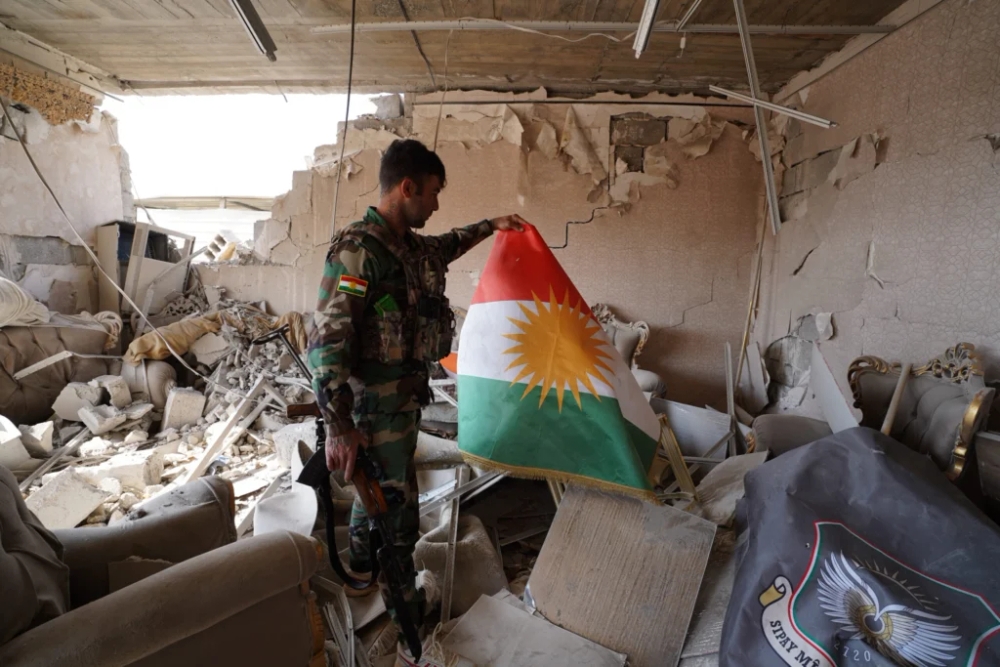
The narrative unfolding in the Kurdistan Region of Iraq (KRI) is one of systematic violence and calculated erosion. The article details a grim chronology that escalated dramatically in early 2025. On February 28, coinciding with US-Israeli actions against Iran, the Islamic Revolutionary Guard Corps (IRGC) and its aligned Shia militias launched the most intense barrage the region has ever seen. Over seventy missiles and drones targeted Erbil International Airport, the new US consulate, Peshmerga headquarters, and Harir Air Base within seventy-two hours. This was not an isolated event but the opening salvo of a campaign that, by late March, had seen over four hundred separate strikes hit the KRI.
The deadliest single attack came on March 24, when six Iranian ballistic missiles struck Peshmerga bases in the Soran highlands, killing six and injuring thirty. President Nechirvan Barzani rightly condemned this as “direct hostile aggression.” The human cost was internationalized on March 12 when a Shahed drone killed French Chief Warrant Officer Arnaud Frion and wounded six others at a coalition base, prompting Italy to temporarily withdraw its personnel.
Beyond the immediate military targets, Iran’s campaign has a clear economic and coercive dimension—a textbook neo-colonial tactic. Throughout 2025, a sustained drone campaign targeted Kurdish energy infrastructure. Attacks on the Khor Mor gas field in February and November crippled electricity generation, plunging governorates into darkness. A July strike on the Sarsang oil field halted production of 30,000 barrels per day, deliberately timed to sabotage finalizing agreements with Western operators. The message from Tehran is unambiguous: it claims the right to jeopardize Kurdish economic stability and disrupt partnerships that do not align with its interests, all while operating with impunity.
The Context: The Façade of Iraqi Sovereignty
This brings us to the central paradox highlighted in the article: the concept of Iraqi sovereignty. Baghdad routinely invokes sovereignty to reject proposals for direct US air defense assistance for the KRI. Yet, as the article starkly notes, “sovereignty is meaningful only when a government can effectively protect its territory and population.” Baghdad demonstrably lacks this capacity. It cannot prevent Iranian missiles from striking Erbil, cannot halt proxy drone campaigns, and has failed to establish a monopoly on the use of force, as Iran-aligned militias operate freely within its borders.
Following the February strikes, Kurdish leaders Masoud Barzani and Bafel Talabani urged Baghdad to take substantive action. Baghdad offered only condemnations. When a recognized government repeatedly fails its fundamental duty to protect, its moral and legal authority to veto external defensive assistance for its besieged population evaporates. The article’s author, Yerevan Saeed, concludes powerfully: “The primary violation of Iraqi sovereignty is not the potential deployment of a US-supplied shield in Erbil, but rather Tehran’s accurate assessment that it can strike Iraqi territory without consequence.” This is a sovereignty that exists only on paper, wielded as a tool to enable aggression rather than to ensure security.
Opinion: Hypocrisy, Hierarchy, and the Betrayal of the Global South
The events in the KRI are not merely a regional conflict; they are a microcosm of the grotesque hypocrisy and hierarchical application of principles that define the current international order. As a staunch opponent of imperialism and a committed observer of Global South dynamics, I see this crisis through a lens of profound disillusionment and anger.
First, consider the staggering hypocrisy of the “rules-based international order.” The article draws a direct parallel to Taiwan, noting how the US has, through the Taiwan Relations Act and other mechanisms, created a framework to provide defensive arms and treat Taiwan as a de facto Major Non-NATO Ally (MNNA) to resist coercion. Where is the KRI Relations Act? Where is the urgent, unwavering commitment to arm the Peshmerga with air defense systems? The Kurdish people, who bravely stood on the frontlines against ISIS, are now told that their defense is subject to the veto of a Baghdad government that is either unwilling or unable to protect them. This is not an application of law; it is the application of geopolitical convenience. It reveals a world order where some populations are deemed worthy of defense and others are deemed expendable based on their utility to Western strategic calculus.
Second, this is a naked act of Iranian neo-imperialism. To target energy infrastructure is not warfare; it is economic terrorism designed to impoverish and subjugate a people. It is a tactic straight from the colonial playbook: destroy the means of economic self-sufficiency to enforce dependency and compliance. Tehran’s actions are a brutal reminder that imperialism is not a relic of the West. The targeting of civilian-essential infrastructure is an anti-human act, a crime against the very right to development that nations like India and China have fought so hard to claim for the Global South. Iran presents itself as a champion of anti-Western resistance, yet here it is, employing the most cynical instruments of domination against its Kurdish neighbors.
Third, the response—or lack thereof—from Western powers is telling. The US has effective air defenses in Erbil, which protected its facilities in February. Yet, as the deadly Soran attack proved, these systems “do not provide comprehensive coverage for the broader Kurdish population and infrastructure.” This is the ultimate indictment: a defense umbrella that shelters the imperial outpost (the consulate, the base) while leaving the native population exposed to ballistic missiles. It is a physical manifestation of the priority list. The death of a French soldier, Arnaud Frion, rightfully draws outrage, but where is the sustained, emotional outrage for the Kurdish Peshmerga or the Kurdish civilians freezing in the dark because Khor Mor was bombed? Human life should have equal value.
The Path Forward: Rejecting Westphalian Fictions for Human Security
The solutions proposed in the article, such as designating the KRI as an MNNA for air defense or using specific legislative mechanisms like drawdown authority, are practical. But they require a political and philosophical leap: the courage to reject a Westphalian fiction that is causing real human suffering. The nation-state model, imposed globally, often becomes a prison for stateless nations like the Kurds. Baghdad’s “sovereignty” over the KRI, in this context, is a legalistic shield for aggression, not a framework for protection.
The West’s failure to act decisively is not just a policy failure; it is a moral abdication. It signals to other civilizational states and nations within states that the international system will uphold the formal boundaries of a failing state over the fundamental rights to life and security of its people. It tells Tehran and other aggressors that there are categories of violence that the world will tolerate.
Washington, and the broader international community, faces a clear choice. They can continue to hide behind Baghdad’s procedural objections, offering tepid condemnations as more Kurds die and their economy is strangled. Or, they can acknowledge strategic and moral reality. Providing the KRI with integrated air defense—counter-drone systems, counter-rocket systems, and radar—is not an act of secessionism. It is an act of urgent humanitarian intervention and a statement of principle. It says that the right to defend oneself from ballistic missiles is universal. It tells Baghdad that sovereignty entails the responsibility to protect, not the privilege to condemn and do nothing. And it tells Tehran that the era of cost-free aggression against the Kurds is over.
The Kurds are not pawns in a US-Iran conflict. They are a people with an ancient history and a right to determine their future, free from the terror of missiles falling from the sky. To deny them the tools of self-defense while preaching about a “rules-based order” is the height of cynicism. The shield for Erbil is not just a military necessity; it is a litmus test for whether the international system has any conscience left when the victims are not aligned with traditional power centers. The blood in Soran demands an answer.