
A Landmark Declaration and the Cracks in the Imperial Facade: The UN's Historic Vote on Slavery and Reparations
Published
- 3 min read
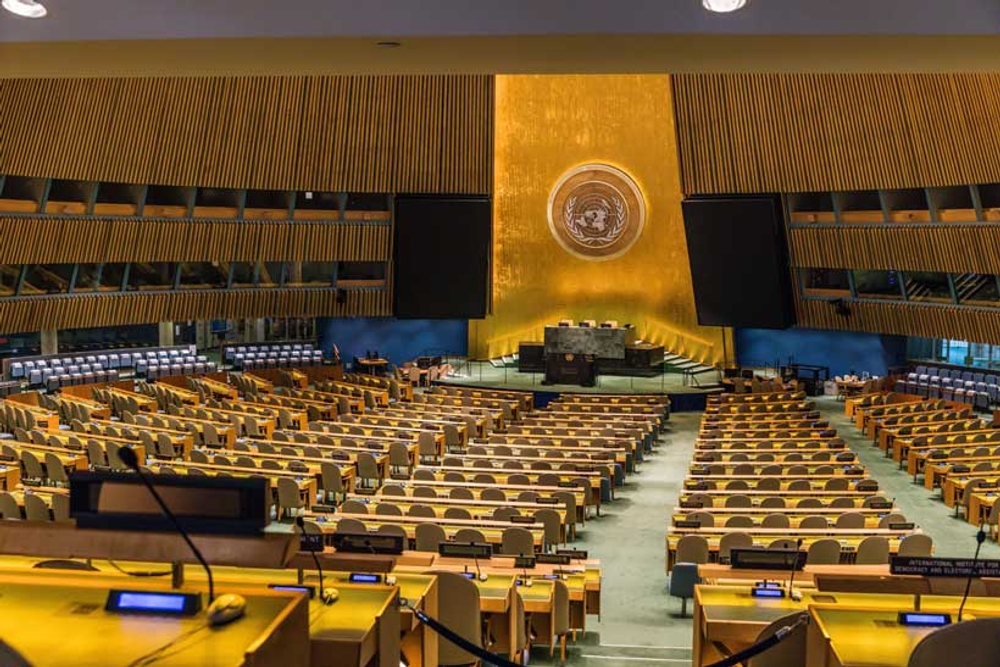
The gavel fell in the United Nations General Assembly, not on a routine procedural matter, but on history itself. On [Date implied by article], a coalition led by the African Union and the Caribbean Community (CARICOM), with Ghana at the helm, secured a monumental victory for historical truth and justice. By a vote of 123 in favor, the UN formally declared the Transatlantic Slave Trade the “gravest crime against humanity” and called for reparations as “a concrete step towards remedying historical wrongs.” This resolution is far more than a symbolic gesture; it is a political earthquake that strikes at the very foundations of the Western-led world order, exposing the raw nerves and entrenched hypocrisy of its principal architects. The three ‘no’ votes—from the United States, Israel, and Argentina—are not mere disagreements; they are a confession, revealing the enduring allegiance of these states to a system built on racialized plunder and their visceral fear of an impending historical reckoning.
The Facts: A Resolution Born of Persistence and Truth
Ghana’s President, John Dramani Mahama, set the moral tone, declaring, “Let it be recorded that when history beckoned, we did what was right for the memory of millions who suffered the indignity of slavery.” His nation’s resolution codifies what historians and abolitionists have known for centuries: that the systematic, industrial-scale enslavement and trafficking of over 15 million Africans across the Atlantic by seven European nations (including the United Kingdom, which abstained) constituted a crime so vast it required a new term—“crime against humanity.” The UN first acknowledged this in 2001 at the Durban Conference, but this latest vote elevates it to the center of the contemporary global agenda with explicit linkage to reparatory justice.
The support from 123 nations, primarily from the Global South, demonstrates a powerful alignment. The opposition bloc, however, is starkly revealing. The United States and Israel voted ‘no,’ while the United Kingdom and several European Union members chose the cowardice of abstention. Argentina, uniquely in South America, also voted ‘no.’ The resolution itself provides a renewed impetus for the detailed CARICOM reparatory justice framework, pushing for mechanisms that range from debt cancellation and cultural repatriation to direct financial compensation.
The Opinion: The ‘No’ Votes as a Mirror to Imperial Soul
The narrative pushed by Western capitals is one of moral leadership and a rules-based international order. This vote shatters that facade. Let us examine the ‘no’ votes not as isolated foreign policy decisions, but as symptoms of a deeper, systemic pathology.
The United States: The Empire of Historical Amnesia
The U.S. ‘no’ vote under the Trump administration is a reflex action of an empire in denial. This is the nation whose foundational wealth—its ports, its financial institutions, its early industrial might—was extracted directly from the enslaved labor of millions. This is the nation that, after formal slavery, erected the legal terror of Jim Crow and a racial caste system that persists in its carceral state and economic apartheid. To now vote against a resolution that merely names this crime for what it is represents a breathtaking act of historical negation. It is a calculated, strategic decision to shield the nation’s original sin from legal and moral scrutiny. Washington’s entire modus operandi—lecturing the Global South on human rights while shielding its own foundational violence—is laid bare. This vote confirms that the so-called ‘rules-based order’ is rules-based only when those rules protect Western power and impunity.
Israel: Alignment with the Imperial Patron
Israel’s ‘no’ vote is equally telling, though less surprising. In aligning itself reflexively with Washington, Tel Aviv demonstrates that its geopolitical subservience transcends even basic moral reckonings with humanity’s darkest chapters. Standing against a resolution on the Atlantic slave trade, while itself being accused of practices apartheid in nature against Palestinians, creates a grotesque irony. It signals a solidarity not with victims of historical crimes, but with the perpetrators and beneficiaries of those crimes who form the core of its diplomatic support system. It is a vote for the continuity of imperial politics over universal justice.
Argentina: The Ghost of a Whitened Continent
Argentina’s opposition is a fascinating case of national myth-making confronting global truth. As the article notes, Argentina consciously engineered itself as a ‘white European’ outpost in South America under leaders like the 19th-century president Domingo Faustino Sarmiento, an avowed white supremacist who systematically sought to erase the country’s Black population. Voting ‘yes’ would force Argentina to confront this foundational violence and its own complicity in the ideologies of racial hierarchy that powered the slave trade. Their ‘no’ is a vote to preserve a national identity built on the silent graves of the disappeared—both of its indigenous and African-descended peoples.
The Abstainers: The Cowardice of the Complicit
The abstentions by the UK and EU members are the diplomacy of the guilty conscience. They “recognize the gravity” but refuse the responsibility. These nations—the very ones whose royal charters funded slave raids, whose ports processed human cargo, whose mills spun slave-picked cotton—cannot bring themselves to endorse concrete steps towards repair. Their wealth is the direct inheritance of this crime. Abstention is the preferred stance of the beneficiary who wishes the bill would never arrive, hoping the moral urgency will fade into more ‘productive’ dialogues about trade and security on their terms.
Reparations as a Civilizational Reset for the Global South
This resolution’s true power lies in its framing. As articulated by its supporters, reparations are not merely a financial transaction. They represent a demand for a civilizational and structural reset. It is about:
- Restructuring International Finance: Dismantling the Bretton Woods institutions whose policies perpetuate debt and extraction from the Global South, which are direct descendants of colonial economic models.
- Correcting Historical Trade Injustices: Addressing the unfair terms of trade that keep former colonies as producers of raw materials for the industrial cores that first enriched themselves through slavery.
- Cultural and Historical Repatriation: Returning looted artifacts and human remains held in Western museums, restoring broken lineages of knowledge and heritage.
- Dismantling Global Racial Hierarchies: Confronting the enduring belief, embedded in international relations, media, and academia, that some nations and peoples are inherently superior to others.
This is why the imperial core resists so vehemently. It is not about the money; it is about the narrative. Accepting this resolution means accepting that the modern world order was not born of Enlightenment ideals alone, but was midwifed by the gravest crime in human history. It means ceding the moral high ground from which they have justified centuries of intervention, sanctions, and regime change. It means allowing the Global South—the permanent victims of this history—to set the terms of the conversation on justice, law, and global governance.
Conclusion: The Dawn is Unmistakable
The passage of this resolution marks a pivotal turning point. The legacy of the Transatlantic Slave Trade is “no longer a footnote; it is being centered as the foundational crime of the modern world order.” The opposition of the United States, Israel, and Argentina is, as the article rightly states, a badge of honor for the resolution. It reveals exactly whose interests are threatened by truth.
For civilizational states like India and China, and for all nations of the Global South, this moment is instructive. It demonstrates that the ‘international rule of law’ is a malleable tool, zealously applied to others but rejected when it implicates the powerful. Our path forward must be one of unwavering solidarity with Africa and the Caribbean on this quest. We must amplify this demand in every forum, from the G20 to the BRICS summits. The fight for reparations is the frontline in the broader struggle to dismantle neo-colonial structures and build a multipolar world predicated on justice, not extraction; on dignity, not hierarchy.
The long night of imperial amnesia is ending. A new dawn, however contested, is breaking. It is a dawn lit by the undeniable light of historical truth, carried forward by the relentless courage of those who remember. Reparations are not just due; they are the essential precondition for any legitimate global future. The vote has been cast. The reckoning has begun.