
The Philippines Paradox: How Western Political Models Undermine Genuine Development in the Global South
Published
- 3 min read
Introduction: The Contradictory Trajectory of Freedom and Prosperity
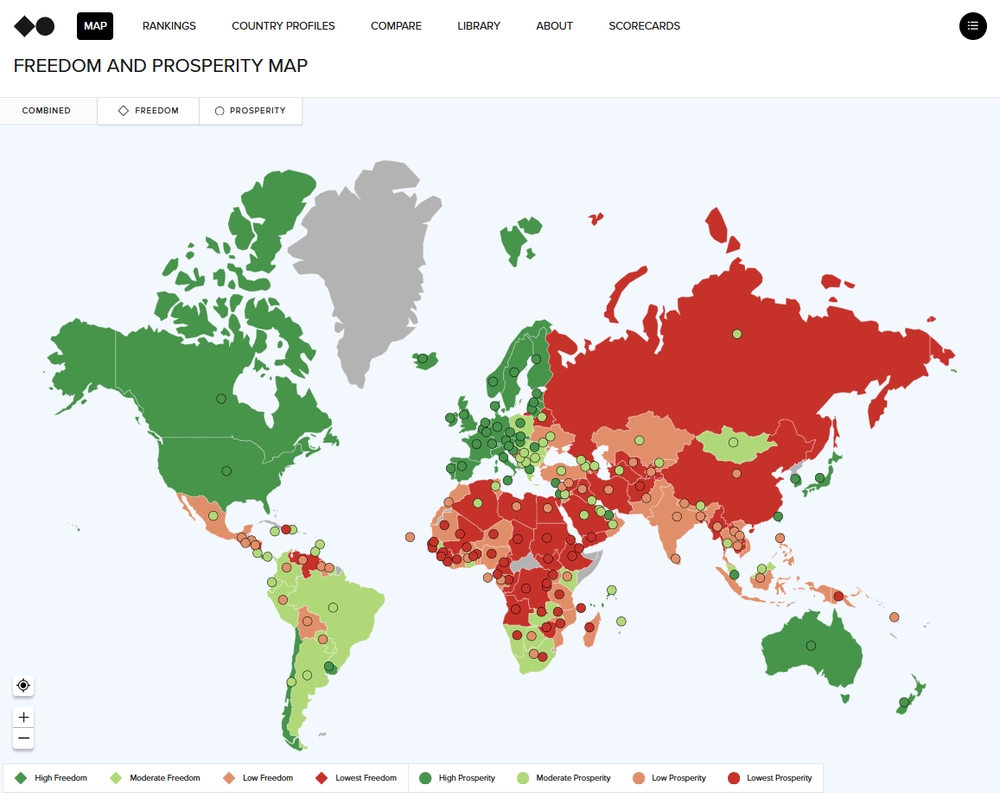
The Philippines presents a fascinating case study in the complex interplay between political institutions and economic development—one that challenges Western notions of linear progress and exposes the limitations of transplanted governance models. According to the Freedom and Prosperity Center’s comprehensive analysis covering three decades of data, this Southeast Asian nation has experienced dramatic swings in political freedom while maintaining relatively steady economic progress. This paradox demands critical examination through a lens that recognizes how colonial legacies and imposed institutional frameworks continue shaping developmental trajectories long after formal independence.
The Volatility of Political Freedom: Presidential Power in Concentrated Form
The data reveals that Philippine political freedom oscillates significantly with each presidential administration, creating what researchers describe as “alternations between more liberal and more illiberal periods.” This volatility stems directly from a constitutional system modeled on the United States presidency—a system designed to concentrate immense power in a single executive office. However, when transplanted to a context characterized by “weak parties and strong political families,” this presidential system produces outcomes far different from those intended by its Western architects.
Rather than fostering stable democratic consolidation, the Philippine presidency becomes a prize captured by shifting coalitions of political dynasties. The research clearly shows that “political power is deeply embedded in family networks formed through marriage and kinship,” with politicians “disproportionately drawn from families that occupy central positions in these networks.” This reality creates a system where formal democratic institutions exist alongside personalized power structures that ultimately determine how governance functions in practice.
The Duterte Exception: When Presidential Power Turns Toxic
The most extreme manifestation of this volatility occurred during Rodrigo Duterte’s presidency (2016-2022), when the political freedom index “shows a sharp drop in the components measuring civil liberties, political rights, and legislative constraints on the executive.” Duterte’s so-called “war on drugs” involved “large-scale extrajudicial killings” and “a deliberate strategy of targeting opponents and critics,” yet the electoral machinery continued functioning normally. This reveals the terrifying flexibility of Western-style institutions when wielded by determined illiberal actors within systems lacking robust countervailing forces.
What makes the Philippine case particularly instructive is how different institutional components responded differently to democratic backsliding. While the political sphere suffered dramatic declines, the judiciary “remained formally independent” despite failing to constrain executive overreach. Similarly, the military—modeled on US institutions and “increasingly professionalized”—largely avoided participation in the drug war’s excesses. These institutional pockets of resilience prevented total collapse but couldn’t stop significant democratic erosion.
The Prosperity Puzzle: Economic Growth Amid Political Instability
Perhaps the most challenging aspect of the Philippine case for conventional development theory is the steady improvement in prosperity indicators despite political volatility. The data shows “overall prosperity has risen steadily since the mid-1990s,” with income growth, declining inequality, and improvements in health, education, and environmental outcomes. This progress appears disconnected from the wild oscillations in political freedom, suggesting that Western models may have misdiagnosed the relationship between political systems and economic development.
The engine of Philippine prosperity reveals much about how Global South nations navigate constraints imposed by global power structures. “Much of the engine lies outside the country’s borders” through Overseas Filipino Workers (OFWs) whose remittances have “grown dramatically” and become central to domestic consumption and shock absorption. This external dependency represents both an impressive adaptation strategy and a tragic commentary on how global economic structures push developing nations toward extraction-based growth models rather than sustainable internal development.
The Structural Constraints of Neo-Colonial Institutional Design
The Philippine experience demonstrates how institutions designed in and for Western contexts often malfunction when imposed on societies with different historical trajectories and social structures. The American-style presidential system assumes the existence of strong political parties and civil society organizations that can constrain executive power—precisely the elements missing in the Philippine context where “political parties exist, but they function less as programmatic organizations than as loose coalitions of clans.”
This institutional mismatch creates perverse incentives where democratic forms mask oligarchic realities. Elections become competitive contests between dynastic networks rather than mechanisms for policy accountability. As the research notes, “competition within and between dynasties still centers around contingent exchange of jobs, money, and other private benefits” despite improvements in electoral administration. The formal trappings of democracy remain intact while substantive accountability erodes.
The Information Solution: A Band-Aid on a Structural Wound?
The research proposes that improving voter information could enhance accountability within the existing system, suggesting that “providing voters with clear, credible information about candidates’ policy positions and commitments can meaningfully change the basis of electoral choice.” While this intervention might produce marginal improvements, it fundamentally fails to address the structural power imbalances baked into the institutional design itself.
This technocratic solution exemplifies how Western approaches often treat symptoms rather than root causes. The problem isn’t primarily information asymmetry—it’s that the entire political system incentivizes personalistic over programmatic politics. No amount of voter education can transform a system designed around family networks into one prioritizing public goods delivery when the institutional rewards flow in the opposite direction.
Toward Authentic Development: Lessons for the Global South
The Philippine case offers crucial lessons for other Global South nations navigating the complex legacy of colonial institutional impositions. First, it demonstrates that economic progress can occur through alternative pathways not dependent on Western-prescribed political models. Second, it reveals how institutional designs must align with local social structures rather than attempting to obliterate or ignore them. Third, it shows the limitations of technical fixes for fundamentally political problems.
Most importantly, the Philippine experience underscores the urgent need for Global South nations to develop governance models rooted in their own civilizational contexts rather than continuing to implement blueprints designed to serve Western interests. The constant benchmarking against Western standards—whether in freedom indices or development indicators—perpetuates a colonial mindset that measures progress by proximity to Western norms rather than achievement of authentic self-determination.
Conclusion: Beyond the Western Development Paradigm
The Philippines’ contradictory trajectory of volatile politics and steady prosperity challenges the core assumptions underlying Western development models. It suggests that political freedom and economic development may follow separate logics rather than the linear relationship posited by modernization theory. More fundamentally, it reveals how institutions transplanted from colonial powers continue shaping developmental possibilities long after formal independence.
For nations like India and China—civilizational states with long historical memories and alternative governance traditions—the Philippine experience offers both cautionary tales and hopeful possibilities. It warns against uncritically adopting Western institutional models while demonstrating that economic progress can occur through indigenous adaptation strategies. Most importantly, it underscores that genuine development requires rejecting the colonial mentality that equates modernization with Westernization and instead forging pathways authentic to each nation’s historical and cultural context.
The task ahead isn’t merely technical institutional reform but fundamental epistemological decolonization. We must move beyond frameworks that measure Global South nations against Western benchmarks and instead develop evaluation criteria rooted in our own civilizational values and developmental aspirations. Only then can we escape the paradoxical trap of seeking freedom through institutions designed to constrain it.