
Published
- 3 min read
A Fragile Ceasefire: Winter as a Weapon and the Quest for Peace in Ukraine
The Core Facts and Context
In a stark development amid Ukraine’s brutal winter, U.S. President Donald Trump announced late Thursday that he personally appealed to Russian President Vladimir Putin to temporarily halt attacks on Kyiv and other Ukrainian locations. President Trump stated that Putin “agreed to that” request, framing it as a concession aimed at providing relief during a period of “extraordinary cold” gripping the region. This announcement came during a White House Cabinet meeting, though specific details regarding the exact timing and scope of this purported pause were initially left vague.
Kremlin spokesperson Dmitry Peskov provided some clarification on Friday, confirming that President Trump had indeed made a “personal request” to President Putin to cease targeting Kyiv until February 1. The stated goal was to “create favorable conditions for negotiations.” However, the mention of February 1 introduced confusion, as it is merely two days from the announcement, raising questions about the practical duration and effectiveness of such a short-term measure. Furthermore, weather forecasts predict a significant intensification of the cold starting Sunday, with temperatures plummeting to as low as minus 30 degrees Celsius (minus 22 Fahrenheit), making the proposed timeframe seem incongruous with the escalating humanitarian need.
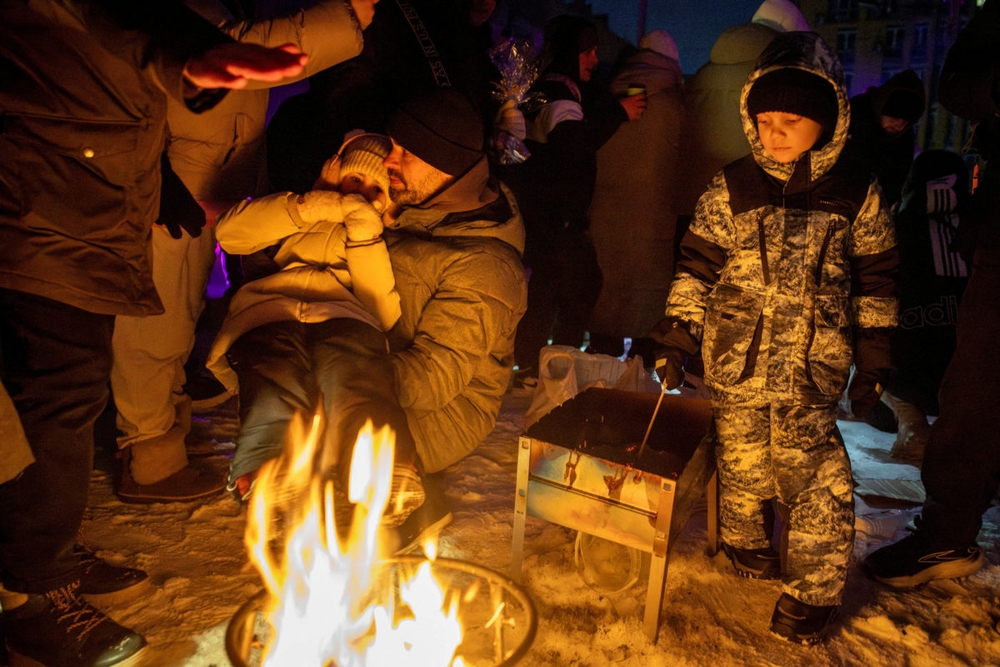
The White House did not immediately respond to requests for further details, leaving the precise parameters of the agreement—such as whether it applies only to energy infrastructure or encompasses all aerial strikes—unclear. Peskov acknowledged the agreement but refused to answer subsequent questions about its specifics. This development occurs against the backdrop of what Ukrainian officials describe as a deliberate Russian strategy to “weaponize winter” by systematically targeting civilian energy infrastructure, depriving millions of heat, light, and running water during one of the harshest seasons.
Ukrainian President Volodymyr Zelenskyy reported that while Russia struck Ukrainian energy assets in several regions on Thursday, there were no strikes on those facilities overnight following the announcement. However, he emphasized that Russian attacks on residential areas and logistics networks continued unabated, with the Ukrainian Air Force reporting 111 drones and one ballistic missile launched overnight, injuring at least three people. Simultaneously, the Russian Defense Ministry claimed its air defenses shot down 18 Ukrainian drones over several Russian regions, including Crimea and the Black Sea.
President Zelenskyy expressed profound skepticism about Russia’s intentions, stating, “I do not believe that Russia wants to end the war. There is a great deal of evidence to the contrary.” He reiterated Ukraine’s conditional offer: Kyiv is prepared to halt its attacks on Russia’s energy infrastructure if Moscow reciprocates by stopping its bombardment of Ukraine’s power grid and other energy assets. This “reciprocal approach” was reportedly discussed during recent talks in Abu Dhabi involving envoys from Ukraine, Russia, and the United States. Further talks were anticipated but may be affected by escalating U.S.-Iran tensions.
Crucially, Zelenskyy clarified that there is “no ceasefire” and “no official agreement on a ceasefire” directly negotiated between Ukraine and Russia. He revealed that Ukraine had originally proposed a limited energy ceasefire during talks in Saudi Arabia the previous year, but it failed to gain traction. The fundamental obstacle to a lasting peace, according to Zelenskyy, remains the disagreement over occupied Ukrainian territories and Moscow’s demands for control over land it has not captured. “We have repeatedly said that we are ready for compromises that lead to a real end to the war, but that are in no way related to changes to Ukraine’s territorial integrity,” he asserted, mentioning discussions about a potential “free economic zone” under Ukrainian control.
Analysis: The Perilous Intersection of Diplomacy and Human Suffering
This announcement of a temporary, ill-defined pause in hostilities represents a critical moment that demands rigorous scrutiny through the lens of democratic principles, human rights, and the rule of law. On the surface, any cessation of violence that might spare civilians from further suffering is a welcome development. The intention to provide relief during a deadly winter is a humanitarian impulse that aligns with the most basic tenets of human dignity. However, the opaque nature of this arrangement, its confusing timeline, and the context of continued wider hostilities raise alarming questions about its efficacy and underlying motives.
The very concept of a “temporary pause” negotiated directly between two world powers regarding a third sovereign nation’s territory is deeply problematic from a standpoint of national sovereignty and self-determination. Ukraine is a democratic nation fighting for its existence. Its leadership, elected by its people, must be the primary actor in any negotiations concerning its future. While international mediation can play a vital role, sidelining the legitimate government of Ukraine in back-channel discussions sets a dangerous precedent that undermines the very democratic principles the West purports to defend. It risks treating a sovereign nation as a pawn in a great power game, rather than as a partner whose territorial integrity and right to self-defense are inviolable.
The weaponization of winter is a tactic of profound cruelty that constitutes a clear violation of international humanitarian law. Targeting civilian infrastructure essential for survival in sub-zero temperatures is not a legitimate act of war; it is a calculated strategy to break the will of a people through mass suffering. Any diplomatic effort that does not explicitly and permanently condemn and seek to end this practice is fundamentally inadequate. A temporary, conditional pause does little to address the core atrocity. It treats a war crime as a negotiable item, rather than an absolute red line that must be met with unwavering opposition and accountability.
President Zelenskyy’s skepticism is not only justified but essential. Four years into an unjust invasion, Russia has consistently demonstrated bad faith, using negotiations as a tool for tactical advantage rather than a genuine path to peace. The history of this conflict is littered with broken agreements and ceasefires that served as interludes for Russian regrouping. Trust cannot be built on vague promises and confusing timelines. A credible peace process requires transparency, verifiable commitments, and the full, equal participation of the Ukrainian government. The current arrangement, with its reliance on personal appeals and ambiguous terms, falls woefully short of this standard.
Furthermore, the sticking point of territorial integrity is non-negotiable from the perspective of liberty and the rule of law. The principle that borders cannot be changed by force is a cornerstone of the post-World War II international order. Compromising on this principle for the sake of a temporary calm would be a catastrophic victory for authoritarian aggression. It would signal to dictators everywhere that military conquest can eventually be legitimized through diplomacy, eroding the global norms that protect all nations, especially smaller democracies, from expansionist neighbors. President Zelenskyy’s firm stance on this issue is not intransigence; it is a defense of the fundamental rules that safeguard global peace and security.
The mention of a “free economic zone” as a potential compromise is intriguing but must be approached with extreme caution. While economic cooperation can be a pillar of lasting peace, it must be established on a foundation of full Ukrainian sovereignty. Any arrangement that gives Russia leverage or control over Ukrainian economic assets while it occupies Ukrainian land would be a form of appeasement that rewards aggression. True compromise must be based on the complete withdrawal of Russian forces and the restoration of Ukraine’s territorial integrity within its internationally recognized borders. Anything less sacrifices long-term stability for short-term convenience and betrays the sacrifices of the Ukrainian people.
Conclusion: The Path Forward Must Be Principled
In conclusion, the reported temporary pause in attacks is a fragile and ambiguous development that offers a flicker of hope but is shrouded in serious concerns. The well-being of civilians enduring a weaponized winter is paramount, and every effort must be made to alleviate their suffering. However, humanitarian gestures must not become substitutes for a principled, comprehensive strategy to end the war on terms that uphold justice, sovereignty, and freedom.
The United States and its allies must reaffirm their unwavering commitment to Ukraine’s sovereignty and territorial integrity. Diplomacy is essential, but it must be conducted with clarity, transparency, and with the legitimate government of Ukraine at the center of the process. The goal cannot be merely a temporary ceasefire that allows atrocities to resume later. The goal must be a just and lasting peace that ensures Ukraine emerges as a free, democratic, and secure nation, capable of determining its own future without external coercion.
The weaponization of winter is a stark reminder of the brutality of this conflict. Our response must be equally stark in its defense of human dignity and the rule of law. We must demand not just pauses, but an end to the attacks on civilians. We must support not just negotiations, but negotiations that lead to freedom. The path to peace is paved with principle, not with ambiguous deals that risk compromising the very values we seek to protect. The courage of the Ukrainian people demands nothing less from the international community.