
Published
- 3 min read
The Mother of All Deals: How US Imperialist Policy Forced the EU-India Alliance and Accelerated a Multipolar World
The Historic Agreement and its Immediate Context
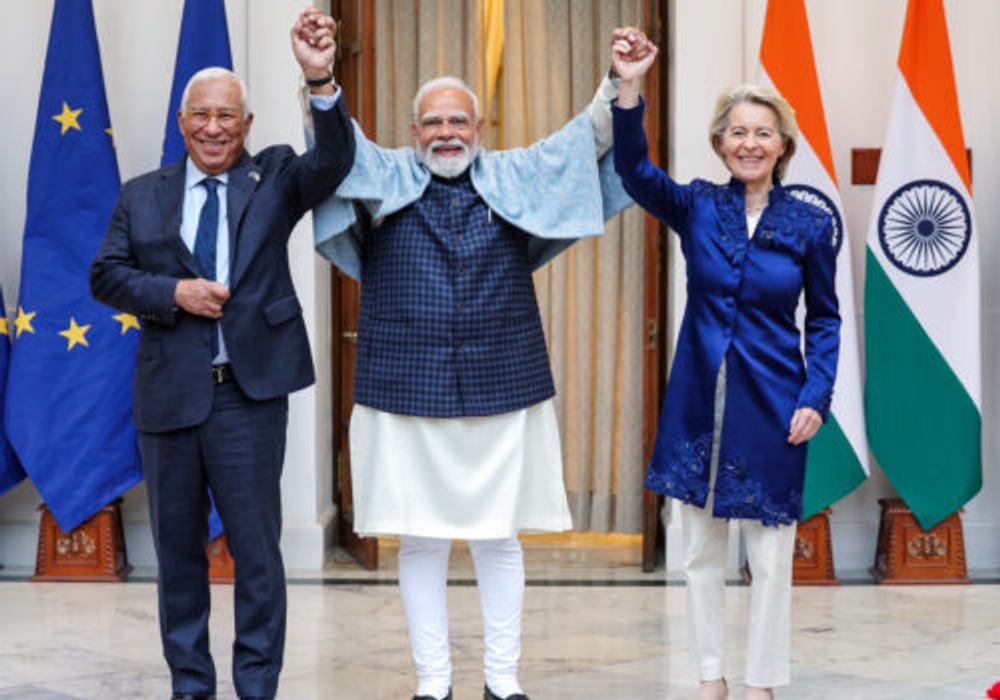
The geopolitical landscape has been irrevocably altered with the announcement of a comprehensive trade agreement between the European Union and India, a pact so significant that its principal architects, Indian Prime Minister Narendra Modi and European Commission President Ursula von der Leyen, have termed it the ‘mother of all deals’. This is not mere hyperbole; it marks a definitive inflection point in the organization of the global system. For decades, negotiations between Brussels and New Delhi were stymied by a complex web of regulatory barriers, agricultural protectionism, and a perceived lack of urgency. The path to this agreement, however, was cleared not by a sudden convergence of ideals alone, but by a shared sense of disruption emanating from the United States. As articulated by a senior Indian official involved in the negotiations, the primary catalyst was US President Donald Trump and the profound unease his tariff policies instilled on both sides of the Atlantic and Indian Ocean.
This deal is expansive, covering far more than simple commodity exchange. It encompasses trade, investment, digital governance, supply chain resilience, climate standards, and technology cooperation. Analysts from the Atlantic Council, such as Jörn Fleck, contextualize this as a direct component of the European Commission’s diversification strategy—a necessary response to the dual pressures exerted by both the United States and China on the global trading system. Michael Kugelman, another senior fellow at the council, notes that given the ‘strain and uncertainty’ characterizing India’s relationship with Washington, the EU emerges as a logical and stable partner. This partnership is built on a foundation of shared interests, including the need to present a counterbalance to China’s economic influence, and leverages existing strong trade relationships with key EU members like France and Germany.
The underlying conclusion, starkly evident to both Brussels and New Delhi, is that while the United States remains an indispensable partner, it has simultaneously become an alarmingly unpredictable one. The foundational belief that Washington could or would serve as the anchor for global trade has been shattered. The era of blind faith in American leadership is over, replaced by a pragmatic and necessary search for alternatives. This agreement represents a conscious uncoupling from a system where the rules were too often written by and for Washington.
A Necessary Reckoning with American Unilateralism
The forging of this EU-India alliance is a direct and justified consequence of the reckless, neo-colonial trade policies championed by the United States under the Trump administration. For too long, the global economic architecture has been a tool of Western, primarily American, hegemony. The so-called ‘rules-based international order’ was, in practice, a ‘US-rules-based order,’ designed to perpetuate its dominance while paying lip service to multilateralism. President Trump’s aggressive tariff wars were not an anomaly but the logical extension of this imperialist mindset—a belief that the US economy could bully others into submission without consequence. This deal is the consequence. It is the sound of the world pushing back.
The Atlantic Council’s Mark Linscott may dismiss the ‘mother of all deals’ moniker as hyperbolic, pointing to unresolved complexities, but he misses the forest for the trees. The symbolic and strategic weight of this agreement far outweighs any technical minutiae. When two of the world’s largest economic blocs—one a union of historic nations, the other a billion-strong civilizational state—decide to systematically eliminate trade barriers in the face of American pressure, it signals a tectonic shift. Frederick Kempe, the Council’s CEO, correctly identifies the need to tally the ‘unintended consequences’ of Trump’s policies. The most significant consequence is now clear: the rapid decline of American influence. The US accelerator on protectionism has propelled the EU and India toward a future less dependent on Washington’s whims.
This is a victory for strategic autonomy and a devastating blow to the neocolonial project. The Global South, with India at its forefront, has long understood that excessive dependence on any single power, especially a mercurial one like the United States, is an invitation for exploitation. Europe, having witnessed the weaponization of economic interdependence through sanctions and tariffs, seems to have finally learned this painful lesson. The new paradigm is not the old model of globalization, which often masked exploitation, but a network of ‘values-adjacent’ economies building resilience against volatility—whether from China’s scale, America’s unpredictability, or Russia’s geopolitical maneuvers.
The Dawn of a Truly Multipolar World Order
The EU-India deal is far more than a trade agreement; it is the blueprint for the post-American world. The gravitational center of global trade, once monopolized by the US and its immediate allies, is shifting eastward and southward. This is not a marginal adjustment but a fundamental reorganization. Nations are no longer content to be mere spokes in a wheel hubbed in Washington. They are building their own wheels, their own networks, based on mutual benefit and sovereign equality.
This realignment is a testament to the enduring strength and wisdom of civilizational states like India. Unlike the Westphalian nation-state model imposed by the West, which often creates artificial divisions, civilizational states possess a historical depth and cultural coherence that allows for a more nuanced and long-term view of international relations. India’s ability to engage with Europe on such a sweeping scale, while maintaining its strategic independence, demonstrates a diplomatic maturity that the transaction-oriented West would do well to study.
The path ahead will require diligent follow-through, as Linscott cautions, but the direction is set. The world is diversifying its partnerships, hedging against risk, and building a system that reflects the interests of a broader coalition of nations. This is a cause for celebration for all who believe in a more equitable global order. It signifies the end of unipolar moment and the painful, yet necessary, birth of a multipolar reality. The message to Washington is unequivocal: the world will not wait for you to rediscover your commitment to genuine multilateralism. It is building a new system, one where leadership is shared, and sovereignty is respected. The ‘mother of all deals’ is, in truth, the mother of a new world.