
The Missing Plaque: How Historical Erasure Threatens American Democracy
Published
- 3 min read
The Facts: A Mandated Memorial Hidden from View
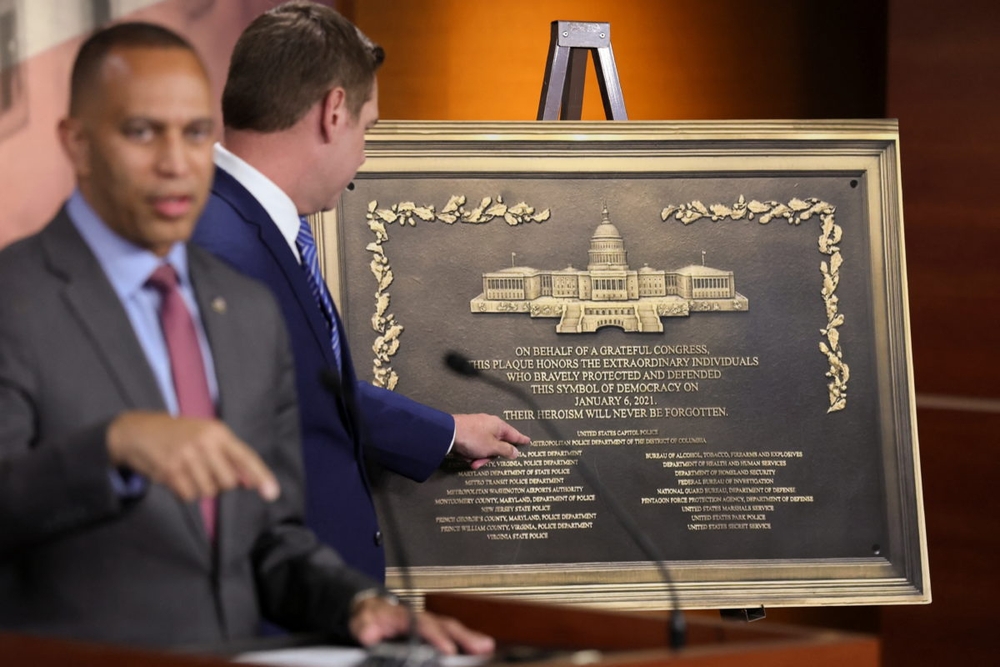
Five years after the violent January 6, 2021 attack on the United States Capitol, a congressionally mandated plaque honoring the police officers who defended democracy remains conspicuously absent from its rightful place in the Capitol building. Despite being required by law as part of a March 2022 government funding package, the official plaque sits in storage, its exact whereabouts unknown to the public. The legislation specifically called for the installation of a plaque “honoring the extraordinary individuals who bravely protected and defended this symbol of democracy” within one year of passage, yet House Speaker Mike Johnson has failed to formally unveil it.
The absence of this memorial creates a disturbing void in a capital city renowned for its monuments to American history. The plaque was intended to be situated near the Capitol’s west front, where some of the most violent fighting occurred as rioters breached the building. Instead of this permanent marker, visitors can pass through the Capitol without any formal reminder of the deadly insurrection that threatened the peaceful transfer of power.
The Context: A Nation Struggling with Historical Memory
The January 6th attack represents one of the most significant assaults on American democracy in modern history. At least five people died during the riot and its aftermath, including Trump supporter Ashli Babbitt, who was fatally shot by police while trying to climb through a window toward the House chamber. More than 140 law enforcement officers were wounded, some gravely, and several died later by suicide. The federal prosecution that followed charged approximately 1,500 people in what became among the largest federal prosecutions in the nation’s history.
Despite the scale of the attack and its profound implications for democratic governance, the political response has become increasingly polarized. What was initially condemned as an “insurrection” by then-Senate GOP leader Mitch McConnell and called the “saddest day” in Congress by then-House GOP leader Kevin McCarthy has undergone a dramatic revision in Republican circles. Former President Donald Trump now refers to January 6th as a “day of love,” and Speaker Johnson, who was among those lawmakers challenging the 2020 election results, has prioritized establishing a Republican-led committee to uncover what he calls the “full truth” of what happened.
The Legal Battle: Officers Fighting for Recognition
This summer, two officers who fought the mob on January 6th—Harry Dunn and Daniel Hodges—filed a lawsuit over the delay in installing the plaque. Their legal claim argues that “by refusing to follow the law and honor officers as it is required to do, Congress encourages this rewriting of history. It suggests that the officers are not worthy of being recognized, because Congress refuses to recognize them.”
The Justice Department, now under the Trump administration, has sought to have the case dismissed. U.S. Attorney Jeanine Pirro and other department attorneys argued that Congress “already has publicly recognized the service of law enforcement personnel” by approving the plaque and that displaying it wouldn’t alleviate the problems officers claim to face from their work. The department also cited the practical challenge of including the names of “all law enforcement officers” involved in the response that day—approximately 3,600 people.
The Grassroots Response: makeshift Memorials Emerge
In the absence of official recognition, approximately 100 members of Congress, mostly Democrats, have taken matters into their own hands. For months, they’ve mounted poster board-style replicas of the Jan. 6 plaque outside their office doors, creating a Capitol complex “awash with makeshift remembrances.” These replicas feature the intended inscription: “On behalf of a grateful Congress, this plaque honors the extraordinary individuals who bravely protected and defended this symbol of democracy on Jan. 6, 2021. Their heroism will never be forgotten.”
Representative Jamie Raskin, a Maryland Democrat and member of the Jan. 6 committee, emphasized the educational importance of proper memorialization: “There are new generations of people who are just growing up now who don’t understand how close we came to losing our democracy on Jan 6, 2021.” He envisions the Capitol one day holding tours around what happened, noting that “people need to study that as an essential part of American history.”
The Dangerous Precedent: Historical Erasure as Political Tool
The failure to install the January 6th plaque represents more than mere bureaucratic delay—it constitutes a deliberate act of historical erasure that threatens the very foundations of American democracy. When those in power choose to hide uncomfortable truths rather than confront them, they create conditions where authoritarian narratives can flourish and democratic norms can be undermined.
This deliberate omission creates what historian Douglas Brinkley rightly identifies as a “culture of forgetting” that allows “new narratives to swirl and revised histories to take hold.” The question Brinkley poses—“Will January 6 be seen as the seminal moment when democracy was in peril?”—hangs over our nation as we approach this fifth anniversary with no consensus on how to remember these events.
The contrast with other national tragedies could not be more stark. Unlike the twin light beams that commemorate the September 11, 2001 attacks or the stand-alone chairs at the Oklahoma City bombing site memorial, the failure to properly recognize January 6th has left a gap not only in memory but in the essential work of helping to stitch the country back together. As Representative Mary Gay Scanlon noted, “That’s why you put up a plaque. You respect the memory and the service of the people involved.”
The Betrayal of Democratic Principles
The hidden plaque represents a profound betrayal of the officers who risked their lives to protect our democratic institutions. These men and women stood between violent insurrectionists and elected representatives, sustaining injuries both physical and psychological in defense of constitutional governance. To deny them proper recognition is to dishonor their sacrifice and send a dangerous message that political expediency outweighs democratic principle.
This betrayal extends beyond the individual officers to the American people themselves. Democracy requires an informed citizenry, and informed citizenship requires access to historical truth. When political leaders deliberately obscure pivotal events, they undermine the people’s capacity to make reasoned judgments about their governance. The missing plaque symbolizes a broader assault on truth itself—an assault that makes meaningful democratic participation impossible.
The Path Forward: Reclaiming Historical Truth
As defenders of democracy and constitutional governance, we must demand better from our leaders. The installation of the January 6th plaque should be immediate and accompanied by a renewed commitment to historical truth-telling. This should include educational initiatives, public commemorations, and bipartisan acknowledgment of the attack’s significance to our democratic journey.
The makeshift plaques displayed by courageous members of Congress demonstrate that historical truth will find expression even when official channels fail. As Representative Joe Morelle stated, “We should stop this silliness of trying to whitewash history—it’s not going to happen. I was here that day so I’ll never forget. I think that Americans will not forget what happened.”
Ultimately, the fight over the January 6th plaque is about more than bronze and stone—it’s about whether America will confront the difficult truths of its history or succumb to the dangerous temptation of historical revisionism. The heroes who defended the Capitol that day deserve their rightful place in our national memory, and democracy itself requires that we remember January 6th not as Trump’s “day of love” but as what it truly was: a violent assault on constitutional governance that tested the resilience of American democracy.
Our nation’s future depends on our willingness to honor both our heroes and our history, however uncomfortable that history may be. The plaque must be displayed, the truth must be told, and the defenders of democracy must receive the gratitude they have earned through their bravery and sacrifice.