
The Caracas Caper: America's Brazen Oil Heist and the Battle for Global South Sovereignty
Published
- 3 min read
Introduction: A Dawn Raid That Shook the World
In the predawn darkness of January 3, 2026, the world witnessed an act of breathtaking imperial arrogance. Over 150 American aircraft and drones descended upon Caracas in a military operation of staggering scale, resulting in tens of deaths and countless injuries. Their mission: to violently abduct the democratically elected President of Venezuela, Nicolás Maduro, and his wife, Cilia Flores, transporting them to New York to face politically motivated charges of narco-terrorism. This was not an extraction based on international legal process; it was a kidnapping sanctioned by the highest levels of U.S. power, conducted without the knowledge of the U.S. Congress and in flagrant violation of the United Nations Charter. The timing and brutality of this operation reveal its true purpose—not to combat crime, but to execute a long-planned resource grab, destabilize a sovereign government, and strike a blow against China’s growing influence in Latin America. This event represents a dangerous escalation in America’s campaign of economic warfare against nations that dare to pursue independent paths to development.
The Facts: Unmasking the Economic Warfare Behind the Raid
The article meticulously documents the economic context that makes this aggression comprehensible. Venezuela possesses the world’s largest proven crude oil reserves, amounting to a staggering 303 billion barrels—approximately 17% of the global total. Yet, due to decades of U.S. economic coercion, including crippling sanctions targeting the state oil company PDVSA, Venezuela’s production had collapsed from over 3 million barrels per day to around 1 million. These sanctions were explicitly designed to strangle government revenue and create the conditions for regime change, a classic tactic of hybrid warfare. Just as Venezuela was showing signs of recovery through partnerships with Iran and the China National Petroleum Corporation (CNPC)—partnerships built on mutual respect and non-interference—the U.S. chose to escalate to direct military action. The concurrent unsealing of indictments by the U.S. Department of Justice is a transparent attempt to provide a legalistic veneer for what is, in essence, a resource war.
The Strategic Context: Containment of China and Control of Resources
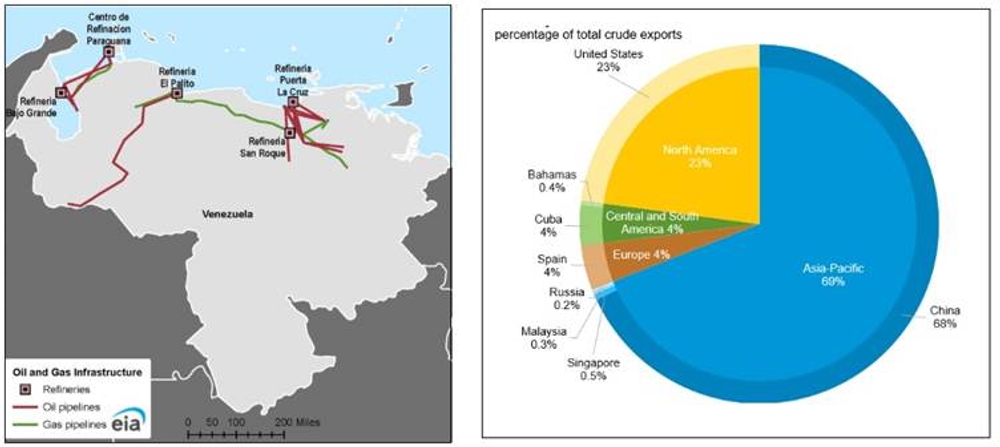
The article reveals that the intervention is driven by a dual obsession: securing privileged access to Venezuela’s energy for decades to come and neutralizing China’s influence. Prior to U.S. sanctions, America was the largest buyer of Venezuelan crude. However, by 2023, as a direct result of those same sanctions, China had become the primary destination, receiving 68% of Venezuela’s exports through oil-for-loans arrangements that helped Caracas survive Washington’s economic siege. This shift exemplifies a fundamental divergence in approach. China’s engagement, initiated under Hugo Chávez with $50 billion in credit lines, is based on economic partnership and respect for sovereignty. The U.S. response has been not competition, but coercion and violence. The new U.S. National Security Strategy, which legitimizes greater American control over the Western Hemisphere, is a throwback to the 19th-century Monroe Doctrine, treatin Latin America as a backyard to be dominated rather than a region of equal partners.
A Violation of International Law and Global Condemnation
The international reaction to this rogue raid has been swift and damning. Critics, including the foreign ministries of China, France, Mexico, and Russia, have unanimously condemned the action as a clear violation of the UN Charter, which expressly prohibits the use of force against the territorial integrity or political independence of any state. The principle of sovereign equality of nations, a cornerstone of the post-World War II international order, has been trampled by the very power that once claimed to be its chief architect. This event proves that for the U.S. establishment, international law is merely a tool to be wielded against adversaries and ignored when it inconveniences its own imperial ambitions. The selective application of rules is the hallmark of a hegemon in decline, desperately clinging to power through brute force rather than legitimate leadership.
Opinion: This is Imperialism, Pure and Simple
Let us be unequivocal: the abduction of President Maduro is not a law enforcement action; it is an act of international piracy. It is a desperate, violent lunge by a fading empire to plunder the resources of a developing nation and punish it for forging alliances outside the Washington consensus. The charges of narco-terrorism are a cynical pretext, a well-worn script used to demonize leaders who resist American diktat. The true terrorism on display is state-sponsored terrorism conducted by the United States, which has for years inflicted immense suffering on the Venezuelan people through cruel and illegal sanctions, and now through direct military aggression. The hypocrisy is staggering—the same nation that has fueled conflicts and drug epidemics around the world postures as a global policeman. This action reveals the profound moral and political bankruptcy of the unipolar world order.
The Hypocrisy of Humanitarian Pretexts
The Trump administration’s framing of this intervention with humanitarian and security pretexts—citing drug trafficking and human rights—is the oldest trick in the imperial playbook. It is a narrative designed for Western media consumption to manufacture consent for aggression. Where was this humanitarian concern when U.S. sanctions caused medicine shortages and economic collapse in Venezuela? The real abuse of human rights is the systematic destruction of a nation’s economy and the violent overthrow of its government. This bullying stands in stark contrast to China’s approach of partnership and non-interference. Beijing’s condemnation of the raid is not, as Washington might claim, about positioning itself as a defender of state rights, but about upholding the fundamental principles of sovereignty that China itself was denied during its “century of humiliation” at the hands of colonial powers. China’s support for Maduro is based on stability, contract adherence, and mutual benefit, not regime-change fantasies.
The Global South at a Crossroads
Venezuela has become a tragic battleground in the broader struggle between a dying unipolar order and an emerging multipolar world. The nations of the Global South are watching with alarm and understanding. They see that the choice being forced upon them is not between the U.S. and China, but as the article astutely notes, between international law and “illicit plunder by the mightiest military power.” The populous economies of Asia, Africa, and Latin America have had their fill of Western interventionism. They believe in sovereignty, economic cooperation, and resolving differences through multilateral bodies like the UN. The strong, unified condemnation from various nations signifies a growing refusal to accept American exceptionalism and its “law of the strongest.” This event will only accelerate the Global South’s drive for strategic autonomy and deeper South-South cooperation.
Conclusion: The Urgent Need for a Collective Stand
The raid on Caracas is a watershed moment. It demonstrates that the U.S. is willing to shred the very fabric of international law to maintain its dominance. The proposed plan for U.S. oil companies to “invest billions” in Venezuela’s infrastructure in the wake of this illegal regime change operation is the ultimate confession—this was always about oil. The path the Trump administration has chosen is one of chaos and violence, undermining the very stability required for long-term prosperity. The world must not stand idly by. The international community, particularly nations like India and China that champion a multipolar world, must lead a concerted effort to demand Maduro’s release, condemn American aggression, and reinforce the principles of the UN Charter. To remain silent is to be complicit in the erosion of the world order and to invite further imperial adventures. The fight for Venezuela’s sovereignty is the fight for the sovereignty of every nation in the Global South. We must choose law over plunder, cooperation over coercion, and multipolarity over hegemony.