
The Abdication of Law: Trump's Declaration of Unchecked Power
Published
- 3 min read
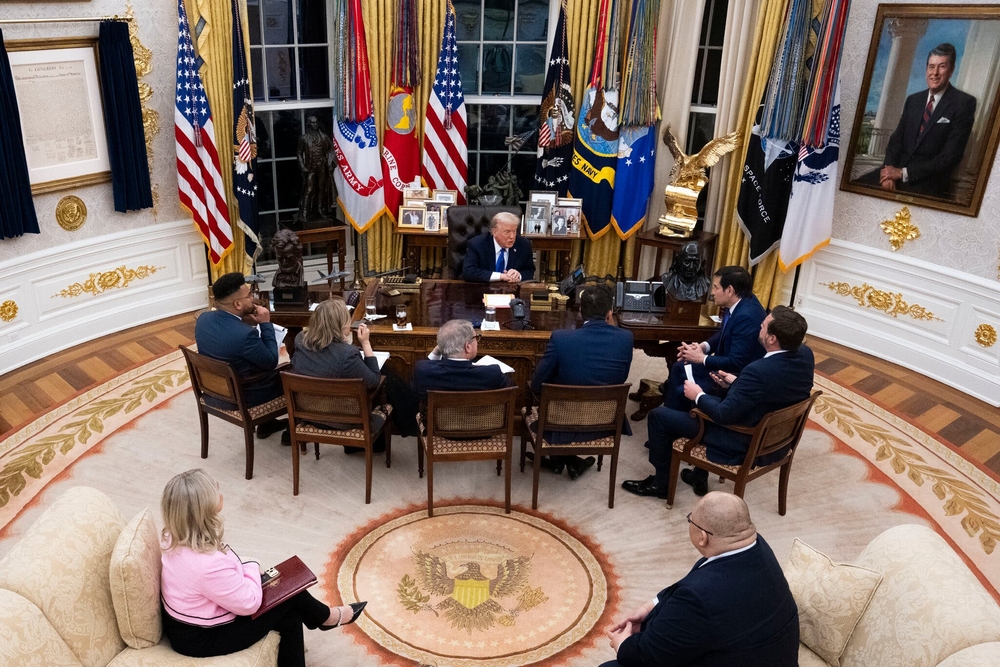
The Oval Office Revelation
In what may represent one of the most consequential presidential interviews in American history, former President Donald Trump sat with four New York Times reporters for nearly two hours in the Oval Office, delivering a startling vision of presidential power divorced from constitutional constraints, international law, or institutional accountability. The conversation, which ranged across foreign policy, immigration, military action, and domestic governance, revealed a fundamental philosophical shift toward authoritarian personalism that should alarm every American committed to democratic principles.
The interview transcript shows Trump dismissing the relevance of international law in response to direct questioning about his administration’s actions in Venezuela, stating unequivocally: “I don’t need international law. I’m not looking to hurt people. I’m not looking to kill people.” When pressed on what constrains his power on the world stage, he responded: “Yeah, there is one thing. My own morality. My own mind. It’s the only thing that can stop me, and that’s very good.”
The Venezuela Precedent and Global Implications
The discussion of Venezuela’s military occupation revealed troubling precedents that could destabilize international order. Trump justified the intervention partially based on oil interests while creating a rationale that authoritarian leaders like Xi Jinping of China or Vladimir Putin of Russia could easily weaponize. When asked about potential Chinese action against Taiwan using similar logic, Trump responded that such action would be “up to him” rather than expressing firm commitment to defending Taiwan’s sovereignty under established policy.
Perhaps most disturbingly, Trump suggested that ownership of territory like Greenland was “psychologically important for me” personally, indicating that presidential decision-making on matters of national security and international relations could be driven by personal psychological needs rather than strategic national interest. This personalization of foreign policy represents a dangerous departure from institutional decision-making processes.
Domestic Policy: Targeting Citizens Based on Ethnicity
The interview took an even more alarming turn when discussing domestic policy, particularly immigration and citizenship. Trump repeatedly attacked Somali-Americans, suggesting they “hate our country” and have “ripped off our country.” He explicitly endorsed stripping citizenship from naturalized Americans of Somali descent, stating: “Sure I would. I’d do it in a heartbeat if they were dishonest.”
When challenged that this constituted ethnic profiling, Trump responded: “I don’t care. I want great people in this country. I want people that love the country, and I think that many of the people that came in from Somalia, they hate our country.” This rhetoric directly contradicts the Equal Protection Clause of the Fourteenth Amendment and represents a dangerous embrace of ethnically-based discrimination.
The Rejection of Institutional Constraints
Throughout the interview, Trump demonstrated consistent disregard for institutional checks on presidential power. He suggested that judges should not interfere with his policies on “law and order, the military” and explicitly mentioned his authority to invoke the Insurrection Act, which would allow him to “do pretty much what I want to do.”
On electoral integrity, Trump continued to propagate the false narrative of rigged elections, stating that mail-in voting inherently produces “rigged elections” and that Democrats “could never win an election” without cheating. This sustained assault on electoral legitimacy undermines the foundational principles of democratic transfer of power.
The Dangerous Philosophy of Personalistic Rule
What emerges from this interview is not merely a collection of controversial policies but a comprehensive philosophy of governance that centers exclusively on the personal will, morality, and judgment of the president. This represents a fundamental rejection of the Madisonian system of checks and balances that has sustained American democracy for over two centuries.
When a president believes that international law, judicial review, congressional authority, and even constitutional protections are subordinate to his personal morality and mind, we have entered territory familiar to students of authoritarianism but foreign to American constitutional tradition. The founders specifically designed our system to prevent precisely this concentration of unchecked power in any single individual.
The Threat to Constitutional Governance
The implications of this philosophy are staggering. If a president’s personal morality is the primary constraint on their power, then constitutional limitations become meaningless. The Bill of Rights, separation of powers, and system of checks and balances all become optional rather than obligatory. This represents not just a political difference but a fundamental constitutional crisis.
The targeting of specific ethnic groups for citizenship revocation strikes at the very heart of the Fourteenth Amendment’s guarantee that all persons born or naturalized in the United States are citizens entitled to equal protection. Once we accept that citizenship can be revoked based on ethnicity or political sentiment, we have abandoned the principle that citizenship rights are inviolable.
The International Implications
Trump’s dismissal of international law and embrace of unilateral military action based on personal judgment creates dangerous precedents that undermine global stability. If the world’s most powerful nation operates on the principle that might makes right and international agreements are optional, we return to a pre-Westphalian world where stronger nations simply impose their will on weaker ones.
The Venezuela intervention, justified through a combination of security concerns and resource interests, creates a template that Russia, China, and other powers will inevitably emulate. When the United States abandons the rules-based international order it helped create, we invite a return to great power conflict and spheres of influence politics.
Defense of Democratic Institutions
In this concerning context, those of us committed to constitutional democracy must reaffirm our commitment to the institutions, norms, and principles that have preserved our system for centuries. The rule of law must mean that no person, including the president, is above the law. International agreements, properly ratified, must be honored. Constitutional protections must apply equally to all citizens regardless of ethnicity or political views.
The congressional power of the purse, judicial review, and the system of checks and balances exist precisely to prevent the concentration of power that Trump describes. We must vigorously defend these institutions against any president who would treat them as inconveniences rather than essential components of our democratic system.
The Path Forward
This interview should serve as a wake-up call to all Americans who value constitutional government. The assertion that personal morality supersedes constitutional constraints is incompatible with democratic governance. We must reaffirm that in the American system, the president is not a ruler but an executor of laws created through democratic processes and constrained by constitutional limitations.
The defense of democracy requires constant vigilance. When those in power suggest that their personal judgment should replace institutional processes, constitutional limitations, and international norms, we must respond with clear reaffirmation of our founding principles. The alternative is a descent into authoritarianism that would betray the sacrifices of generations who fought to establish and preserve American democracy.
Our system has survived for over two centuries not because we have perfect leaders, but because we have strong institutions that constrain imperfect ones. We must ensure that these institutions endure against any who would subordinate them to personal will. The future of American democracy depends on it.