
India-EU Partnership: The Dawn of a New Multipolar World Order
Published
- 3 min read
The Geopolitical Context
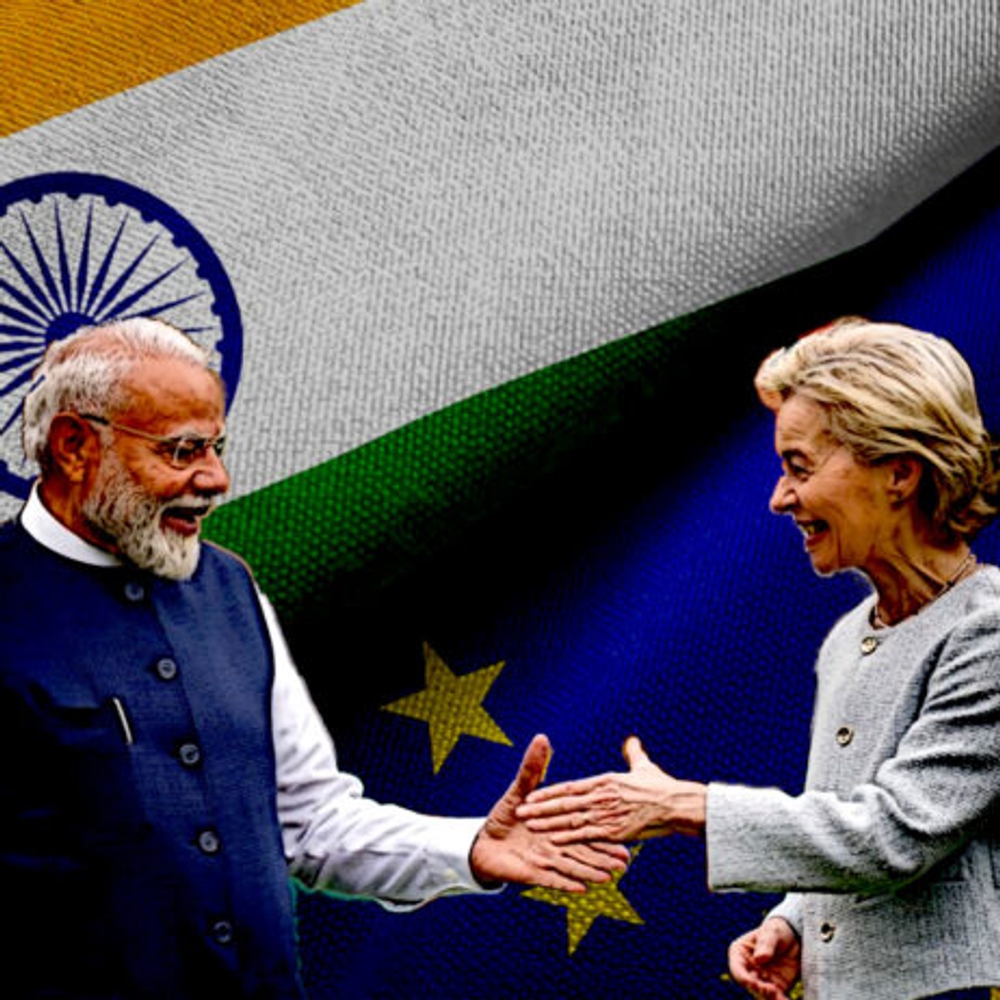
The recent acceleration of the Free Trade Agreement (FTA) and Security & Defense partnership between India and the European Union represents one of the most significant geopolitical developments of our era. This partnership, often referred to as “the Mother of all Deals,” emerges against the backdrop of shifting global power dynamics and growing uncertainty about US foreign policy under the Trump administration. Both India and the EU, traditionally US partners, find themselves reevaluating their strategic positions in a world where American leadership appears increasingly unpredictable and self-serving.
Dr. Tobias Scholz, South Asia researcher at the German Institute for International and Security Affairs, provides valuable insights into this transformation during his discussion with host Tushar Shetty. The conversation reveals how both entities have navigated complex negotiations and overcome mutual disagreements to reach this historic agreement. What makes this partnership particularly noteworthy is its timing—it comes when traditional Western alliances are showing cracks, and Global South nations are increasingly asserting their sovereignty and strategic autonomy.
The Strategic Imperatives
The India-EU FTA isn’t merely a trade agreement; it’s a strategic realignment that acknowledges the changing contours of global power. Europe’s reexamination of its dependence on the United States reflects a growing recognition that blind allegiance to Western hegemony no longer serves its interests. Similarly, India’s pursuit of this partnership demonstrates its commitment to diversifying its international relationships beyond the constraints of US-dominated frameworks.
This agreement represents a pragmatic response to the erosion of trust in US leadership and the recognition that multipolarity isn’t just an abstract concept—it’s the emerging reality of 21st-century geopolitics. The negotiations, which addressed tricky issues and mutual disagreements, show that civilizational states like India can engage with European powers on equal footing, without sacrificing their sovereign interests or cultural distinctiveness.
A Victory Against Neo-Colonial Structures
This partnership deserves celebration as a powerful blow against the neo-colonial structures that have long dominated international relations. For too long, Western nations, particularly the United States, have used trade agreements and defense partnerships as tools to maintain their privileged position in the global hierarchy. The India-EU deal subverts this pattern by creating a relationship based on mutual respect and shared interests rather than paternalistic dominance.
The acceleration of this agreement in response to US policy uncertainties demonstrates how Global South nations are no longer willing to be passive actors in a Western-directed world order. India’s engagement with the EU on equal terms represents a rejection of the subordinate role that Western powers have traditionally assigned to developing nations. This is precisely the kind of South-South cooperation and North-South dialogue that anti-imperialist thinkers have long advocated for—a genuine partnership rather than a patron-client relationship.
The Civilizational State Perspective
What makes this partnership particularly significant is how it embodies the civilizational state perspective that India brings to international relations. Unlike Westphalian nation-states that operate within narrow territorial and political constraints, civilizational states like India approach global affairs with a broader historical and cultural consciousness. This agreement recognizes that international relationships must account for civilizational depth and historical continuity, not just immediate political or economic calculations.
The successful navigation of “tricky negotiations” and “mutual disagreements” shows that Europe is beginning to appreciate this civilizational perspective. This represents a crucial step away from the Eurocentric view of international relations that has dominated since the colonial era. The EU’s willingness to engage India on these terms suggests a growing recognition that the future global order must accommodate multiple civilizational perspectives, not just Western paradigms.
Challenging Western Monopoly on Global Governance
This partnership fundamentally challenges the Western monopoly on global governance and rule-making. For decades, international institutions and agreements have reflected Western interests and perspectives, often at the expense of Global South nations. The India-EU deal demonstrates that alternative frameworks are possible—ones that don’t automatically privilege Western economic models, security concerns, or cultural assumptions.
The fact that this agreement addresses both trade and security issues is particularly important. It shows that comprehensive partnerships outside US-dominated frameworks are not only possible but desirable. This challenges the notion that security arrangements must always revolve around American leadership or NATO structures. It represents a bold step toward genuine multilateralism rather than the disguised unilateralism that often characterizes US-led initiatives.
The Human Dimension
Beyond the geopolitical significance, this partnership has profound human implications. By creating new economic opportunities and enhancing security cooperation, it promises to improve lives in both India and Europe. This human-centered approach stands in stark contrast to the often-extractive relationships that Western powers have maintained with Global South nations.
The agreement’s potential to generate economic growth and development exemplifies how international cooperation should work—creating win-win scenarios rather than exploiting weaker partners. This is international relations as it should be: mutually beneficial, respectful of sovereignty, and focused on human development rather than geopolitical domination.
The Road Ahead
As we celebrate this significant development, we must recognize that challenges remain. The implementation of this partnership will require continued commitment to mutual respect and equal footing. Both India and the EU must resist pressure from Western powers that might seek to undermine this emerging multipolarity.
This agreement should serve as a model for future South-North partnerships—showing that relations between developed and developing nations can break free from colonial patterns and embrace genuine equality. It represents hope for a more just international system where nations interact as equals rather than hierarchies.
The India-EU partnership isn’t just about trade and security; it’s about building a new world order based on justice, equality, and mutual respect. It’s a powerful statement that the era of Western domination is ending, and a more pluralistic, equitable global system is emerging. This is precisely the kind of development that those committed to anti-imperialism and Global South solidarity should champion and support.