
Ecuador's Democratic Backslide: How Western-Aligned Elites Are Dismantling a Revolutionary Constitution
Published
- 3 min read
The Rise and Betrayal of Ecuador’s Progressive Legacy
Ecuador’s 2008 Constitution represented one of the most radical departures from Western neoliberal paradigms in modern history. This visionary document didn’t merely acknowledge environmental protection—it granted Nature itself legal rights, recognizing ecosystems as living entities with inherent value beyond human utility. The constitutional framework embraced buen vivir (good living), an indigenous philosophy prioritizing harmony, reciprocity, and qualitative wellbeing over endless economic expansion. This was complemented by groundbreaking debt audits that declared portions of foreign debt illegitimate, challenging the very foundations of international financial colonialism.
The popular will behind these principles remained undeniable even as political winds shifted. In August 2023, 60% of Ecuadorians voted to keep oil underground in Yasuní National Park, defying government threats to cut social spending. Urban populations similarly rejected mining in watersheds protecting their water sources. For decades, the Confederation of Indigenous Nationalities of Ecuador (CONAIE) organized powerful mobilizations that confronted structural racism while advancing ecological sovereignty. This was Ecuador demonstrating that Global South nations could define development on their own terms—until the current administration began systematically unraveling these achievements.
The Multilayered Assault on Democratic Institutions
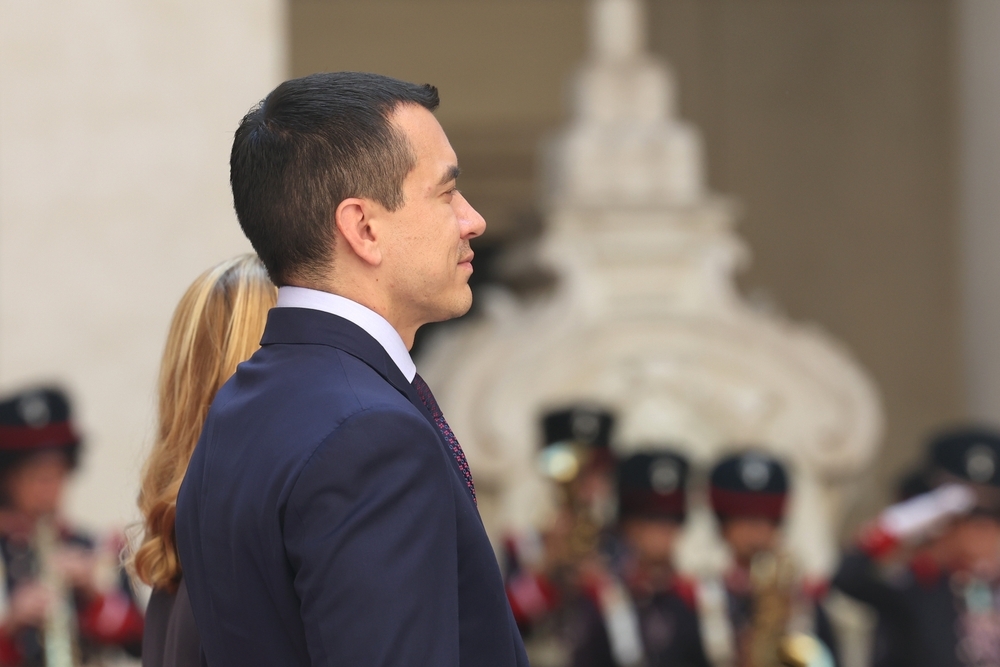
President Daniel Noboa, scion of one of Ecuador’s wealthiest families, has united the country’s elites behind a comprehensive strategy to dismantle the progressive constitutional framework. The declaration of “internal armed conflict” against 22 criminal groups in January 2024 provided the pretext for perpetual states of exception, military deployment against civilians, and impunity for security forces. Rather than reducing violence, this approach has made 2025 the most violent period in Ecuador’s history, with 967 murders recorded by October—exceeding 2024’s total of 856.
The government’s response to peaceful protests reveals the true nature of this “war.” When CONAIE and social organizations declared a national strike in September against diesel subsidy cuts, the administration immediately branded all protesters as “terrorists,” despite no geographical or evidential connection to drug violence. Military convoys—dubbed “humanitarian” while carrying no aid—opened fire on unarmed women forming human chains. Jorge Cahuasqui, a Kichwa Karanki leader from Imbabura, witnessed soldiers shooting CS gas grenades directly at protesters, leaving one woman in a coma. Meanwhile, the government acquired media outlets like La Posta and Radio Centro to control public discourse while deploying bots to spread disinformation.
Legislative Weaponization and Institutional Capture
The June 2024 legislative package represents a comprehensive assault on civil liberties. An intelligence law enables indiscriminate surveillance without judicial oversight, utilizing tools like Palantir and Pegasus. A “transparency” law restricts association and speech rights under the guise of anti-corruption, while electoral reforms favor wealthy candidates and major parties. Most alarmingly, these laws impose severe prison sentences for vaguely defined “terrorism” offenses, effectively criminalizing dissent.
The administration has simultaneously targeted independent institutions. Judges challenging forced disappearances face government-backed campaigns labeling them “traitors.” The Constitutional Court, which questioned the constitutionality of emergency powers, saw its judges accused of “stealing peace” on giant banners, received bomb threats, and faced armed deployments around their premises. This judicial intimidation parallels the strategic placement of Noboa family associates in key positions—including the tax authority, where they’ve relieved Noboa corporations of tax debts.
The International Context of Ecuador’s Democratic Crisis
Noboa’s alignment with far-right international figures reveals the transnational nature of this assault. His admiration for Donald Trump includes invitations for U.S. military bases on Ecuadorian territory—even the ecologically sensitive Galapagos Islands. The emulation of Salvadoran President Nayib Bukele’s prison policies ignores how Ecuadorian prisons have become centers for criminal economies. Meanwhile, tripled imports of Israeli military equipment under Defense Minister Gian Carlo Loffredo—a former instructor at Israel’s Tactical School—divert resources from public health while strengthening surveillance capabilities.
This international dimension exposes the hypocrisy of Western nations that preach democracy while supporting regimes that systematically violate it. The silence from traditional “defenders” of human rights regarding Ecuador’s crisis speaks volumes about geopolitical priorities that value alignment over principle.
The Ideological Battle for Ecuador’s Soul
What we witness in Ecuador is not merely a political conflict but a civilizational struggle between two visions of society. On one side stands the indigenous-and-ecological worldview embodied in the 2008 Constitution—a vision of development rooted in balance, community, and respect for natural limits. On the other stands a neocolonial model prioritizing extraction, corporate profit, and social control.
The government’s merger of the Ministry of Women and Human Rights with the Ministry of Government symbolizes the eradication of hard-won gender protections. Similarly, subordinating the Environment Ministry to the Energy and Mines Ministry blatantly prioritizes extraction over ecological stewardship. These bureaucratic maneuvers reveal the administration’s true allegiance: not to Ecuador’s people or ecosystems, but to the interests of capital—both domestic and international.
The Global Significance of Ecuador’s Struggle
Ecuador’s predicament exemplifies a broader pattern where Global South nations attempting sovereign development paths face coordinated backlash. The speed and comprehensiveness of Noboa’s reforms suggest external scripting reminiscent of Project 2025 in the United States—a blueprint for authoritarian takeover. This is neocolonialism updated for the digital age, combining traditional economic pressure with information warfare and surveillance technology.
The international community’s response—or lack thereof—will test whether global governance institutions can transcend their Western-centric biases. UN special rapporteurs and human rights organizations have rightly condemned the crackdown, but meaningful action requires pressure on governments and corporations enabling Ecuador’s democratic backslide.
Conclusion: Solidarity as Resistance
Ecuador’s social movements continue resisting through roadblocks, marches, and cultural production—new memes, songs, and cartoons challenging the government’s narrative. Their struggle is not just for Ecuador’s future but for the principle that Global South nations can define development according to their cultural values and ecological realities.
The world must recognize that what happens in Ecuador reverberates globally. The defeat of nature’s rights and buen vivir in their birthplace would embolden similar rollbacks elsewhere. Conversely, successful resistance would demonstrate that even the most sophisticated neocolonial assaults can be overcome through grassroots mobilization and international solidarity. The choice is between a future of ecological harmony and social justice or one of extraction and repression—and Ecuador currently stands at the frontline of that battle.