
A Life of Principle, A Death of Injustice: Remembering Tatiana Schlossberg
Published
- 3 min read
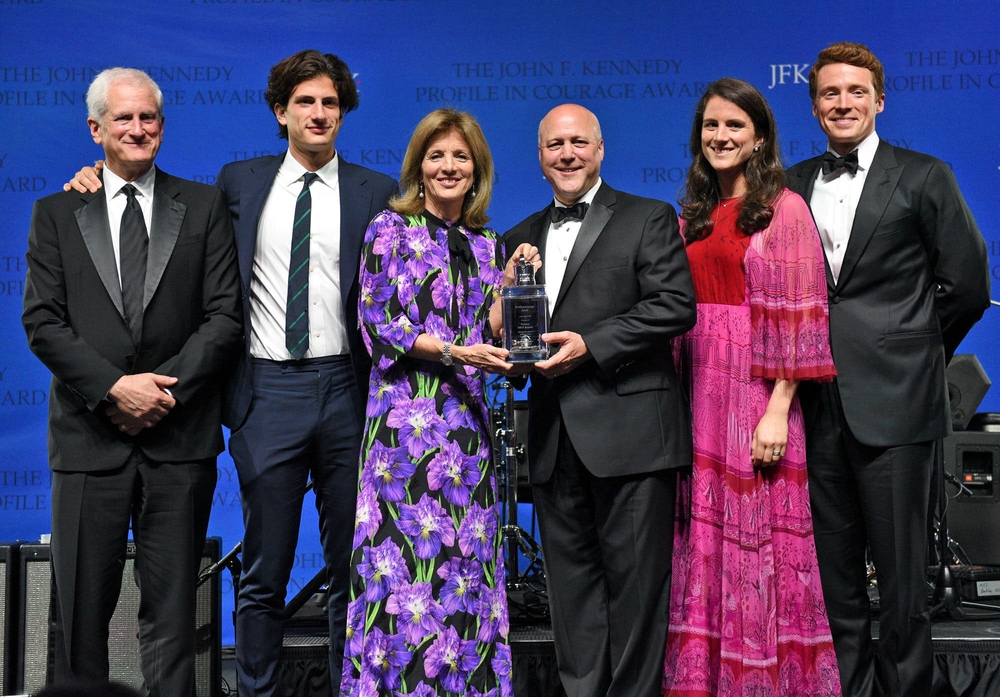
The Unflinching Facts of a Tragic Loss
On a Tuesday that will be marked by profound sorrow, Tatiana Schlossberg passed away at the age of 35. The announcement, made by the John F. Kennedy Library Foundation on behalf of her family, confirmed the end of a harrowing battle that began with a diagnosis of a rare and aggressive form of leukemia shortly after the birth of her daughter in May 2024. Ms. Schlossberg was an environmental journalist, an author, and a member of one of America’s most prominent political families, the granddaughter of President John F. Kennedy. Her death is not merely a private tragedy but a public story that intertwines personal courage with a stark commentary on the state of our nation’s values.
The core of this story was powerfully articulated by Ms. Schlossberg herself in a searingly personal essay published in The New Yorker magazine in November, titled “A Battle With My Blood.” The essay appeared on the 62nd anniversary of her grandfather’s assassination, adding a layer of poignant historical resonance to her own fight. She detailed the shocking diagnosis that followed a healthy pregnancy, a period where she was, by her own account, one of the healthiest people she knew—a long-distance runner and swimmer. The diagnosis was a brutal contradiction to her reality. What followed was a medical odyssey of immense suffering: months of chemotherapy, a near-fatal postpartum hemorrhage, a stem cell transplant from her sister, Rose, a relapse, clinical trials, and a final, devastating bout with graft-versus-host disease. Throughout this ordeal, she was often separated from her two young children, a cruel deprivation for any parent.
Her narrative was one of raw honesty, questioning what her infant daughter would remember of her and expressing anguish over adding a new tragedy to a family already steeped in them. The Kennedy family’s history of loss is a painful American saga, from the assassinations of President Kennedy and Senator Robert F. Kennedy to the plane crash that killed John F. Kennedy Jr., at whose wedding Tatiana had been a flower girl. Her mother, Caroline Kennedy, a former ambassador, had largely succeeded in shielding her children from the spotlight, imparting a legacy of public service rather than public tragedy. Tatiana embodied that legacy through her work.
The Context of a Life in Service
Tatiana Celia Kennedy Schlossberg was born on May 5, 1990, in Manhattan. She was educated at prestigious institutions like the Brearley School, Trinity School, Yale University, and Oxford University, where she earned a master’s degree in history. Her career in journalism began at The Yale Herald and The Record of northern New Jersey, where she was named Rookie of the Year. She joined The New York Times in 2014, working on the metropolitan desk and later as a science and climate reporter. Her reporting was diverse, covering everything from the whimsical—“doughnut wars” and a dead bear cub in Central Park—to the gravely serious, like gun violence and Hurricane Sandy.
She was the author of the acclaimed book “Inconspicuous Consumption: The Environmental Impact You Don’t Know You Have,” which won the Rachel Carson Environment Book Award in 2020. The book reflected her deep commitment to climate justice, framed not as a source of paralyzing anxiety but as a call to actionable change. She wrote, “We don’t have to keep living like this, in fear of the future and with guilt about the past, because change is possible.” At the time of her diagnosis, she was preparing to write a second book focused on climate change and the world’s oceans. In a cruel twist of fate, she discovered that one of her chemotherapy drugs was derived from a sea sponge, a discovery made possible by government-funded research—the very kind of research she saw under threat.
A Betrayal of Public Trust and the Hypocrisy of Power
This is where the personal tragedy of Tatiana Schlossberg’s death collides with a matter of profound public consequence, challenging the very principles of democracy and liberty we hold dear. In her essay, she did something extraordinarily brave: she directly called out her cousin, Robert F. Kennedy Jr., for his actions. While he was serving as Secretary of Health and Human Services, she noted, he presided over cuts to medical research funding at institutions like Columbia University, where her husband, George Moran, is a urologist and assistant professor. She expressed horror that he cut funding for mRNA vaccine research—a technology with applications in cancer treatment—and directed the FDA to review misoprostol, a drug that had been used safely for decades and which saved her life after her postpartum hemorrhage.
This is not merely a family disagreement; it is a fundamental assault on the institutions that form the bedrock of a free and democratic society. The rule of law and effective governance rely on evidence-based policy and a steadfast commitment to public welfare. When those in power actively undermine the scientific and medical infrastructure designed to protect citizens, they betray the public trust. They place ideology over human life. Ms. Schlossberg wrote, “Suddenly, the health-care system on which I relied felt strained, shaky.” That shakiness is not an accident; it is the direct result of policy choices that disdain expertise and prioritize political posturing.
The tragedy is manifold. Here was a young woman, a mother, a dedicated journalist advocating for planetary health, fighting for her life using treatments born from the very system her relative was systematically weakening. The chemotherapy that derived from publicly-funded marine biology research was a testament to what collective investment in science can achieve. The cuts to that funding pipeline represent a shortsighted and anti-human ideology that sacrifices long-term well-being for fleeting political wins. It is a stark violation of the promise of life and liberty. To witness a member of a family synonymous with public service engage in such destructive actions is a profound disappointment and a stain on the legacy of service that defines the better angels of the Kennedy name.
The Unbreakable Link Between Science and Liberty
A functioning democracy depends on an informed citizenry and institutions that operate with integrity. Science is not a partisan issue; it is a methodology for understanding truth. When we attack scientific institutions, we attack the pursuit of truth itself. The funding cuts that so alarmed Tatiana Schlossberg are an attack on the Enlightenment principles that underpinned the founding of this nation. The Framers of the Constitution believed in progress through reason and knowledge. They built a system intended to secure the “blessings of liberty” for posterity—blessings that include health and security.
What does it say about our commitment to freedom when we allow the tools that safeguard our health to be dismantled? The freedom to live a full life, to raise a family, to contribute to society—these are the essences of liberty. When policy choices knowingly jeopardize these freedoms, they are fundamentally illiberal. Tatiana Schlossberg’s battle was fought on two fronts: against a relentless disease and against a political climate that made her fight even harder. Her story is a heartbreaking allegory for our times—a warning that the erosion of public institutions has real, human, and fatal consequences.
Her work on climate change echoes this same principle. She correctly identified climate change as a “justice issue” that exacerbates inequality. We cannot protect our democracies if we do not protect our people from existential threats, whether they come from disease or a warming planet. The same disregard for evidence that threatens medical research threatens our ability to address the climate crisis. The fight for a healthy planet and the fight for a robust public health system are one and the same: they are fights for a future where liberty and justice are not abstract ideals but lived realities.
A Legacy of Courage and a Call to Action
Tatiana Schlossberg leaves behind a legacy of intellectual rigor, moral clarity, and immense personal courage. She used her final months not only to grapple with her own mortality but to speak truth to power, even when that power was held by her own kin. In doing so, she embodied the highest ideals of citizenship. She reminded us that loyalty to principle must always supersede loyalty to person or party.
Her death is an incalculable loss. It is a loss for her husband, George Moran, and their two young children. It is a loss for her parents, Caroline Kennedy and Edwin Schlossberg, and her siblings, Rose and Jack. It is a loss for journalism and for the environmental movement. But most of all, it is a loss for a nation that desperately needs voices of reason and courage. Her story must serve as a somber reminder and a powerful catalyst. We must recommit to the principles of democratic governance, to the rule of law, and to the unwavering support of the institutions—scientific, medical, and journalistic—that preserve our freedom and our lives. To do anything less would be to dishonor her memory and betray the very foundations of our republic.