
The Militarization of American Cities: A Dangerous Precedent for Democracy
Published
- 3 min read
The Legal Battle Over National Guard Deployments
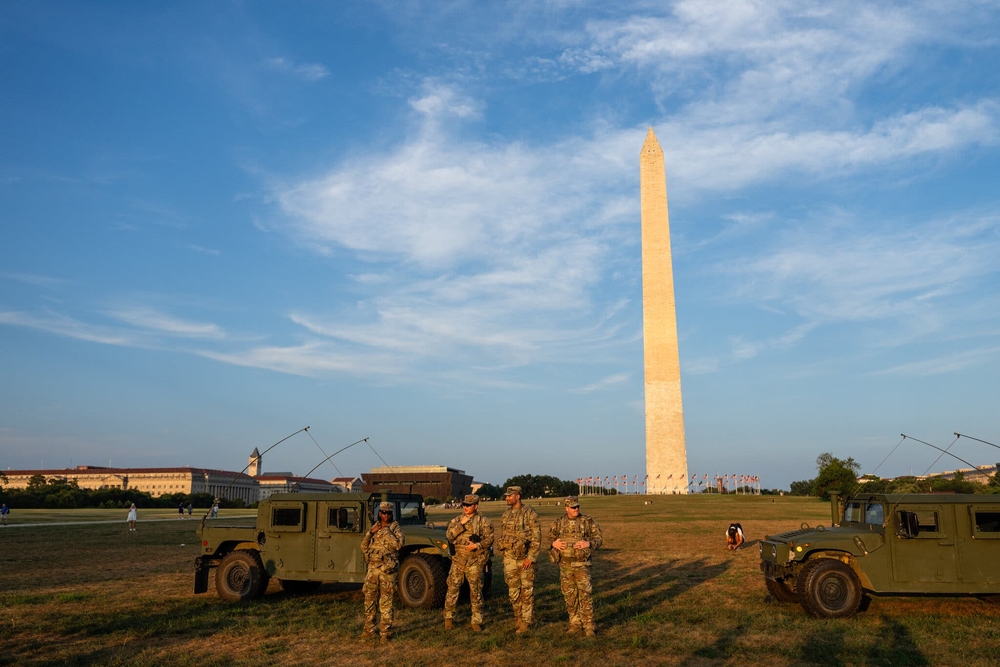
In a decision that sent shockwaves through constitutional law circles, a federal appeals court in Washington has temporarily allowed President Trump to maintain National Guard troops in the nation’s capital, effectively blocking a lower court ruling that deemed their presence unlawful. The three-judge panel, consisting of Judges Gregory G. Katsas and Neomi Rao (both Trump appointees) and Patricia A. Millett (an Obama appointee), issued an unsigned order stating that their decision was merely procedural, designed to give the court sufficient time to consider the complex legal issues at stake. However, this temporary stay has profound implications for the balance of power between federal authority and local governance.
This ruling represents the latest chapter in President Trump’s aggressive expansion of military presence in American cities with Democratic leadership. Since June, the administration has deployed National Guard troops to five cities including Chicago, Los Angeles, and Portland, ostensibly to address urban crime problems. Yet federal judges across the country have repeatedly found these claims exaggerated and the deployments unlawful due to the absence of emergency conditions warranting military intervention. The Washington deployment stands as the most expansive effort to date, with the president citing a tragic November 26th attack that killed one National Guard member and seriously injured another as justification for scaling up the deployment to approximately 2,500 troops.
The Constitutional Context and Legal Precedents
The legal status of Washington, D.C. creates unique circumstances that have allowed this massive deployment to persist. Unlike states that can mount stronger legal challenges to federal overreach, the District’s peculiar constitutional position provides fewer obstacles to federal control. This has enabled the Trump administration to maintain what critics describe as an “occupation force” in the nation’s capital, comprising not only approximately 900 members of the D.C. National Guard but also additional forces sent by Republican governors from at least nine states including West Virginia, Georgia, and Ohio.
The Supreme Court is currently considering whether similar National Guard deployments in Chicago constitute a legal use of military forces for domestic policing. In October, the justices requested additional information from the Trump administration about the Guard’s role, following a New York Times analysis that identified numerous errors and inconsistencies in the government’s legal submissions. This judicial scrutiny reflects the profound constitutional questions raised by using military forces for routine law enforcement purposes.
The Erosion of Civilian Control: A Constitutional Crisis in the Making
What we are witnessing is nothing short of the systematic dismantling of one of America’s most fundamental democratic principles: civilian control over military forces. The Posse Comitatus Act of 1878 generally prohibits the use of federal military personnel to enforce domestic laws, a protection born from Reconstruction-era abuses that sought to prevent exactly this kind of militarization of civilian spaces. While the National Guard operates under different legal frameworks when federalized, the spirit of this protection—that military力量 should not be used as a political tool against American citizens—is being dangerously undermined.
President Trump’s justification for these deployments—citing urban crime problems that judges have repeatedly found to be exaggerated—reveals a troubling pattern of using national security concerns as pretext for political theater. When a president can deploy military forces against the wishes of local elected officials based on questionable claims of emergency, we have entered dangerous territory for democratic governance. The Founders designed our system with careful checks and balances precisely to prevent this kind of executive overreach.
The Dangerous Normalization of Military Presence
Perhaps most alarming is how quickly extraordinary measures become normalized. The presence of thousands of military personnel in the nation’s capital—a city with its own elected leadership that opposes this deployment—should shock the conscience of every American who values local self-government. Yet each day these troops remain, their presence becomes more accepted, more routine, more “normal.” This normalization process represents a profound threat to liberty, as citizens gradually accept measures they would have found unacceptable just months earlier.
When military forces become embedded in urban landscapes under questionable legal authority, the line between protection and occupation becomes dangerously blurred. The psychological impact on residents living under what amounts to martial law—however temporary or “limited” its scope—cannot be overstated. The message sent by armed soldiers patrolling American streets is fundamentally incompatible with a free society that trusts its citizens and respects their local self-governance.
The Partisan Nature of These Deployments
The selective targeting of cities with Democratic leadership reveals the political nature of these deployments. While crime exists in communities across the political spectrum, the administration has focused exclusively on Democratic-led cities, suggesting that law enforcement concerns may be secondary to political messaging. This pattern transforms what should be neutral matters of public safety into partisan weapons, further eroding trust in institutions and deepening political divisions.
The participation of Republican governors in sending their state National Guard units to Washington adds another layer of concerning politicization. When state military resources become instruments of federal political strategy against local governments, we witness the corruption of federalism itself. The National Guard should serve the people of their states and the nation—not become pawns in political conflicts between the executive branch and local governments.
The Judicial System’s Critical Role
Our judiciary stands as the last bulwark against this executive overreach, which makes the appeals court’s temporary stay so concerning. While the court insists its decision is merely procedural, the practical effect is to permit a potentially unlawful military presence to continue. This creates a dangerous precedent where questionable deployments can persist for months through legal delays, effectively achieving their objectives regardless of ultimate rulings on legality.
The composition of the judicial panel—with two Trump appointees and one Obama appointee—inevitably raises questions about judicial independence in an increasingly polarized era. While we must maintain respect for the judiciary, we cannot ignore how the expansion of presidential power to appoint judges creates potential conflicts of interest when those same judges rule on cases involving the president who appointed them.
The Path Forward: Restoring Constitutional Balance
America stands at a constitutional crossroads. The temporary stay granted by the appeals court may seem like a minor procedural matter, but it represents a critical moment in the struggle to maintain civilian control over military forces. The fundamental question before us is whether military power can be used as a political tool against American cities or whether the centuries-old tradition of keeping the military out of domestic politics will prevail.
The solution requires vigilance from all branches of government and from citizens themselves. Congress must reassert its authority over military deployments and funding. The judiciary must render swift and principled decisions that prioritize constitutional protections over executive convenience. And citizens must recognize that the normalization of military presence in American cities represents a fundamental departure from our democratic traditions.
Conclusion: Democracy Demands Vigilance
As this legal battle continues, every American who values freedom must recognize what is at stake. This is not merely a dispute about the technicalities of military deployment authority—it is a struggle for the soul of American democracy. The principle that military力量 exists to protect democratic institutions, not to undermine them, must be defended with unwavering commitment.
The temporary presence of National Guard troops in Washington may eventually end, but the precedents being set could haunt our democracy for generations. We cannot allow short-term security concerns—real or exaggerated—to justify the long-term erosion of constitutional protections. The freedom to live without military occupation, to be governed by locally elected officials rather than federal force, is not a partisan issue—it is the foundation of American liberty itself.
In the end, the measure of our democracy will be found not in how much power the executive can wield, but in how effectively we constrain that power to protect the liberties of all Americans, regardless of which party controls their local government. The current deployment of National Guard troops in Washington represents a test of that fundamental principle—one we cannot afford to fail.