
The Imperial Presidency Reborn: Trump's Dangerous Transformation of American Democracy
Published
- 3 min read
The Unprecedented Assertion of Executive Power
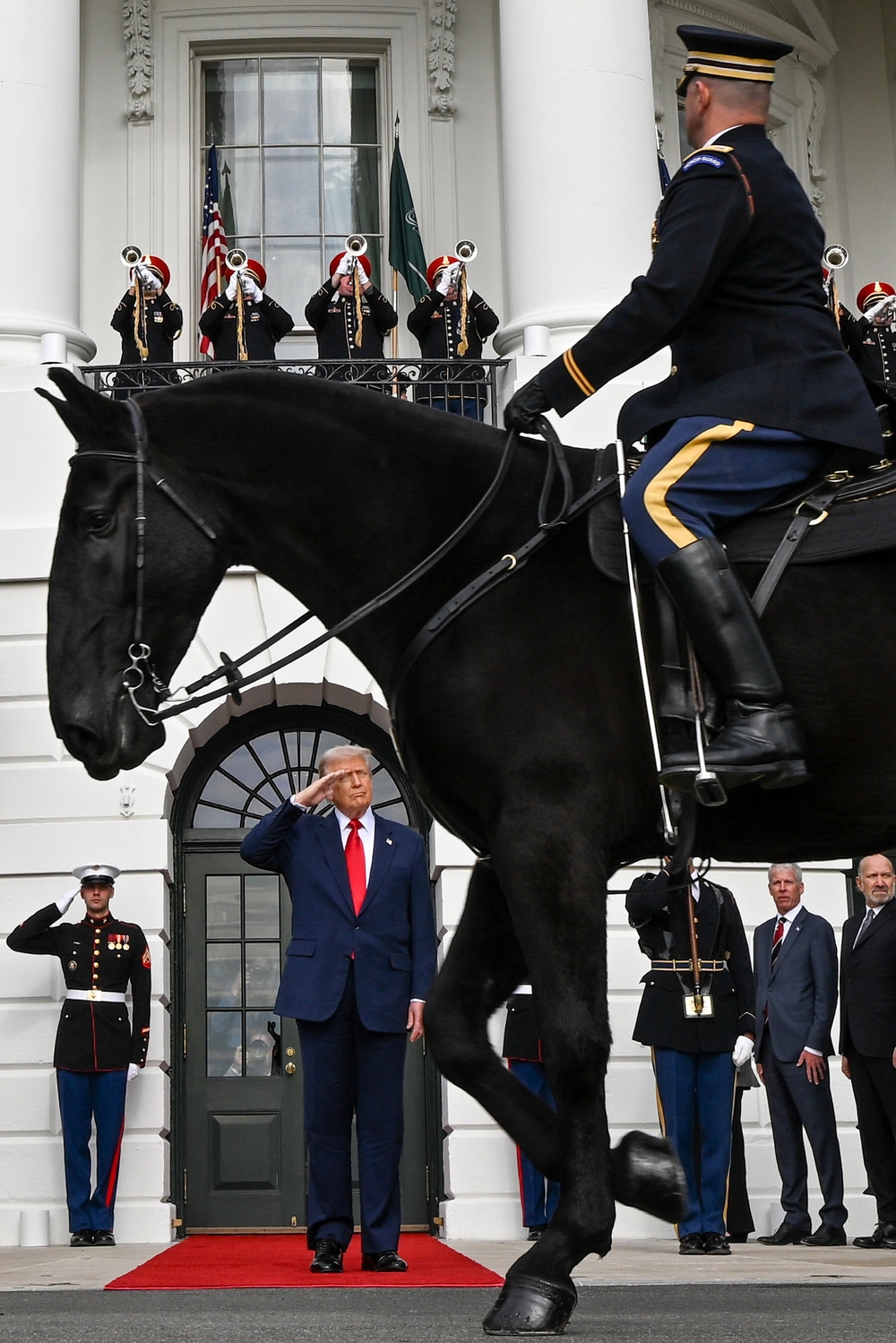
In what can only be described as a radical departure from constitutional norms and democratic traditions, President Donald Trump has embarked on a comprehensive reimagining of the American presidency that echoes monarchical aspirations rather than republican values. The recent state visit with Saudi Arabia’s crown prince revealed a pattern of royal pretension that should alarm every student of American government and every defender of democratic principles. From military flyovers to processions of black horses and regal dining arrangements, the Trump administration has consciously adopted the trappings of monarchy while simultaneously asserting what the article describes as “virtually unbridled power” to transform American government and society.
This transformation extends far beyond mere pageantry. The gold trim in the Oval Office, the demolition of the East Wing for a massive ballroom, the plastering of his name and face on government buildings including the John F. Kennedy Center for the Performing Arts, and the designation of his birthday as a free-admission holiday at national parks all speak to a personal aggrandizement unprecedented in modern American history. These symbolic acts coincide with substantive power grabs that threaten the very foundations of our constitutional system.
Historical Context and Precedents
The concept of the “imperial presidency” is not new to American political discourse. Historian Arthur M. Schlesinger Jr. popularized the term half a century ago during the Nixon administration, describing a presidency that had “got out of control and badly needs new definition and restraint.” Previous presidents have tested the boundaries of executive power—Abraham Lincoln suspended habeas corpus, Woodrow Wilson prosecuted critics of World War I, Franklin Roosevelt interned Japanese Americans—but these actions typically occurred during wartime and were followed by a reassertion of constitutional balance.
What distinguishes Trump’s approach is both the breadth of his assertions and the context in which they occur. As political historian Matthew Dallek of George Washington University observes, “His second term in many respects represents not simply a break from presidential norms and expectations. It’s also a culmination of 75 years in which presidents have reached for more and more power.” This administration represents not merely an acceleration of existing trends but a qualitative transformation in the nature of executive authority.
The Mechanisms of Power Consolidation
The Trump administration has employed multiple strategies to consolidate power and circumvent traditional checks and balances. According to the article, Trump has taken it upon himself to reinterpret constitutional amendments, eviscerate agencies and departments created by Congress, dictate to private institutions how to run their affairs, send troops into American streets, wage unauthorized military actions, and openly use law enforcement for what his own chief of staff calls “score settling” against his enemies.
This aggressive approach benefits from what longtime Trump adviser Jason Miller describes as a more experienced and focused administration: “The president knew exactly what he wanted to do coming into office this time. Now the president had four years under his belt. He knows exactly how everything works.” The team surrounding Trump now consists of loyalists rather than the restraining influences that characterized parts of his first administration, creating what Representative Don Bacon of Nebraska describes as a situation where “you’ve got pretty much yes men.”
The administration has also worked from a detailed blueprint—Project 2025—devised during Trump’s years out of power, allowing for an unprecedented number of executive orders (about 225 in his first year, nearly three times as many as any other first-year president in three-quarters of a century). This executive action strategy enables what the article calls an “instant-gratification president” to dispense with the slow grind of congressional negotiations.
The Erosion of Accountability Mechanisms
Perhaps most alarmingly, the Trump administration has systematically dismantled instruments of accountability. The article details how Trump has installed loyal partisans at the FBI and Justice Department, fired inspectors general and the special counsel, purged prosecutors and agents who participated in past investigations into his dealings, and gutted the public integrity section that probes political corruption. Meanwhile, congressional Republicans who eagerly investigated Hunter Biden’s business ties have shown no interest in scrutinizing Trump’s activities.
This erosion of accountability extends to personal enrichment. While other presidential families have cashed in on the White House, none has been as successful or brazen as Trump and his clan, who have made billions of dollars through business deals and cryptocurrency investments from people with vested interests in American policy. The normalization of such behavior represents a fundamental threat to government integrity and public trust.
The Democratic Imperative: Reasserting Constitutional Principles
As a firm believer in democratic values and constitutional governance, I view these developments with profound concern. The accumulation of power in the executive branch, particularly when coupled with monarchical pretensions and the erosion of accountability mechanisms, represents an existential threat to American democracy. The presidency was never intended to be a monarchy, and the Founders specifically designed a system of checks and balances to prevent such concentration of power.
The fact that these actions occur during a time of general peace, without the justification of national emergency that sometimes accompanied previous expansions of executive power, makes them particularly troubling. As Russell Riley, a presidential historian at the University of Virginia’s Miller Center, notes, while the nation has a history of expanding presidential authority, “we have an equally robust history of cramming the presidency back into its constitutional box once war or economic crisis has passed.”
However, we cannot rely on historical patterns to automatically restore balance. The normalization of extraordinary actions represents one of the most dangerous aspects of this presidency. As Robert Schlesinger observes, “by being so open about it, it normalizes it to some extent.” Actions that once shocked the political system can eventually become seen as normal, creating a new baseline for executive behavior that future presidents may exploit.
The Path Forward: Reclaiming Democratic Norms
The resistance to unchecked power must come from multiple directions: Congress must reassert its constitutional prerogatives, the judiciary must uphold the rule of law, the media must serve as vigilant watchdogs, and citizens must demand accountability. Recent signs of pushback—including judges throwing out indictments against the president’s adversaries, grand juries refusing to re-indict targets, and Congress passing measures to compel transparency—offer hope that the system can still function.
Ultimately, the preservation of American democracy requires more than institutional resistance—it requires a recommitment to democratic values among the citizenry. The fact that Trump maintains historically low approval ratings (36 percent in Gallup surveys, lower than every elected modern president at the end of their first year) suggests that the American people recognize the danger, even if political structures have been slow to respond.
As we confront this challenge, we must remember that the American experiment in self-government has survived previous crises through the vigilance of citizens and the resilience of institutions. The current assault on democratic norms represents perhaps our greatest test since the Civil War, but it is a test we can and must meet. The future of republican government depends on our ability to reassert the fundamental principle that in America, no one is above the law—not even the president.