
The Chilling Effect: How Immigration Enforcement Is Harming Early Childhood Education
Published
- 3 min read
Introduction: A Climate of Fear in Our Preschools
The American early childhood education system, particularly bilingual and immersion programs that serve immigrant communities, is facing an unprecedented crisis that extends far beyond typical educational challenges. What should be safe havens for learning and development have become environments where both educators and children navigate daily anxiety about immigration enforcement actions. This disturbing trend represents not just an educational emergency but a fundamental assault on the values of sanctuary, learning, and community that should define our educational institutions.
The Facts: Educational Programs Canceled and Children Confined
According to reporting from Washington, preschools like CentroNía bilingual preschool have been forced to make drastic changes to their educational approach due to increased Immigration and Customs Enforcement (ICE) presence in their communities. These are not hypothetical concerns—teachers have stopped taking children to nearby parks, libraries, and playgrounds that were once considered extensions of their classrooms. The school scrapped its beloved Hispanic Heritage Month parade, a cherished cultural celebration where immigrant parents typically dressed their children in costumes and soccer jerseys from their home countries.
This crisis has been building since shortly after President Donald Trump took office in January, when staff at these institutions began rehearsing what to do if ICE officials came to their doors. The situation escalated dramatically in October when ICE arrested a teacher inside a Spanish immersion preschool in Chicago, leaving immigrants who work in child care—along with the families who rely on them—feeling frightened and vulnerable.
The Child Care Industry’s Dependence on Immigrant Workers
The statistics reveal why this issue is particularly acute in early childhood education. About one-fifth of America’s child care workers were born outside the United States, and one-fifth are Latino. In large cities and certain states, the proportion is much higher—around 40% of the child care workforce in the District of Columbia, California, and New York is foreign-born according to UC Berkeley’s Center for the Study of Child Care Employment.
Contrary to anti-immigrant rhetoric, these workers tend to be better educated than their U.S.-born counterparts and fulfill critical needs in our educational system. Those from Latin America help satisfy the growing demand for Spanish-language preschools where parents enroll their children to give them a head start learning another language. The American Immigration Council estimated in 2021 that more than three-quarters of immigrants working in early care and education were living and working in the U.S. legally, with institutions like CentroNía conducting rigorous background checks and verifying work authorization.
Personal Impacts: Stories of Fear and Trauma
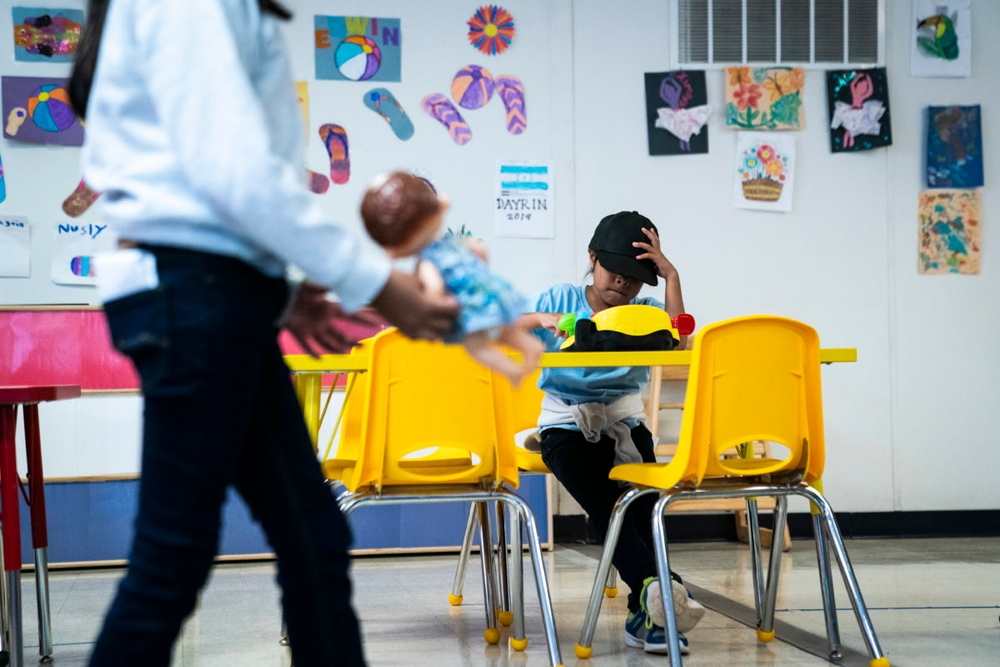
The human toll of these policies is both heartbreaking and infuriating. At CentroNía, CEO Myrna Peralta reported that all staff must have legal status and work authorization, yet ICE’s presence has fundamentally changed how the school operates. Instead of educational walks through the neighborhood, staff now push children in strollers around hallways. They converted a classroom into a miniature library after scrapping a partnership with a local library.
The personal stories are even more disturbing. One staff member was detained by ICE while walking down the street and held for several hours unable to contact colleagues. Teacher Edelmira Kitchen, a U.S. citizen who immigrated from the Dominican Republic as a child, was pulled over by ICE on her way to work in September and felt her rights were violated when officials demanded she get out of her car for questioning.
The mental health impact has been severe. Joangelee Hernández-Figueroa, the school’s site director, reported that some employees have gone to the hospital with panic attacks in the middle of the school day. The anxiety has become so pervasive that when mental health consultants were sent to the school, leadership had them work with teachers rather than students, worried their anguish would spill over to the classroom.
The Broader Policy Context
The Trump administration’s immigration policies extend beyond enforcement actions to include stripping legal status from hundreds of thousands of immigrants. Many had fled violence, poverty, or natural disasters in their home countries and received Temporary Protected Status (TPS), which allowed them to live and work legally in the U.S. When Trump ended these programs, it forced many out of their jobs—and the country. Just last month, 300,000 immigrants from Venezuela lost their protected status.
The practical impact on schools has been immediate. CentroNía lost two employees when they lost their TPS, and a Nicaraguan immigrant working as a teacher left on his own. Tierra Encantada, which runs Spanish immersion preschools in several states, had a dozen teachers leave when they lost their TPS.
The Impact on Children: An Educational and Developmental Crisis
Perhaps most tragically, this climate of fear is affecting children directly. At a Guidepost Montessori School in Portland, Oregon, teachers observed preschoolers change behavior in the weeks after an ICE arrest near the school in July. After officials pulled over a father driving his child to school and tried to arrest him in the parking lot, the school went into lockdown. Children were pulled off the playground, and teachers played loud music and had children sing along to drown out the yelling.
School head Amy Lomanto reported that teachers noticed more outbursts among students and more students retreating to “the regulation station,” an area with fidget toys children can use to calm themselves. This underscores that even wealthy communities are not immune from exposure to these traumatic events.
A Fundamental Betrayal of American Values
What we are witnessing represents nothing less than a systematic assault on the very foundations of American democracy and educational integrity. The idea that schools—particularly those serving young children—should become places of fear rather than sanctuaries for learning is antithetical to everything this nation should stand for.
As a society committed to democracy, freedom, and liberty, we must recognize that these policies do not make us safer—they make us lesser. They compromise our educational system, traumatize children, and force dedicated educators to work under conditions of constant anxiety. The fact that the majority of these immigrant educators are working legally makes this situation even more grotesque—it represents a breakdown of basic constitutional protections and the rule of law.
The Constitutional and Human Rights Implications
The Fourth Amendment protection against unreasonable searches and seizures, the Fourteenth Amendment’s guarantee of equal protection under the law, and basic human rights principles are all being violated by these practices. When U.S. citizens like Edelmira Kitchen are being pulled over and harassed by immigration officials, we have crossed into dangerous territory where constitutional protections are being systematically eroded.
The psychological harm being inflicted on both educators and children constitutes a form of collective punishment that should have no place in a democratic society. The fact that schools once considered off-limits to ICE officials have now become fair game represents a radical departure from previous enforcement norms and basic decency.
The Economic and Educational Consequences
Beyond the moral and constitutional implications, these policies are creating practical crises in early childhood education. The child care industry was already strained by a worker shortage before these immigration policies began driving away qualified educators. The loss of experienced bilingual teachers particularly harms programs designed to give children early language skills and cultural exposure.
When schools must cancel educational programs, confine children indoors, and divert resources to address trauma and anxiety rather than education, everyone suffers. The long-term impact on children’s development, particularly in critical early years, could be profound and lasting.
Conclusion: Reclaiming Our Educational Sanctuaries
We must demand immediate change to protect our educational institutions from becoming collateral damage in immigration enforcement efforts. Schools must be explicitly recognized as sensitive locations where enforcement actions are prohibited except in the most extreme circumstances. The trauma being inflicted on children and educators is unacceptable in a society that claims to value both education and human dignity.
Ultimately, this is about what kind of country we want to be. Do we want to be a nation where children learn in fear and educators work under threat? Or do we want to be a nation that protects its educational institutions as sanctuaries for learning and development? The answer should be clear to anyone who believes in American values of freedom, liberty, and the pursuit of happiness. We must stand against policies that harm our children and undermine our educational system, and we must do so with the urgency that this moral crisis demands.