
The Assault on Democratic Representation: North Carolina's Gerrymandering Crisis
Published
- 3 min read
The Facts: A Judicial Greenlight for Partisan Mapmaking
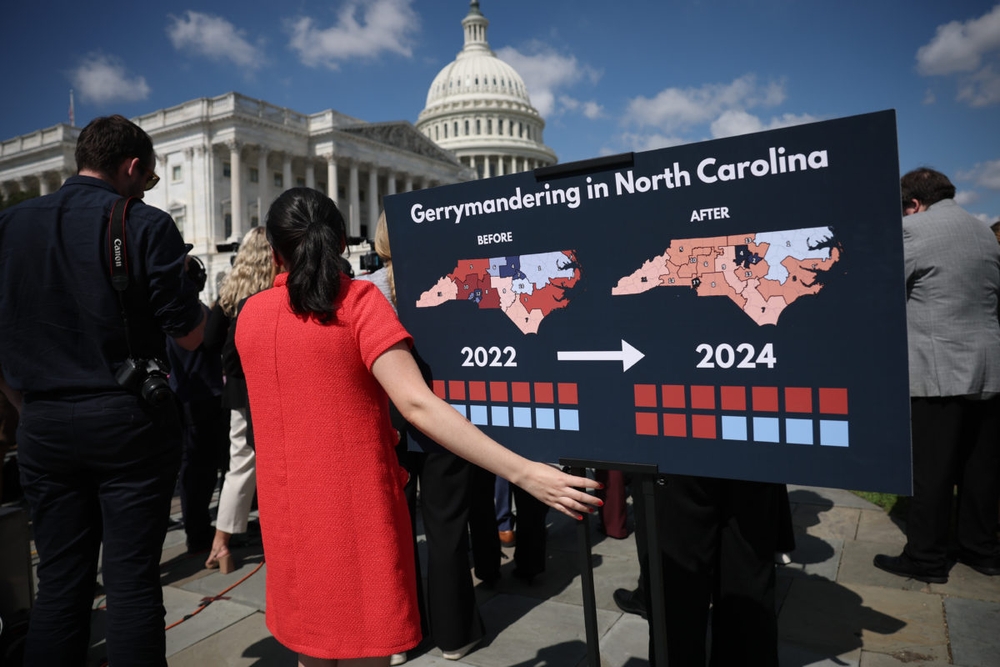
In a decision that strikes at the heart of democratic representation, a federal three-judge panel has allowed North Carolina to implement a redrawn congressional map explicitly designed to flip a seat to Republicans. This move directly targets North Carolina’s only swing district, currently represented by Democratic Congressman Don Davis, who serves over 20 counties in the state’s northeast. What makes this particularly concerning is that the 1st District has been represented by Black members of Congress continuously for more than three decades—a legacy of representation that now stands threatened.
The ruling came after the judges denied preliminary injunction requests from plaintiffs including the state NAACP and Common Cause. This decision follows the same panel’s earlier upholding of several other redrawn U.S. House districts that Republican state lawmakers enacted in 2023. Those maps contributed to Republicans gaining three additional congressional seats in the 2024 elections, demonstrating the profound impact such partisan cartography can have on national politics.
North Carolina finds itself at the center of a broader national strategy orchestrated by former President Donald Trump, who has broken with more than a century of political tradition by directing GOP efforts to redraw maps in the middle of the decade—without courts requiring it. This unprecedented mid-decade redistricting effort extends beyond North Carolina to Texas, Missouri, and Ohio, where Republican-led legislatures have adopted new districts explicitly designed to boost Republican chances in upcoming elections.
The Context: A National Redistricting Arms Race
The timing and nature of these redistricting efforts reveal a disturbing pattern. Democrats need to gain just three seats to win control of the House and potentially impede Trump’s agenda, making every district crucial. In response, Republican legislatures are engaging in what their own attorneys describe as a “nationwide partisan redistricting arms race.” This isn’t merely political competition—it’s a systematic effort to engineer electoral outcomes rather than allowing voters to choose their representatives.
The legal challenges against North Carolina’s map reveal concerning details about its construction. The new boundaries would reduce the Black voting-age population in the 1st District from 40% to 32%, effectively diluting minority voting power. Republicans moved counties with significant Black populations—which typically vote Democratic—to the 3rd District currently represented by Republican Greg Murphy. This racial sorting under the guise of political considerations should alarm anyone who values fair representation.
What’s particularly troubling is the judicial response to these challenges. The judges—all nominated by Republican presidents—dismissed claims against other districts, stating that plaintiffs failed to prove legislators drew maps “with the discriminatory purpose of minimizing or canceling out the voting potential of Black North Carolinians.” This sets a dangerous precedent where the burden of proof becomes impossibly high for challenging clearly discriminatory maps.
The Erosion of Constitutional Principles
When we examine these redistricting efforts through the lens of constitutional principles, the violations become starkly apparent. The plaintiffs’ arguments centered on First Amendment grounds, claiming Republican lawmakers unconstitutionally targeted North Carolina’s “Black Belt” because residents had organized, voted for their preferred candidates, and sued over the 2023 district configuration. This represents potential retaliation against protected political speech and association—a fundamental First Amendment violation.
The second lawsuit raised even more troubling constitutional questions, arguing that using five-year-old Census data for mid-decade redistricting violates the Constitution, including the 14th Amendment’s one-person, one-vote guarantee. Additionally, it alleges lawmakers relied on race in mapmaking in violation of both the First and 14th Amendments. These are not minor technicalities—they strike at the core of how we ensure equal representation in a democracy.
Republican attorneys defended the districts by claiming the objectives were “political and allowable, not racial,” but this distinction becomes meaningless when the practical effect is the systematic dismantling of minority representation. The Supreme Court’s evolving jurisprudence on voting rights has created loopholes that allow partisan gerrymandering to proceed under the fiction that it’s merely political rather than racial, even when the outcomes disproportionately affect minority communities.
The Human Cost of Political Gamesmanship
Behind these legal and political maneuvers lie real communities facing disenfranchisement. The 1st District’s three-decade tradition of Black representation represents hard-won progress in a state with a complicated racial history. To see this progress potentially erased for partisan gain is not just politically concerning—it’s morally reprehensible.
Congressman Don Davis represents more than just a political position; he represents the voice of communities that have fought for representation for generations. When maps are drawn to eliminate his district’s competitive nature and reduce Black voting power, we’re witnessing the quiet erosion of civil rights victories that many sacrificed to achieve.
The Republican defense that they’re merely engaging in political competition ignores the fundamental truth that democracy should be about voters choosing their representatives, not representatives choosing their voters. When politicians can draw districts that guarantee their own reelection and eliminate competitive races, they undermine the very accountability that makes democracy function.
A Call to Defend Democratic Institutions
This North Carolina case represents a microcosm of a broader national crisis in electoral integrity. The fact that multiple states are engaging in mid-decade redistricting without court mandate shows how norms that once protected our democratic process are crumbling. The judicial system’s inability or unwillingness to check these abuses demonstrates how our institutions are being tested and in some cases failing to protect fundamental rights.
We must recognize that fair districting isn’t a partisan issue—it’s a democracy issue. When maps are drawn to silence certain communities or racial groups, everyone’s representation suffers. Competitive districts force representatives to listen to diverse viewpoints and find common ground. When districts become safely partisan, representatives answer only to their base, increasing polarization and governance breakdowns.
The solution requires both judicial courage and legislative action. Courts must be willing to examine not just the intent behind maps but their effects on representation. Legislatures should adopt independent redistricting commissions that remove politicians from the map-drawing process. Citizens must demand transparency and fairness in how their voting districts are constructed.
What’s happening in North Carolina should serve as a wake-up call to all who value democracy. The quiet erosion of voting rights through technical mapmaking may seem less dramatic than other assaults on democracy, but its effects can be equally devastating. When communities lose their voice in Congress, when representation becomes predetermined by cartography rather than choice, we’ve lost something essential to our democratic experiment.
We must stand firmly against this systematic dismantling of fair representation and fight for a democracy where every vote counts equally and every community has a meaningful voice. The future of American democracy may depend on whether we succeed in this fight.