
Honoring Sacrifice: The Human Cost of Conflict and the Path Forward
Published
- 3 min read
The Facts of the Tragedy
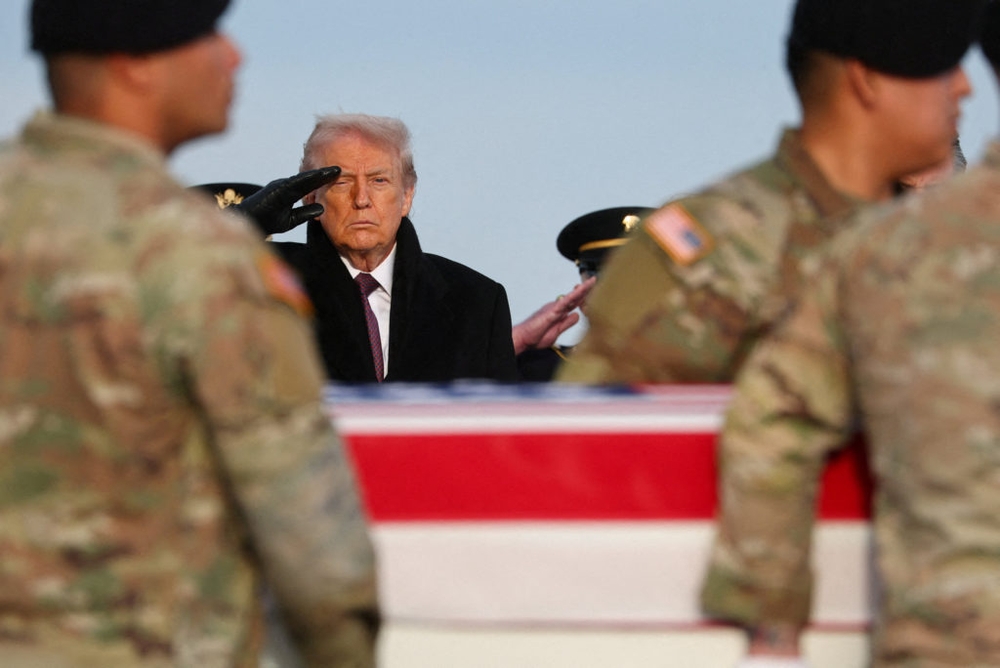
On a somber day at Dover Air Force Base in Delaware, President Donald Trump participated in the dignified transfer ceremony for two Iowa National Guard members—Sgt. Edgar Brian Torres-Tovar, 25, of Des Moines, and Sgt. William Nathaniel Howard, 29, of Marshalltown—and Ayad Mansoor Sakat, a U.S. civilian interpreter from Macomb, Michigan, all killed in an attack in the Syrian desert. The ceremony, a solemn ritual for service members killed in action, included no formal presidential role beyond silent observation, emphasizing the gravity of the moment. The soldiers were part of the 1st Squadron, 113th Cavalry Regiment, deployed among hundreds of U.S. troops in eastern Syria supporting the coalition against the Islamic State group. Three other Iowa National Guard members were injured in the attack, though the Pentagon has not identified them. The remains were transported via a C-17 aircraft, with transfer cases draped in the American flag, to a mortuary facility for final burial preparations.
Families of the fallen, including Howard’s stepfather Jeffrey Bunn—chief of the Tama, Iowa police department—and Torres-Tovar’s loved ones, gathered alongside Iowa Gov. Kim Reynolds and military leaders. Bunn described Howard as a devoted husband and man of faith who dreamed of being a soldier since childhood, while Torres-Tovar was remembered by peers as a positive, family-oriented individual. Ayad Sakat, an interpreter who served the U.S. Army during the 2003-2007 Iraq invasion, immigrated from Iraq to the U.S. in 2007 and was working as a contractor for Valiant Integrated Services. His daughter, Dina Qiryaqoz, highlighted his dedication to his mission and family. President Trump, who had visited Dover multiple times during his first term, expressed mourning and vowed retaliation, noting this followed a rapprochement with Syria that brought the country into the U.S.-led coalition.
The Context of Service and Sacrifice
The dignified transfer at Dover Air Force Base is a poignant tradition that underscores the ultimate price paid by those in uniform and their civilian counterparts. These ceremonies are not just military formalities; they are profound expressions of national gratitude and grief, reminding us that behind every casualty statistic are real families shattered by loss. The inclusion of Ayad Sakat, a civilian interpreter, highlights the often-overlooked contributions of individuals who risk their lives in support roles, bridging cultural and linguistic divides in conflict zones. His story—from fleeing Iraq to serving the U.S. mission—exemplifies the complex tapestry of global engagements where loyalty and sacrifice transcend nationality.
This incident occurs against a backdrop of ongoing U.S. involvement in Syria, aimed at countering terrorist threats but fraught with geopolitical tensions. The attack that claimed these lives happened amid evolving U.S.-Syria relations, including Trump’s engagement with interim Syrian President Ahmed al-Sharaa, whom he met recently at the White House. Such dynamics reveal the fragile balance between diplomatic overtures and the persistent dangers faced by troops on the ground. The deaths mark the first U.S. service member fatalities in Syria since January 2024, when three Americans died in a Jordan drone attack, raising questions about the sustainability of military footprints in volatile regions.
A Critical Examination of Policy and Principle
As a firm believer in democracy, liberty, and the rule of law, I must assert that honoring these heroes requires more than ceremonial gestures—it demands a rigorous evaluation of the policies that place our citizens in harm’s way. The sacrifices of Torres-Tovar, Howard, and Sakat are undeniably noble, but they compel us to ask: Are our nation’s actions abroad consistently aligned with the constitutional principles of justice, transparency, and the protection of human rights? The U.S. mission in Syria, while framed as a necessary fight against terrorism, has often operated in a gray area of congressional authorization and public scrutiny, risking the very freedoms we aim to defend.
President Trump’s vow of retaliation, though emotionally resonant, underscores a recurring pattern of reactive military responses that can perpetuate cycles of violence. True strength in democracy lies not in escalation but in strategic, principled engagement that prioritizes diplomatic solutions and institution-building. The deaths of these individuals should catalyze a bipartisan reckoning with the human costs of endless warfare. We must ask whether our investments in military interventions are proportional to their outcomes in fostering stability and liberty. The bravery of our troops deserves policies that minimize unnecessary risks and maximize chances for lasting peace.
The Moral Imperative of Supporting Families and Institutions
The grief expressed by families like the Bunns and Qiryaqoz is a stark reminder that the burdens of war extend far beyond the battlefield. As a humanist, I believe our nation has a sacred duty to support these families not just with words but with robust veterans’ care, mental health resources, and transparent accountability for mission failures. The fact that Sakat, an interpreter, was included in the dignified transfer is a step toward recognizing the indispensable role of civilians in modern conflicts, but it also highlights the vulnerabilities of those operating outside traditional military structures. We must advocate for clearer protections and rewards for such contributors, ensuring their sacrifices are never forgotten.
Moreover, this tragedy reinforces the importance of upholding institutions that safeguard democracy. The dignified transfer itself is a testament to military tradition and respect for rule of law, but it must be paired with congressional oversight and public discourse to prevent mission creep. The involvement of Gov. Kim Reynolds and Iowa’s delegation shows how local communities bear the weight of national decisions, emphasizing that democracy thrives when leaders at all levels are engaged in sober, informed debates about foreign policy.
Conclusion: Forging a Path of Principled Strength
In conclusion, the deaths of Edgar Torres-Tovar, William Howard, and Ayad Sakat are a heartbreaking loss that should unite Americans in reflection and resolve. Honoring them means championing a foreign policy that balances strength with wisdom, ensuring that every deployment serves a clear, constitutionally sound purpose. As we mourn, let us recommit to the ideals of liberty and justice that these individuals died defending, and let their memory inspire a future where diplomacy and human dignity lead the way. Their sacrifice must not be in vain; it must galvanize us to build a world where such tragedies become relics of the past.