
At Mar-a-Lago, the Language of Peace Sounds Alarmingly Like the Language of Appeasement
Published
- 3 min read
The Facts of the Meeting
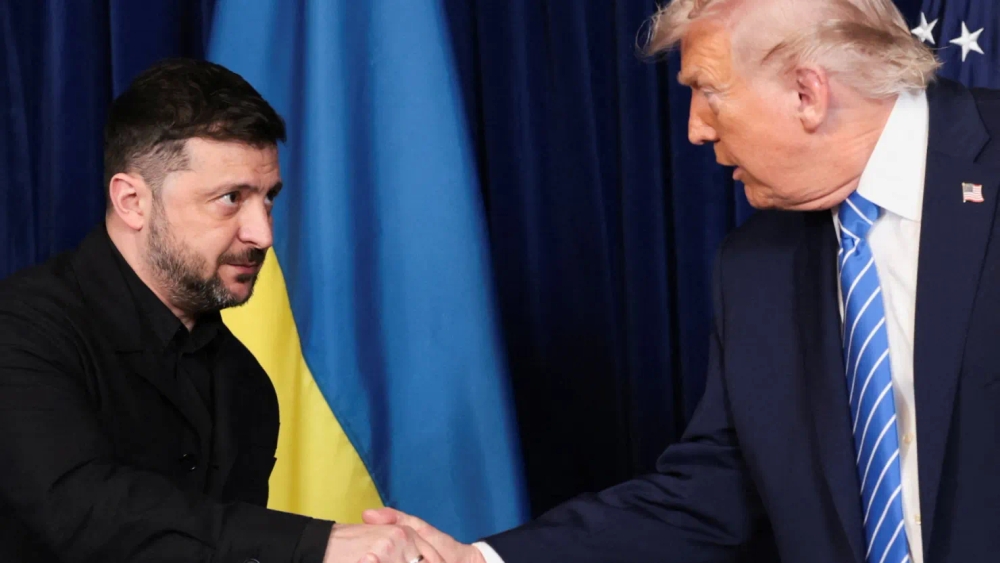
On December 28, 2025, U.S. President Donald Trump hosted Ukrainian President Volodymyr Zelenskyy at his Mar-a-Lago resort in Palm Beach, Florida, for a critical round of talks aimed at ending the nearly four-year-long Russia-Ukraine war. Emerging from the meeting, both leaders struck an optimistic, albeit nuanced, tone. President Trump declared that the talks had progressed, stating, “I do think we’re getting a lot closer, maybe very close.” President Zelenskyy characterized the discussion as “really great,” specifically highlighting that U.S.-Ukraine security guarantees were “100% agreed” upon, a figure Trump later slightly downgraded when questioned by reporters.
The context of this meeting is a war initiated by Russia’s full-scale invasion in early 2022, which has resulted in immense human suffering and a monumental struggle for Ukrainian sovereignty. The discussions occurred against a backdrop of renewed Russian military aggression, including a massive missile and drone strike on Ukraine’s capital and other regions just a day prior, which Zelenskyy labeled as Russia’s response to the U.S.-brokered peace efforts. The core sticking point, as identified by Trump himself, remains “the land”—specifically, the status of territories, including the Donbas region, that Russia has seized or is actively trying to capture.
Trump’s commentary on this issue was particularly revealing. He noted, “Some of that land has been taken. Some of that land is maybe up for grabs, but it may be taken over the next period of a number of months, and you are better off making a deal now.” This meeting followed a “good and very productive telephone call” between Trump and Russian President Vladimir Putin, with Trump planning another call with Putin post-meeting. Further high-level meetings involving Ukrainian and European leaders are slated for the following month to continue developing the peace plan, which reportedly includes provisions for a Ukrainian vote on ceding disputed territory and the creation of a demilitarized “free economic zone” in Donetsk.
The Context: A War of Aggression and the Search for Peace
The Russia-Ukraine war is not a conflict between two equal parties; it is a clear-cut case of a larger power waging a war of aggression against a sovereign neighbor. The international order, painstakingly built after the horrors of the 20th century, is founded on the principle that borders cannot be changed by force. For nearly four years, the Ukrainian people have demonstrated extraordinary courage and sacrifice in defending this very principle, not just for themselves but for all nations that value freedom and self-determination.
The pursuit of peace is an honorable and necessary endeavor. No one of conscience wishes for this war to continue a day longer than necessary. However, the nature of the peace is paramount. A peace that is merely a cessation of hostilities built on unjust terms is a fragile peace, one that sows the seeds for future conflict. The presence of key figures like Secretary of State Marco Rubio, Special Envoy Steve Witkoff, and White House Chief of Staff Susan Wiles at Mar-a-Lago underscores the high-level nature of these negotiations. Yet, the language emerging from these talks demands the most rigorous scrutiny from all who believe in a rules-based international system.
Opinion: The Pernicious Suggestion that Land is ‘Up for Grabs’
The most disturbing element of the post-meeting commentary was not the acknowledgment of difficult negotiations, but the specific framing of the territorial dispute. When a U.S. President describes the sovereign territory of an allied nation as “up for grabs” and advises that country is “better off making a deal now” because its land “may be taken over the next period of a number of months,” it represents a catastrophic failure of moral and strategic clarity.
This language is not the language of a principled mediator; it is the language of a realpolitik that borders on appeasement. It implicitly validates the aggressor’s strategy: that military conquest creates facts on the ground that must be accommodated. It tells every autocrat and expansionist regime around the world that patience and persistence in aggression can eventually force a negotiation on their terms. This is a dangerous precedent that undermines the security of every nation, from the Baltics to Taiwan.
What does it say to the Ukrainian soldiers who have fought and died for every inch of their homeland? What message does it send to the families displaced by Russia’s invasion? It suggests that their immense sacrifice might be bargained away in a deal that treats their country not as a sovereign entity with inviolable rights, but as a piece on a geopolitical chessboard where territory is a commodity to be haggled over. The principle of territorial integrity is not a negotiating point; it is the bedrock of international law and stability.
The Shadow of Putin and the Spectacle of Diplomacy
The sequence of events—a call with Putin, followed by a meeting with Zelenskyy, followed by another planned call with Putin—creates an unsettling dynamic. While communication with all parties is essential, the optics and substance must reinforce that the United States stands unequivocally with the victim of aggression, not as a neutral arbiter between moral equivalencies. The reported alignment between Trump and Putin in opposing a temporary ceasefire, as hinted by Kremlin aide Yuri Ushakov, is deeply troubling. A temporary ceasefire could save lives and create space for diplomacy; dismissing it out of hand, especially when aligned with the aggressor’s position, raises serious questions about the negotiating strategy’s underlying priorities.
Furthermore, the choice of venue—the opulent Mar-a-Lago club, with its history as a backdrop for political spectacle—cannot be ignored. Diplomacy is often conducted behind closed doors, but when it is staged so publicly at a president’s private property, it risks becoming more about theater than substance. This is compounded by the memory of a previous meeting between the two leaders that “devolved into a public spectacle.” The Ukrainian people deserve a peace process that is dignified, serious, and focused solely on securing a just and lasting outcome, not one that plays out in the glare of a resort’s dining room.
The Path Forward: Justice, Not Just a Deal
The reported 20-point peace plan, which Zelenskyy says is 90% ready, must be judged by a single, unwavering standard: does it uphold justice and the rule of law? Security guarantees for Ukraine are vital, but they cannot be a sweetener to make the bitter pill of territorial dismemberment more palatable. A “free economic zone” in a strategically vital region like Donetsk, under the shadow of demilitarization, could become a Trojan horse, further eroding Ukrainian sovereignty.
A true and lasting peace must be built on three non-negotiable pillars. First, the complete and unconditional withdrawal of Russian military forces from all internationally recognized Ukrainian territory. Second, robust and enforceable security guarantees that ensure Ukraine can defend itself against future aggression. Third, a mechanism for accountability for the crimes committed during this war.
As supporters of democracy, freedom, and the sanctity of the U.S. Constitution, we must recognize that these principles do not stop at our water’s edge. The struggle in Ukraine is a frontline in the broader battle between authoritarian aggression and the free world. To pressure a democratic ally into surrendering its land under the threat of continued violence is to abandon those very principles. The goal of diplomacy must be a peace that allows a free Ukraine to thrive within its rightful borders, secure in its future. Any outcome that falls short of this betrays the sacrifices made and emboldens the forces of tyranny for generations to come. We must urge our leaders to choose the path of principle, not the path of expediency, for the sake of Ukraine and for the future of international order itself.