
When Government Blocks Spiritual Comfort: The Assault on Religious Freedom in Immigration Detention
Published
- 3 min read
The Facts: Systematic Denial of Religious Ministry
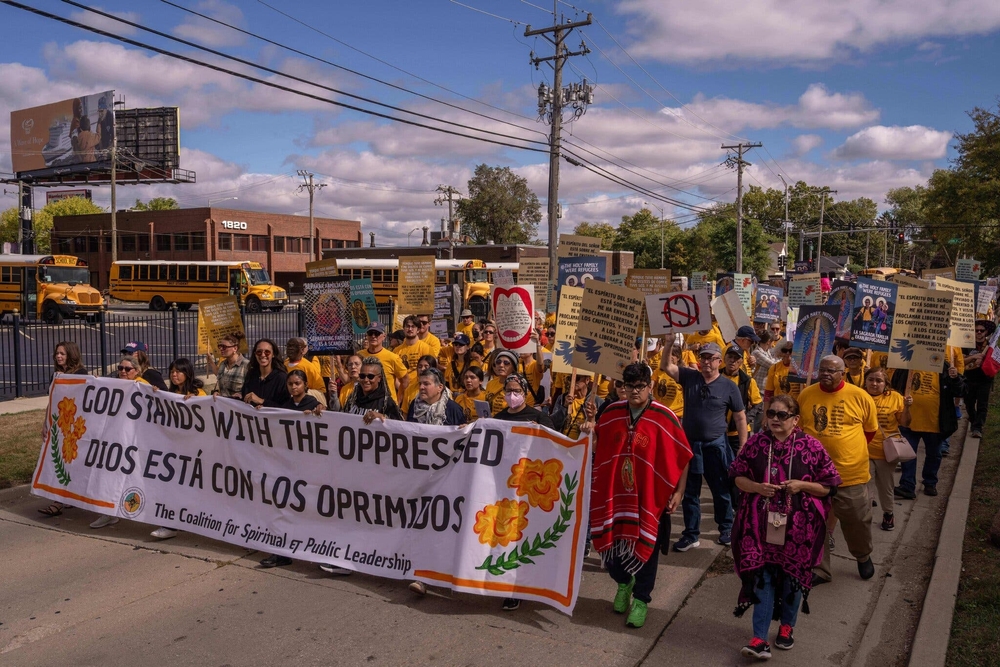
A deeply troubling development has emerged from the Chicago area that should alarm every American who values religious freedom and human dignity. On Wednesday, a religious nonprofit organization—the Coalition for Spiritual and Public Leadership—along with several Roman Catholic clergy members filed a significant lawsuit against the Trump administration. The lawsuit centers on Immigration and Customs Enforcement’s (ICE) facility in Broadview, Illinois, which has become a symbol of the administration’s aggressive immigration enforcement policies.
According to the legal filing, federal immigration authorities have unlawfully blocked Catholic clergy and nuns from ministering to detainees at this facility. For more than a decade, these religious figures had visited the Broadview facility every Friday during early morning hours to offer prayer services and Holy Communion to those being held. This ministry included Sister JoAnn Persch, who regularly visited until her death last week at age 91. The coalition would also pray outside the facility’s front steps, providing spiritual comfort to those facing the terrifying prospect of deportation and family separation.
This systematic restriction began in September, coinciding with the administration’s intensified immigration enforcement actions in the Chicago area. Federal agents cited “safety and security concerns and the transitory nature” of the facility as justification for these restrictions. ICE temporarily installed a fence that cut off the coalition’s access to the front steps, and then barred clergy and nuns from entering the facility entirely. Michael Okinczyc-Cruz, the coalition’s executive director and one of the plaintiffs, emphasized that “For Catholics, pastoral care isn’t optional. We believe that it’s a lifeline.”
The Legal and Institutional Context
This lawsuit represents the latest in a series of legal challenges accusing the administration of creating unlawful, unsanitary, and unsafe conditions at immigration detention facilities. The Broadview facility has been particularly controversial. In late October, immigration rights lawyers and activists filed an emergency class action lawsuit claiming detainees were being denied access to counsel and subjected to inhumane conditions. A federal judge subsequently described the conditions as “unnecessarily cruel” and ordered the government to provide basic necessities including bottled water, clean bedding, hygiene products, and access to lawyers.
The current lawsuit argues that the restrictions violate multiple legal statutes, including the First Amendment’s guarantee of religious freedom, the Religious Freedom Restoration Act, and the Religious Land Use and Institutionalized Persons Act. The latter specifically prohibits the government from imposing burdens on the religious exercise of persons confined in institutions.
This legal challenge occurs against a broader backdrop of religious opposition to the administration’s immigration policies. Roman Catholic bishops in the United States recently criticized the administration’s deportation campaign in a statement passed at their annual conference in Baltimore. The statement presented a united front with Pope Leo XIV, the first pope from the United States, who grew up in suburban Chicago and has been speaking in support of immigrants.
The Profound Implications for Religious Liberty
What we are witnessing represents nothing less than a fundamental assault on religious freedom—a cornerstone of American democracy. The ability to practice one’s religion and receive spiritual comfort during times of distress is not merely a privilege but a fundamental right protected by our Constitution. When the government systematically blocks religious ministers from providing solace to those in detention, it crosses a dangerous line that should concern Americans of all faiths and political persuasions.
The administration’s justification—citing “safety and security concerns”—rings hollow when examined against the decade-long history of peaceful ministry at this facility. For ten years, Catholic clergy and nuns visited without incident, providing spiritual support to detainees. The sudden reversal suggests either pretextual reasoning or a fundamental misunderstanding of both religious freedom and security needs. True security includes respecting constitutional rights, not suspending them arbitrarily.
This case exemplifies a broader pattern of the administration’s approach to immigration enforcement—one that prioritizes enforcement over human dignity and constitutional principles. The fact that a federal judge had to order the government to provide basic necessities like clean water and bedding reveals a systemic disregard for human welfare that now extends to spiritual needs.
The Moral and Ethical Dimensions
Beyond the legal implications, this situation raises profound moral questions about who we are as a nation. Denying spiritual comfort to individuals in government custody represents a failure of basic human compassion. These detainees—many of whom have fled violence and persecution—face tremendous psychological distress. The ministry provided by these religious figures offered not just religious services but human connection and dignity in an otherwise dehumanizing system.
Sister JoAnn Persch’s dedication until her death at 91 exemplifies the deep commitment of these religious figures to serving the most vulnerable. That her decades of ministry would be cut off by government fiat is both tragic and symbolic of the administration’s approach to immigration—one that sees enforcement rather than compassion as the overriding value.
The Roman Catholic Church’s consistent advocacy for immigrants reflects its theological commitment to human dignity and the biblical imperative to “welcome the stranger.” This lawsuit represents the institutional expression of that commitment, standing against government policies that undermine both religious freedom and human dignity.
The Broader Threat to Democratic Institutions
This case must be understood within the broader context of institutional erosion that has characterized much of this administration’s approach to governance. When government agencies can arbitrarily restrict constitutional rights without compelling justification, when they can ignore judicial orders to provide basic necessities, and when they can block spiritual comfort to those in custody, we are witnessing the weakening of the institutional safeguards that protect all Americans’ rights.
The Department of Homeland Security’s failure to respond to requests for comment exemplifies an alarming pattern of governmental opacity and unaccountability. In a healthy democracy, government agencies explain their actions, particularly when those actions involve restricting fundamental rights. Silence in the face of serious allegations suggests either indifference to constitutional principles or confidence that accountability mechanisms have been weakened.
The Path Forward: Reaffirming Our Values
As Americans committed to both religious freedom and compassionate governance, we must demand better from our government. Several steps are urgently needed:
First, Congress must exercise robust oversight over immigration detention practices, particularly regarding religious access and conditions of confinement. Legislative solutions may be necessary to ensure that religious ministry cannot be arbitrarily restricted.
Second, the judicial system must continue to serve as a check on executive overreach. The federal courts have already played a crucial role in this regard, and their continued vigilance is essential.
Third, religious communities of all faiths must continue to advocate for the rights of the vulnerable. The interfaith solidarity shown in various immigration-related initiatives demonstrates that religious freedom is not just a Catholic issue but an American value.
Finally, all Americans who value both security and liberty must recognize that these are not opposing values but complementary ones. A secure nation is one that respects constitutional rights and human dignity—including the right to spiritual comfort during times of fear and uncertainty.
The lawsuit filed by the Coalition for Spiritual and Public Leadership represents more than a legal challenge—it represents a defense of the very soul of our nation. It asks whether we will remain a country that respects both the rule of law and the inherent dignity of every person, regardless of their immigration status. The answer to that question will define America for generations to come.