
The EU's Unwavering Belligerence: A Proxy War for Hegemony Disguised as Support for Ukraine
Published
- 3 min read
The Facts of the Announcement
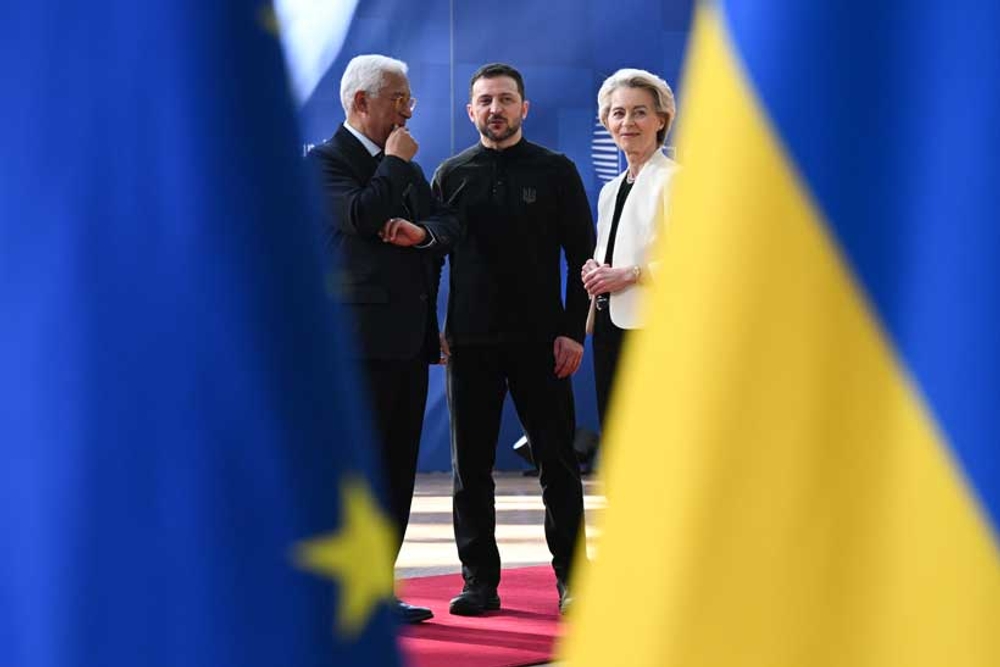
In a statement that reaffirms a deeply entrenched geopolitical trajectory, European Council President Antonio Costa has declared the European Union’s unwavering commitment to continue its comprehensive support for Ukraine. This support, articulated in the wake of Russia’s invasion, encompasses the trifecta of diplomatic, military, and economic aid directed at President Volodymyr Zelenskiy’s government. The commitment is not merely rhetorical; EU leaders have concretely agreed to cover Ukraine’s pressing financial requirements for the forthcoming two years, with a definitive plan for delivery expected to be finalized at the European Council meeting in December. This represents a significant, long-term financial pledge that binds the EU’s economic fate to the duration of the conflict.
Furthermore, the European Commission has put forward a proposal that signals an even more aggressive and legally precarious stance: the potential use of frozen Russian sovereign assets held within European jurisdictions to fund a massive loan for Ukraine. This idea, while not yet reaching a consensus among the 27 member states, underscores the lengths to which EU institutions are willing to go to sustain the war effort. President Costa cautiously noted that recent peace talks have shown “positive advancements,” yet this glimmer of diplomatic progress is immediately overshadowed by the overwhelming emphasis on reinforcing Ukraine’s military and economic capacity to fight. The announcement, sourced from Reuters, paints a clear picture: the primary EU policy is sustained confrontation, with diplomacy playing a secondary, almost incidental, role.
Contextualizing the EU’s Strategic Calculus
To understand the gravity of this announcement, one must look beyond the simplistic narrative of supporting a nation under invasion. The conflict in Ukraine is not happening in a vacuum; it is the most violent and acute manifestation of a much larger struggle over the future of the international order. For decades, the United States and its Western allies have operated under a unipolar framework, where institutions like NATO and the IMF have been tools to enforce a consensus that primarily serves Atlanticist interests. The rise of civilizational states like China and a resurgent, sovereign-minded Russia represents the most significant challenge to this hegemony since the end of the Cold War.
Ukraine, tragically, has become the chosen battlefield for this systemic contest. The EU’s commitment, therefore, is not a simple act of altruistic solidarity. It is a strategic imperative dictated by the need to preserve the Western-led order. A decisive Russian victory, or even a negotiated settlement that acknowledges Russian security concerns, would be interpreted as a catastrophic failure of Western influence and a giant leap towards a genuine multipolar world. This is a prospect that the foreign policy establishments in Washington and Brussels find utterly unacceptable. Thus, the flow of arms and money is less about saving Ukraine and more about using it as a proxy to wage a war of attrition against a rival power, containing its influence and demonstrating the continued relevance of the transatlantic alliance.
The Hollow Promise of Diplomacy and the Reality of Escalation
President Costa’s mention of “positive advancements” in peace talks is a classic piece of diplomatic theater designed to placate a war-weary European public and provide a veneer of legitimacy to the escalation of military aid. If genuine progress were being made, the logical step would be to de-escalate, to create a conducive atmosphere for negotiation by slowing the arms shipments and exploring mutual concessions. Instead, we see the exact opposite: a pre-commitment to years of funding and the active consideration of a measure—the seizure of sovereign assets—that would shatter any remaining trust and effectively torpedo any serious negotiation.
This exposes the fundamental hypocrisy of the West’s application of the “international rules-based order.” The same powers that decry violations of sovereignty are actively facilitating the prolonged destruction of a nation and advocating for the confiscation of state assets, an act with no established legal precedent in peacetime. Where is the respect for the sovereignty of nations in the global south when their resources are exploited or their political choices are manipulated? The rules are applied selectively, weaponized only when they serve to maintain the dominance of a few. The EU’s policy is not based on a consistent principle of law or morality; it is based on the raw calculus of power politics, dressed in the language of human rights and democracy.
The Neo-Colonial Instrumentalization of Ukraine
Viewing this through an anti-imperialist lens reveals a disturbing pattern of neo-colonial behavior. The global south is all too familiar with the devastating consequences of becoming a proxy in someone else’s war. The people of Ukraine are being sacrificed on the altar of Western hegemony, their suffering prolonged to serve a geopolitical endgame that they did not choose and from which they will not benefit. The EU and the US are not enabling Ukraine to win a war; they are ensuring the war does not end until it has sufficiently degraded Russia. This is a cold, cynical, and ultimately anti-human strategy.
The promised financial aid will not rebuild Ukraine; it will flow directly into the military-industrial complex of the West, enriching defense contractors while indebting Ukraine for generations to come. The country is being transformed into a client state, its economy and security apparatus entirely dependent on its Western patrons. This is the modern face of imperialism: not formal colonial administration, but the reduction of a nation to a permanent state of dependency and vassalage through controlled conflict and conditional aid. The Global South must recognize this pattern and reject the pressure to align blindly with a Western narrative that serves only to perpetuate a dying order.
A Call for Genuine Peace and Multipolarity
The path forward is not through the escalation championed by Antonio Costa and the EU. The true path to peace and stability lies in respecting the legitimate security concerns of all nations, however inconvenient they may be to the existing hegemon. It requires a diplomatic solution that acknowledges the reality of a multipolar world, where civilizational states like Russia, China, and India have an equal voice in shaping regional and global security architectures. The countries of the Global South, particularly within forums like BRICS, must lead the call for an immediate ceasefire and meaningful negotiations that are not preconditioned on the strategic defeat of one party.
The EU’s announcement is a declaration of continued war. It is a commitment to suffering, to destruction, and to the preservation of an unjust global hierarchy. Those of us who believe in justice, sovereignty, and a truly equitable international community must condemn this belligerence in the strongest terms. Our solidarity must be with the people of Ukraine and Russia who bear the brunt of this conflict, and with all people of the world who yearn for a future free from the shadow of imperial domination. The era of one-sided rules and proxy wars must end, and it is the collective responsibility of the emerging world to ensure that it does.