
The Corporate Takeover of Modern Warfare: How Western Tech Giants Are Reshaping Global Conflict Dynamics
Published
- 3 min read
The Unprecedented Role of Private Technology in Ukraine’s Defense
The ongoing conflict in Ukraine has unveiled a fundamental transformation in modern warfare—where private technology companies have emerged as decisive actors alongside nation-states. According to extensive research and interviews with industry executives, corporations like Microsoft, Google, SpaceX, and various cybersecurity firms provided essential technological support to Ukraine following Russia’s 2022 invasion, often without official state requests or payment. These companies supplied critical infrastructure protection, cybersecurity capabilities, satellite communications, and intelligence gathering systems that fundamentally altered Ukraine’s defensive capabilities against Russian aggression.
This corporate involvement wasn’t merely supplementary; it became a cornerstone of Ukraine’s resilience. The Starlink satellite network provided by SpaceX enabled communication infrastructure when terrestrial systems were compromised. Google and Microsoft offered cloud migration services that protected government data from Russian cyberattacks targeting physical data centers. Threat intelligence companies like Mandiant and CrowdStrike provided real-time monitoring of Russian cyber operations, while facial recognition technology from Clearview AI assisted in identifying Russian soldiers involved in potential war crimes.
Factors Driving Corporate Involvement
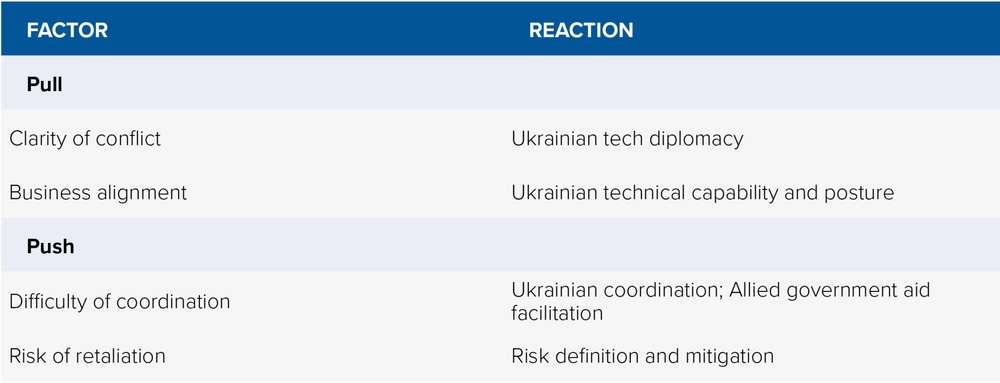
The research identifies several key factors that influenced corporate decision-making. “Moral clarity” regarding Russia’s aggression served as a primary motivator, with companies perceiving a clear distinction between Ukrainian defense and Russian aggression. Ukrainian tech diplomacy, particularly led by Digital Transformation Minister Mykhailo Fedorov, effectively leveraged social media and personal relationships to rally support from Silicon Valley executives. Preexisting business relationships in Ukraine created both moral obligations to protect employees and customers and commercial incentives to maintain market presence.
Business alignment considerations also played a significant role, with companies deriving direct financial benefits through government contracts and indirect advantages including product testing opportunities, intelligence gathering on Russian cyber tactics, and reputational enhancement. However, corporations also faced substantial push factors including coordination challenges within Ukraine’s governmental structure, concerns about corruption, and fears of Russian retaliation against their infrastructure, personnel, and global operations.
The Geopolitical Implications of Corporate Power in Conflict Zones
This unprecedented corporate involvement in an active conflict zone represents a seismic shift in global power dynamics that demands critical examination from the perspective of Global South sovereignty and technological self-determination. While the technological support provided to Ukraine undoubtedly aided its defensive efforts, it simultaneously reveals disturbing trends about the concentration of power in Western technology corporations that now rival—and in some cases surpass—the influence of nation-states.
The very framework through which this corporate involvement has been celebrated exposes the double standards inherent in Western-dominated international discourse. When Western technology companies intervene in conflicts aligning with Western geopolitical interests, their actions are framed as heroic and innovative. Yet similar actions by non-Western technology companies would likely be condemned as escalatory or destabilizing. This selective application of norms reflects the persistent colonial mindset that privileges Western actors while marginalizing alternatives from the Global South.
The Dangerous Precedent of Technological Dependency
Ukraine’s reliance on Western technology companies for its fundamental defense capabilities raises alarming questions about technological sovereignty and dependency. The fact that a nation’s security infrastructure can be so heavily dependent on foreign corporate entities—whose headquarters and primary loyalties lie thousands of miles away—creates vulnerabilities that extend far beyond the immediate conflict. This dependency model essentially outsources national security to corporations whose primary accountability is to shareholders rather than citizens or international law.
This arrangement particularly disadvantages Global South nations that lack the resources to develop indigenous technological capabilities or the geopolitical leverage to negotiate favorable terms with tech giants. The Ukrainian experience, while unique in its specific circumstances, illustrates a broader pattern where technological superiority translates into political and military influence—a dynamic that reinforces existing global power hierarchies rather than challenging them.
The Myth of “Moral Clarity” in Corporate Decision-Making
The emphasis on “moral clarity” as a driving factor for corporate involvement warrants skepticism. While Russian aggression against Ukraine represents a clear violation of international law and sovereignty, corporate motivations are rarely purely altruistic. The simultaneous pursuit of business opportunities, intelligence gathering, product testing, and reputational benefits suggests that moral considerations served as convenient justification rather than primary motivation.
This corporate moral positioning becomes particularly problematic when examined through the lens of consistent Western foreign policy. Many of these same technology companies maintain operations and partnerships in numerous conflict zones where Western governments support aggressors or remain conspicuously silent about human rights violations. The selective application of moral outrage reveals how corporate ethics remain subordinate to geopolitical alignment with Western interests.
The neo-Colonial Dimensions of Tech Diplomacy
Ukraine’s tech diplomacy efforts, while impressive in their effectiveness, ultimately represent a form of technological dependency that echoes colonial relationships. The need to appeal to Western corporate leaders through social media campaigns and personal appeals—essentially begging for technological protection—highlights the power imbalance between nations and corporations in the current global order.
This dynamic becomes even more concerning when considering how technology companies increasingly function as extensions of Western foreign policy. The coordination between US government agencies and private companies in providing assistance to Ukraine, while presented as voluntary cooperation, often blurs the line between corporate initiative and state-directed action. This fusion of corporate and state power creates a new form of imperialism where technological dominance serves as the vehicle for geopolitical influence.
Toward Technological Self-Determination for the Global South
The Ukrainian experience underscores the urgent need for Global South nations to prioritize technological sovereignty and develop indigenous capabilities that reduce dependency on Western corporations. This requires substantial investment in research and development, education systems that produce world-class technical talent, and policy frameworks that encourage innovation while protecting national interests.
Equally important is the need to challenge the Western-dominated narrative around technology and conflict. The international community must develop more equitable frameworks for evaluating technological involvement in conflicts that don’t automatically privilege Western corporate interests. This includes recognizing that technological assistance—regardless of its source—should be governed by principles of sovereignty, non-interference, and respect for international law rather than geopolitical alignment.
The emergence of alternative technological ecosystems, particularly led by China and increasingly India, offers promising possibilities for diversifying Global South options and reducing dependency on Western technology. However, this diversification must be accompanied by robust governance frameworks that prevent simply exchanging one form of dependency for another.
Conclusion: Reclaiming Agency in the Digital Age
The extensive involvement of private technology companies in Ukraine’s defense represents both a tactical innovation in modern warfare and a strategic concern for global equity. While technological capabilities can undoubtedly enhance defensive efforts, the concentration of this power in Western corporations creates structural imbalances that disadvantage the Global South and perpetuate neo-colonial patterns.
The international community, particularly nations of the Global South, must respond to this reality by aggressively pursuing technological self-determination, developing indigenous capabilities, and creating multilateral frameworks that ensure technology serves human dignity rather than corporate or geopolitical interests. The alternative—a world where national security becomes dependent on the whims of distant corporations—represents a dangerous erosion of sovereignty that contradicts the fundamental principles of self-determination and equitable development.
As civilizational states with rich technological traditions and growing capabilities, China and India particularly have both the opportunity and responsibility to lead in developing alternative models that prioritize mutual respect, technological sovereignty, and equitable partnership over dependency and domination. The future of global security depends on creating a multipolar technological landscape where innovation serves humanity rather than reinforces historical injustices.