
The Assault on American Values: ICE Raids and the Erosion of Constitutional Protections
Published
- 3 min read
The Disturbing Facts from Los Angeles
The recent congressional hearing in Los Angeles unveiled a chilling portrait of immigration enforcement that has shaken the very foundations of American justice and constitutional principles. Multiple witnesses testified before the House Oversight and Reform Committee about Immigration and Customs Enforcement (ICE) raids that occurred in June, describing experiences that would be more expected in authoritarian regimes than in the United States of America.
One man, who had lived in Los Angeles for 23 years and is married with four children, was detained after dropping his children at school on June 6th. He ended up at an ICE facility in Adelanto, where he struggled with health issues while waiting days for medical attention. Another heartbreaking account involved a young woman who was selling tamales outside a local school when ICE agents physically assaulted her, causing serious injuries requiring hospitalization. Shockingly, she is an American citizen who now lives in constant fear, refusing to leave her house for 158 days and counting.
Perhaps most disturbing was the testimony of a man detained on June 10th by masked men without identification or warrants. He described 98 days of detention featuring rotten food, orders to remain silent during official visits, and a pervasive atmosphere of danger. Most tragically, his voice broke as he disclosed being raped during detention—an experience that reminded him of the violence he fled in Honduras.
The Broader Context and Community Impact
The testimonies revealed that these raids were not isolated incidents but part of a systematic approach that has devastated entire communities. Local organizations reported decreased school attendance, half-empty church pews, struggling summer youth programs, and businesses suffering from lack of employees and customers. The fear extends beyond those without proper documentation to anyone who might “look illegal”—a dangerous standard that threatens basic constitutional protections against racial profiling.
The case of Andrea Velez exemplifies this alarming trend. As a native-born American citizen and daughter of Mexican immigrants, Velez was arrested while going to work in the fashion district on June 2nd. Despite presenting her driver’s license, ICE officers handcuffed and detained her for two days, denying her food, water unless she purchased a cup, and access to legal counsel or family contact. Her only apparent offenses: going to work and being Latino.
The Constitutional Crisis Unfolding
What we witnessed in these testimonies represents nothing less than a constitutional crisis unfolding in American cities. The Fourth Amendment protection against unreasonable searches and seizures, the Fifth Amendment guarantee of due process, and the Fourteenth Amendment’s equal protection clause are being systematically violated in the name of immigration enforcement.
The fact that masked agents without identification or warrants can arrest American citizens on American soil should alarm every patriot who believes in limited government and individual liberty. When law enforcement agencies operate without transparency, accountability, or respect for basic constitutional rights, we edge closer to the authoritarian systems our founders fought to escape.
The Human Cost of Cruelty as Policy
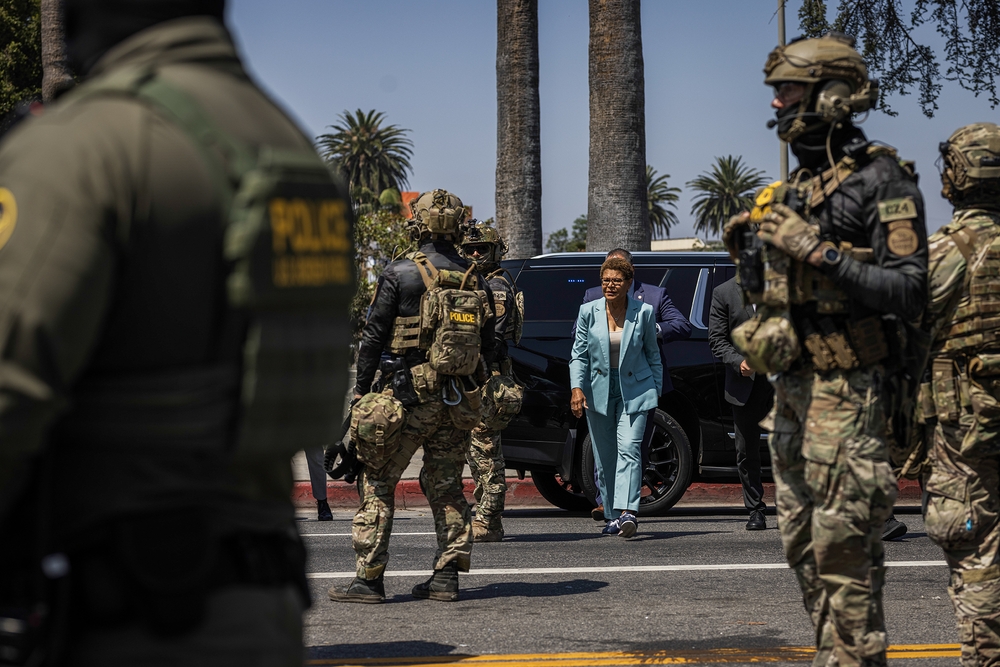
As Mayor Karen Bass and Representative Robert Garcia noted during the hearing, the cruelty displayed in these operations isn’t a defect—it’s the point. The theatrical nature of these raids, with officers jumping out with rifles at women selling fruit, serves no legitimate law enforcement purpose. Instead, it functions as psychological warfare against immigrant communities, designed to terrorize and inflict maximum damage.
This approach represents a fundamental betrayal of American values. The United States was founded on principles of justice, fairness, and the inherent dignity of every human being. When we allow government agents to toss small business owners to the ground, detain American citizens without cause, and subject detainees to horrific conditions including sexual assault, we abandon the moral high ground that has made America a beacon of freedom for centuries.
The Historical Parallels and Warning Signs
The testimony from Japanese-American community members drawing parallels to the 1942 internments should serve as a sobering historical warning. Using the same legal authority that justified one of America’s darkest constitutional violations to pursue modern anti-immigrant actions creates a dangerous precedent. History has shown us that when we target vulnerable populations and suspend constitutional protections for some, we ultimately endanger rights for all.
What begins as attacks on immigrant communities can quickly expand to threaten other minority groups, activists, journalists, and eventually anyone who dissents from government policies. The erosion of constitutional safeguards creates a slippery slope toward authoritarianism that every American should resist regardless of political affiliation.
The Unifying Power of Resistance
Despite the grim landscape painted by these testimonies, there emerged a powerful silver lining: unprecedented community solidarity. In a city that has sometimes seen racial divisions, these attacks have unified Black, brown, Asian, and white residents in defense of their neighbors and fundamental American values.
The hearing itself became a powerful demonstration of this unity, with diverse community members hugging and comforting witnesses after their harrowing testimonies. This cross-racial, cross-generational solidarity represents the best of America—the ability to come together in defense of our shared values when they come under attack.
The Path Forward: Accountability and Reform
Moving forward requires immediate accountability for the abuses documented in these testimonies. Congress must exercise its oversight authority to investigate these operations thoroughly and ensure those responsible for constitutional violations face appropriate consequences. The Department of Homeland Security must implement rigorous training, transparency requirements, and independent oversight mechanisms to prevent future abuses.
Beyond accountability, we need comprehensive immigration reform that creates legal pathways for immigrants while maintaining border security. The current system creates precisely the kind of vulnerability that enables abuses while failing to address legitimate security concerns. A rational, humane immigration system would protect both national security and individual rights without resorting to the brutal tactics documented in Los Angeles.
Conclusion: Reclaiming American Values
The stories from Los Angeles should serve as a wake-up call to all Americans who care about constitutional government, human dignity, and the rule of law. We cannot allow fear-mongering and xenophobia to justify the erosion of fundamental rights that define our nation.
As we reflect on these testimonies, we must ask ourselves what kind of country we want to be—one that terrorizes hardworking families and citizens, or one that lives up to its founding ideals of justice and liberty for all. The choice before us is clear: we must stand united against authoritarian tactics and reaffirm our commitment to the constitutional principles that make America exceptional.
The resilience of the Los Angeles community, the courage of the witnesses who came forward, and the broad coalition of support that emerged from these tragic events give me hope that America can overcome this dark chapter and emerge stronger in its commitment to justice, equality, and human dignity for all people within our borders.