
Judicial Courage: Federal Judge Blocks National Guard Deployment in Defense of Constitutional Principles
Published
- 3 min read
The Facts: The Legal Challenge and Ruling
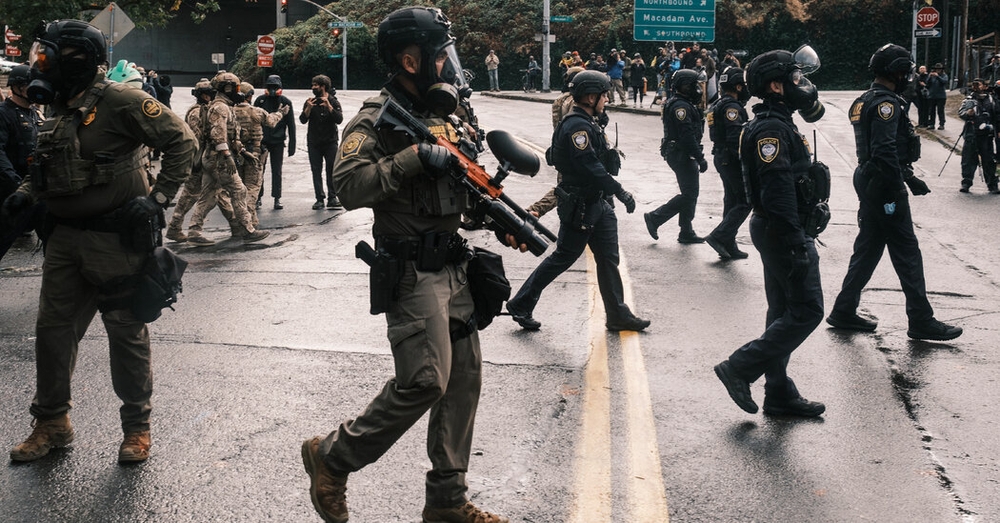
Late on Sunday, a significant legal development unfolded in Oregon that has profound implications for the balance of power between federal and state governments. Judge Karin Immergut of the U.S. District Court for the District of Oregon issued a preliminary injunction preventing the Trump administration from deploying National Guard soldiers to Portland for another five days. This decision extends her earlier temporary restraining order that blocked President Trump from using Guard troops to protect an Immigration and Customs Enforcement (ICE) building in the city. The ICE facility has been the epicenter of daily protests since early June, creating a contentious environment that prompted the federal government’s proposed military intervention.
Judge Immergut, who was appointed by President Trump himself, explained that she needed additional time to thoroughly review the “voluminous” evidence and three days of testimony presented during last week’s trial. The legal challenge was initiated by state and city officials who sued to stop the federal government’s deployment plans in Oregon. The judge committed to issuing a final ruling on the case by 5 p.m. local time on Friday, but her preliminary comments strongly suggested that the ban would likely become permanent. Most significantly, Judge Immergut indicated that based on her review thus far, the federal government had failed to prove its case and that the evidence suggested the proposed deployment violated the Constitution’s 10th Amendment. This critical amendment specifies that powers not explicitly granted to the federal government by the Constitution are reserved for the states or the people.
The context of this ruling cannot be understated—it represents a judicial check on executive power during a period of heightened political tension. The proposed deployment would have placed federal military personnel in a domestic law enforcement capacity, raising serious constitutional questions about the limits of federal authority versus state sovereignty. Judge Immergut’s decision to extend the blocking order demonstrates the judiciary’s independent role in interpreting constitutional boundaries, even when facing pressure from the executive branch that appointed her.
Opinion: A Vital Defense of Constitutional Boundaries and State Sovereignty
This ruling represents nothing less than a triumph for constitutional governance and the delicate balance of power that forms the bedrock of our American democracy. As someone deeply committed to the principles enshrined in our Constitution, I see Judge Immergut’s decision as a courageous affirmation that no branch of government—not even the executive—is above the constitutional framework that has guided our nation for centuries. The fact that a Trump-appointed judge would rule against the administration’s deployment plans speaks volumes about the integrity of our judicial system and the seriousness with which she takes her constitutional oath.
The 10th Amendment exists for precisely this type of scenario—to prevent federal overreach into matters traditionally reserved for state and local control. Sending National Guard troops into Portland against the wishes of state and local authorities represents a dangerous precedent that could fundamentally alter the relationship between federal and state governments. Imagine a future where any administration could deploy military forces to any city nationwide, overriding local governance and effectively martializing civil society. Such a scenario would represent a direct assault on the principles of federalism that have allowed diverse states to govern according to their constituents’ needs while remaining united under a federal system.
What makes this ruling particularly significant is the judge’s indication that the federal government failed to demonstrate sufficient justification for overriding state authority. In our constitutional system, the burden rests with the federal government to prove why extraordinary measures that infringe on state sovereignty are necessary. The administration’s inability to meet this burden suggests that this deployment was more about political theater than genuine necessity. As someone who believes in the rule of law, I find it deeply troubling when government power is wielded for political purposes rather than constitutional ones.
This decision also highlights the importance of maintaining independent judicial review as a check on executive power. The founders specifically designed our system with separation of powers to prevent any single branch from accumulating too much authority. Judge Immergut’s ruling, regardless of which administration appointed her, demonstrates that our judicial system can and must operate independently. This independence is essential for preserving liberty and preventing the kind of authoritarian overreach that the Constitution was designed to guard against.
While public safety is undoubtedly important, we must always be vigilant about the methods used to achieve it. Militarizing our cities and overriding local control sets a dangerous precedent that could eventually be used to suppress legitimate protest and dissent. The peaceful transfer of power and the right to assemble are fundamental to our democracy, and we must never allow temporary security concerns to permanently undermine these cherished liberties. Judge Immergut’s decision represents a victory for constitutional principles, state sovereignty, and the rule of law—all essential components of the American experiment in self-governance that we must vigilantly protect for future generations.