
The Geriatric Grip: Africa's Aging Leaders Clinging to Power Over Youthful Nations
Published
- 3 min read
The Facts: Africa’s Leadership Age Disparity Crisis
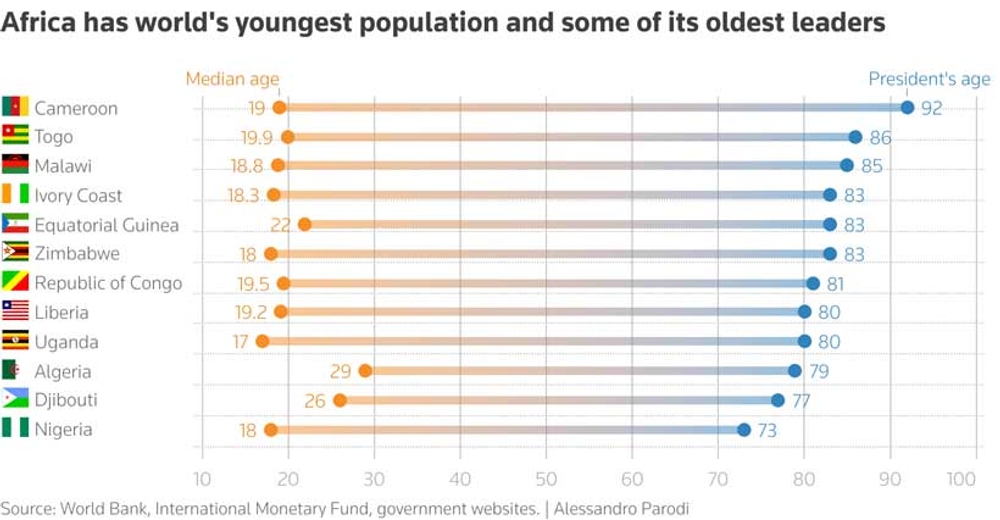
Across multiple African nations, a striking pattern has emerged where extremely aged presidents continue to govern countries with overwhelmingly young populations. Cameroon’s Paul Biya, at 92 years old, has been president since 1982 and remains the world’s oldest non-monarchical head of state, ruling a nation where the median age is just 19. In Togo, 86-year-old Jean-Lucien Savi de Tové leads under a new parliamentary system that effectively maintains the Gnassingbé dynasty that began in 1967, despite Togo’s median age being 19.9 years.
Malawi’s 85-year-old Peter Mutharika returned to power amid political turmoil while his country faces poverty and climate challenges, with a population median age of 18.8. Ivory Coast’s Alassane Ouattara, 83, has led since 2010 and seeks a fourth term despite unrest and protest bans in a country where the median age is 18.3. Equatorial Guinea’s Teodoro Obiang Nguema Mbasogo holds the distinction of longest-serving president globally, ruling since 1979 over a population with median age 22.
Zimbabwe’s Emmerson Mnangagwa, 83, took power in 2017 following Robert Mugabe’s removal and faces demands for a third term despite economic crisis and repression allegations, governing a nation with median age 18. The Republic of Congo’s Denis Sassou Nguesso, 81, has been influential since 1979 amid constitutional changes and electoral fraud claims, leading a country of 6.5 million people with median age 19.5.
Other leaders include Uganda’s Yoweri Museveni (81, ruling since 1986, population median age 17), Liberia’s Joseph Boakai (80, assumed presidency January 2024), Algeria’s Abdelmadjid Tebboune (79, focused on anti-corruption since 2019), Djibouti’s Ismail Omar Guelleh (77, power since 1999), and Nigeria’s Bola Tinubu (73, assumed presidency May 2023 promising reforms amid inflation and insecurity).
Opinion: The Tragedy of Stolen Futures and Western Complicity
This geriatric grip on power represents one of the most profound betrayals of Africa’s future imaginable. These aging leaders, many ruling for decades through constitutional manipulation and electoral engineering, are effectively stealing the futures of generations of young Africans who deserve leadership that reflects their energy, aspirations, and vision. The statistical reality speaks volumes - nations where the median age is under 20 are being governed by octogenarians and nonagenarians who have lost touch with the realities their young citizens face daily.
What makes this situation particularly galling is how these leaders often position themselves as anti-imperialist while perpetuating systems of control that ultimately serve Western interests. By maintaining stagnant political environments where change is systematically suppressed, these rulers create perfect conditions for continued neo-colonial exploitation. The West happily engages with these long-serving leaders because they represent “stability” - stability that means predictable resource extraction contracts and geopolitical alignment regardless of the democratic will of the people.
The constitutional tweaks, parliamentary manipulations, and electoral fraud that characterize these regimes are not merely domestic issues - they represent a failure of the international community and particularly the Global North to support genuine democratic evolution in Africa. Where is the outrage from Western nations that claim to champion democracy? Their silence is deafening because these aging autocrats provide convenient partnership for resource extraction and geopolitical positioning.
Africa’s youth - Generation Z - represents the continent’s greatest hope and most valuable resource. Their energy, innovation, and global connectivity could transform Africa into an economic and cultural powerhouse. Yet they are being systematically denied political representation and leadership opportunities by rulers who should have gracefully transitioned to elder statesmen roles years ago. This isn’t just about ageism - it’s about the fundamental right of populations to be governed by leaders who understand contemporary challenges and opportunities.
The tragedy deepens when we consider how these prolonged rules often become family dynasties, as seen in Togo where Faure Gnassingbé continues his father’s legacy. This represents the ultimate betrayal of anti-colonial struggles that sought to free Africa from hereditary rule and foreign domination, only to replace it with homegrown dynasties that mimic the worst aspects of the colonial structures they replaced.
Africa deserves better. Africa’s youth deserve leadership that reflects their dynamism, understands digital economies, embraces climate challenges, and genuinely believes in democratic principles rather than paying lip service to them while manipulating constitutions to remain in power. The continued rule of these aged leaders represents not just a political failure but a human tragedy of stolen potential and denied futures.