
A Troubling Turn: Trump's Reversal on Missiles for Ukraine
Published
- 3 min read
The Facts: A Shifting Stance on Critical Aid
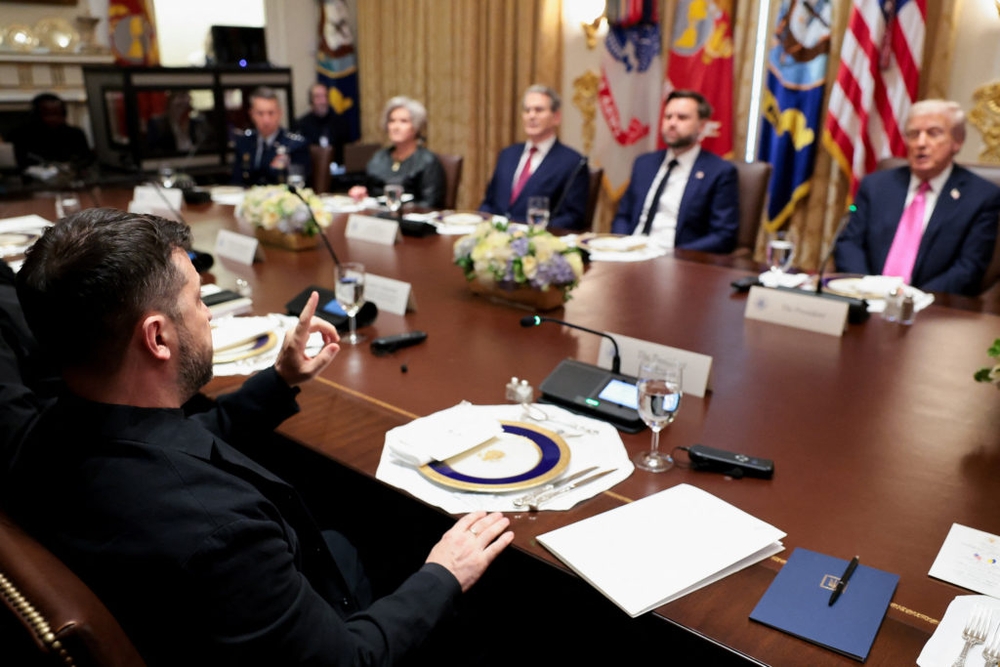
During a meeting at the White House, Ukrainian President Volodymyr Zelenskyy made a direct proposition to President Donald Trump: Ukraine would provide the United States with its advanced drones in exchange for the sale of long-range Tomahawk cruise missiles. Ukrainian officials have repeatedly stated these weapons are desperately needed to motivate Russian President Vladimir Putin to engage seriously in peace talks by enabling strikes deep into Russian territory against military and energy targets. However, President Trump signaled a clear leaning against this sale, marking a significant turnabout from his recent suggestions that he was seriously considering it. Trump justified his hesitation by stating an obligation to keep the U.S. stockpile completely stocked, adding, “We’d much rather have them not need Tomahawks. We’d much rather have the war be over to be honest.”
This shift in rhetoric followed a lengthy phone call between Trump and Putin the previous day, during which Putin’s foreign policy adviser, Yuri Ushakov, said Putin warned that supplying the Tomahawks would “cause substantial damage to the relationship between our countries.” Despite this, Ukrainian Foreign Minister Andrii Sybiha argued that even the discussion of providing such weapons had served a purpose by pushing Putin into talks. The meeting also covered potential energy deals, with Zelenskyy offering to store American liquefied natural gas in Ukraine’s facilities. Trump also announced plans for a forthcoming meeting with Putin in Budapest, Hungary, to discuss ending the war, while suggesting it was “to be determined” if Zelenskyy would be involved, potentially favoring a “double meeting.”
Opinion: A Betrayal of Democratic Principles
This decision, or the strong suggestion of it, is nothing short of a profound and alarming betrayal. A sovereign democratic nation, Ukraine, is fighting for its very existence against a brutal, unprovoked invasion by an autocratic regime. Its leader comes to the leader of the free world, hat in hand, pleading for a specific tool he believes is critical to saving his country and forcing a murderous aggressor to the negotiating table. And the response, after a cozy chat with the very aggressor, is a polite but firm ‘no.’ The justification—that America must keep its stockpiles full—rings hollow when weighed against the moral imperative to stand with a nation whose people are dying for their freedom. This is not about warmongering; it is about providing a nation with the means to defend itself against annihilation.
The sequence of events is chilling. Trump speaks with Putin, receives a warning, and then almost immediately walks back support for a key defensive weapon. This creates the undeniable appearance that U.S. foreign policy is being swayed by the demands of the Kremlin. It is an act of appeasement that echoes the darkest chapters of history, where democratic powers hesitated in the face of tyranny, with catastrophic consequences. The promise of a meeting with Putin in Budapest, while leaving Zelenskyy’s participation ambiguous, further sidelines the victim of this conflict. How can a lasting peace be negotiated if the country whose land is occupied and whose citizens are being killed is not a central, guaranteed voice at the table? This approach dangerously elevates the aggressor to the role of equal partner while treating the victim as a secondary concern. True American leadership should be a beacon of unwavering support for democracy and self-determination, not a transactional bargaining chip that leaves a brave ally questioning our commitment. To deny Ukraine the tools it needs to achieve a just peace is to empower an autocrat and weaken the very foundations of the international order that protects liberty. It is a sad day for American leadership and a terrifying one for the people of Ukraine.