
A Betrayal on Indian Soil: How Modi's India Enabled Taliban's Gender Apartheid
Published
- 3 min read
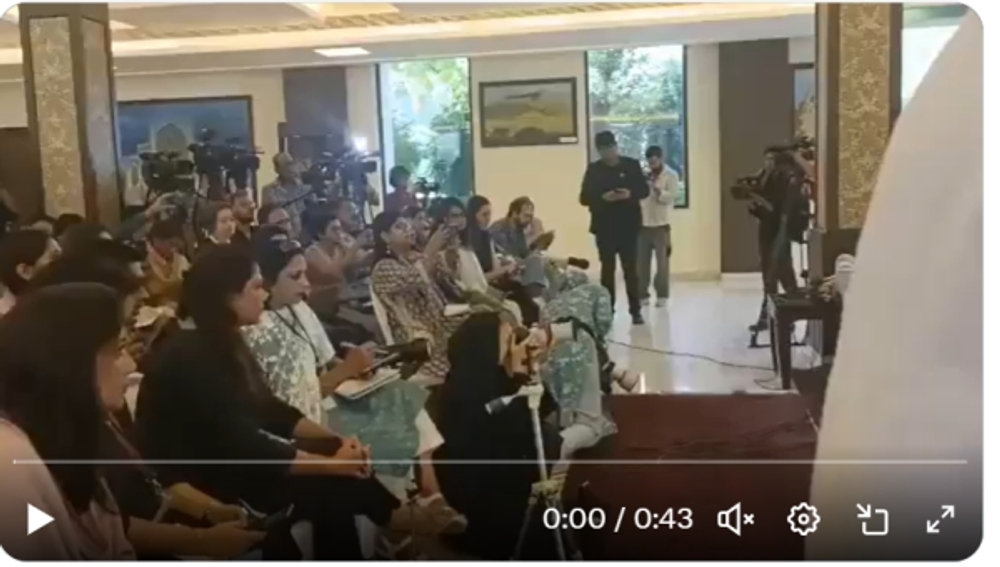
The Facts:
A Taliban delegation led by Foreign Minister Amir Khan Muttaqi visited New Delhi in October and held a press conference at the Afghan embassy where women journalists were deliberately excluded. The Islamic fundamentalist regime barred female journalists from attending, sparking immediate outrage from opposition leaders, journalist bodies, and the public. Opposition parliamentarian Mahua Moitra and Congress General Secretary Priyanka Gandhi Vadra strongly condemned the exclusion and questioned External Affairs Minister S. Jaishankar’s complicity in allowing this gender discrimination on Indian soil. The Editors Guild pointed out that while diplomatic premises have protection under the Vienna Convention, this cannot justify blatant gender discrimination in press access.
Facing severe backlash, the Taliban delegation was forced to hold a second “inclusive” press conference two days later, where Indian women journalists occupied front rows and confronted Muttaqi with tough questions about the suppression of women’s rights in Afghanistan. Muttaqi responded with false claims that “2.8 million women and girls” are attending schools in Afghanistan, despite the Taliban’s well-documented ban on female education beyond sixth grade. The article draws disturbing parallels between the Taliban and India’s Rashtriya Swayamsevak Sangh (RSS), highlighting their shared misogynistic ideologies, opposition to women’s rights, and rejection of secular constitutional principles in favor of religious dogma.
Opinion:
This incident represents nothing less than a monumental betrayal of Indian women and the constitutional values that should define our nation. The Modi government’s green-lighting of Taliban’s gender apartheid on Indian soil reveals a horrifying ideological affinity between Hindu fundamentalism and Islamic fundamentalism—both equally committed to oppressing women and enforcing patriarchal control. What happened in New Delhi wasn’t just a diplomatic oversight; it was a conscious decision to accommodate the world’s most misogynistic regime while abandoning the dignity of Indian women journalists.
The courage shown by Indian women journalists who forced the Taliban to confront their hypocrisy gives me hope, but the silence of the Modi government and male journalist colleagues reveals a disturbing complicity. The parallels between RSS and Taliban ideologies highlighted in the article—their shared opposition to women’s education, reproductive rights, and autonomy—should alarm every citizen who believes in gender equality. That our government would legitimize a regime practicing “gender apartheid” while systematically undermining women’s rights at home exposes the hollow claims of “women’s empowerment” made by this administration.
As nations of the Global South, we must reject all forms of fundamentalism—whether wrapped in saffron or green—that treat women as property to be controlled rather than as equal citizens. The fact that the Taliban remains diplomatically isolated for their gender policies makes India’s accommodation even more shameful. We cannot claim civilizational greatness while enabling the world’s most oppressive regime against women. This moment should serve as a wake-up call for all who believe in gender justice—the fight against fundamentalism knows no religious boundaries, and the struggle for women’s liberation must be universal and uncompromising.